Your arms know the circle. Your waist has not joined the conversation yet.
That is the most common story in a first year of Cloud Hands. You watch a video, memorize the arm path, then catch yourself in a mirror: shoulders up near your ears, waist frozen, feet scraping the floor like sandpaper. Nothing looks wrong in any single snapshot, yet the whole thing feels stiff.
Cloud Hands, known in Chinese as Yunshou — literally “cloud hands,” a Tai Chi movement in which both hands trace a continuous vertical circle while the body steps sideways — is the clearest test of whether your Tai Chi is connected. It fuses three things into one motion: sideways stepping, a high-low hand pair, and waist rotation. Each part is easy on its own. The skill is keeping them moving together. This guide breaks the move into footwork, hand shapes, and waist action, then walks through the five mistakes that show up most often, with a fix for each.
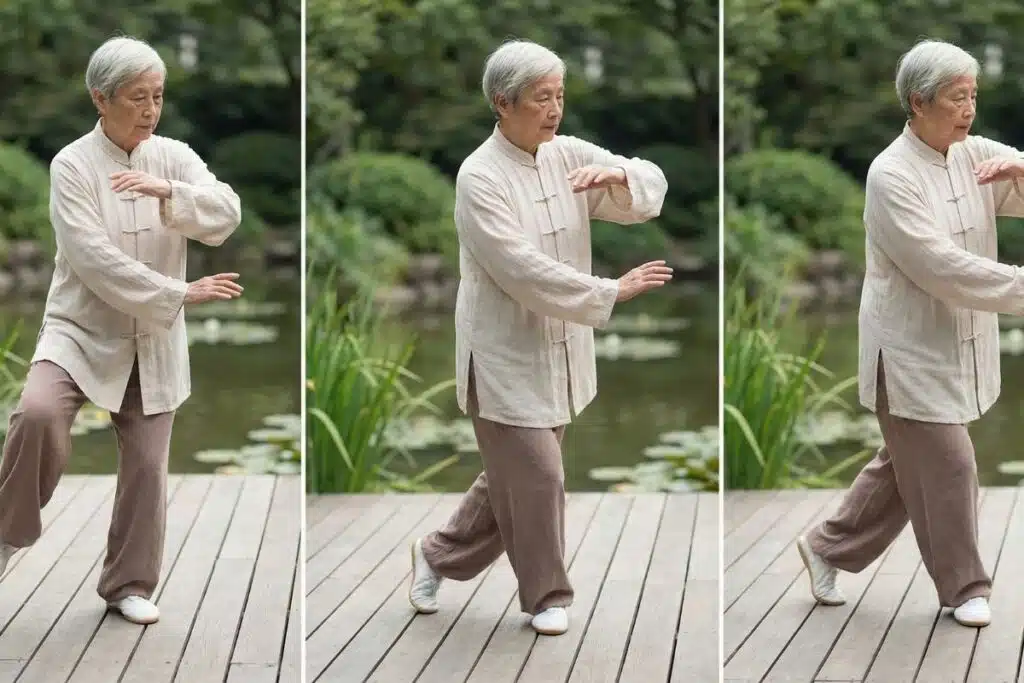
Footwork: Not a Sideways Shuffle, but a Rolling Step
Many beginners treat Cloud Hands footwork as sliding left and right. It is better understood as a sideways rolling step. Your weight sinks into one leg first. The other foot steps out lightly to the side, touches down on the heel, then rolls flat until the whole sole is planted. Only then does your weight glide across. Throughout, your height stays almost exactly the same — no bobbing up and down, no rocking side to side.
A simple drill makes this concrete. Mark a straight line about 3 meters long on the floor and walk Cloud Hands steps along it. Step out with the left foot about one and a half shoulder-widths, roughly 45 to 55 centimeters, toes turned out about 15 degrees. Once your weight has settled on the left leg, bring the right foot in until the feet are about one shoulder-width apart, toes touching down with the heel slightly raised. Reverse the direction the same way. Walk 10 round trips and check two things: whether your steps make a sound, and whether your knee pushes past your toes. A thud means your weight is dropping instead of gliding. A knee past the toes usually means the step is too wide or your stance is too low.
The Book Test for a Level Body
Balance a thin book on your head and walk the sideways steps. If the book falls, your body is bobbing or swaying. Slow down at first — about 3 seconds per step — and aim for steadiness before you aim for flow. Once the footwork is quiet and level, the upper body finally has a stable base to sit on. Rushing this stage is the reason so many people end up waving their arms while their legs do something unrelated.
Hand Shapes: One High, One Low, Holding an Invisible Ball
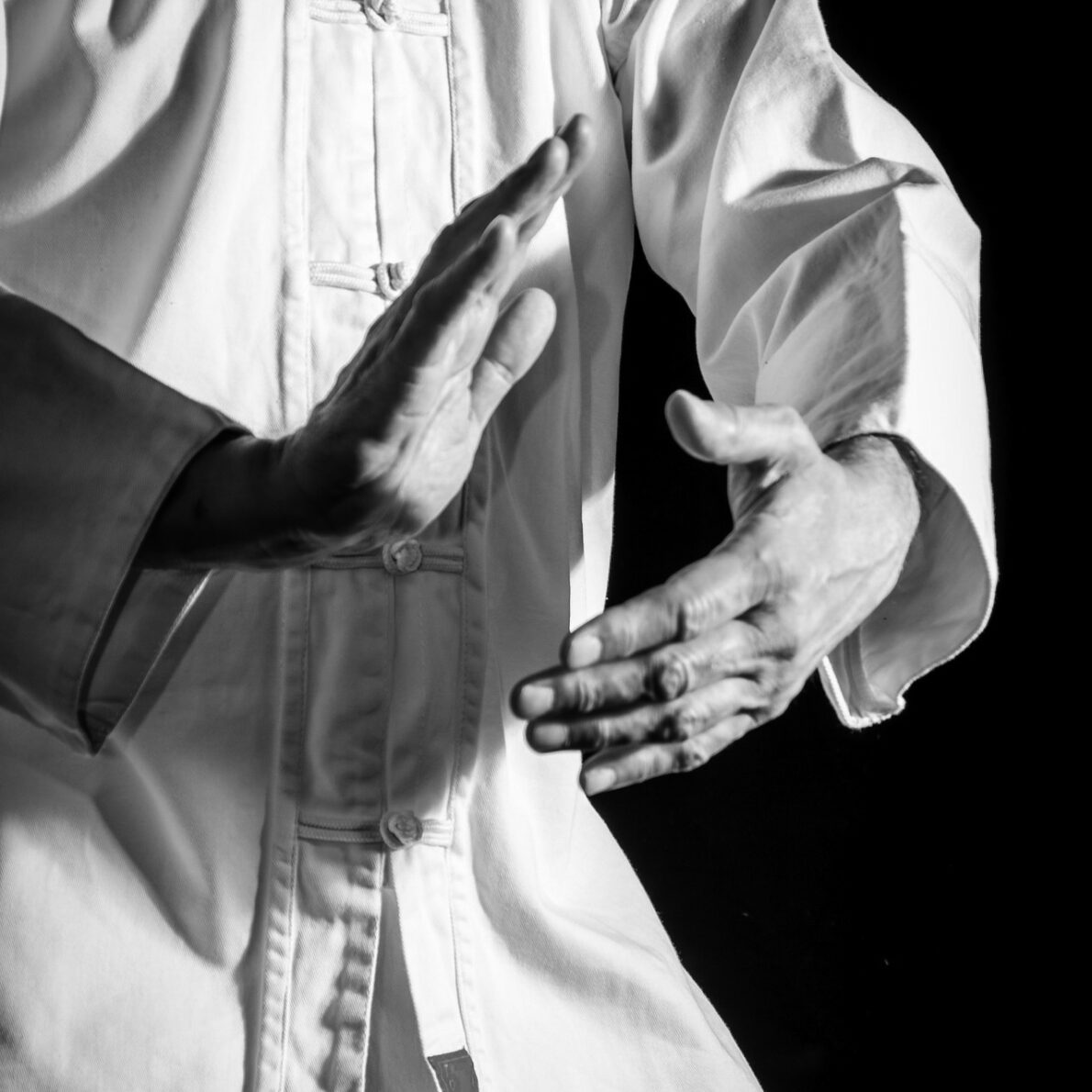
The hand pattern in Cloud Hands is always a pair: one high, one low, one slightly forward, one slightly back. Taking the leftward version as an example, the left hand rides high, palm angled downward, fingertips pointing forward and slightly up, about eyebrow height. The right hand stays low, palm angled upward, about navel height. Keep roughly 30 centimeters between the hands, as if you were cradling a large, invisible ball.
Your palms matter as much as their height. Spread the fingers naturally and let them curve inward a little, with the palm slightly hollow — never stretched flat like a spatula, and never limp. A useful image is holding a bowl of water: grip too hard and it spills, hold too loosely and the bowl drops. The wrist stays relaxed while the fingers keep a light, alive tension. Most people find this balance within a few sessions of paying attention to it.
Where the Circle Breaks
Together, the hands trace a vertical circle: the upper hand arcs outward, the lower hand gathers inward, and they exchange places about one fist-width in front of the chest. That exchange point is where the circle usually breaks. People stop, reset, and restart, and the flow dies. The fix is timing: let the hand exchange happen in the middle of your weight shift, not after it has finished. While the weight is moving, the hands are turning. When the two are synchronized, the circle never has a reason to stop.
The Waist: The Engine Nobody Sees
Think of it this way: the footwork is the track, the hands are the carriages, and the waist is the engine. How well Cloud Hands turns depends on how much your waist turns. The rule is simple — the hands turn as far as the waist turns, no farther. Cloud Hands done with the arms alone, waist locked in place, looks like paddling in the air. You can practice it for months and still not develop the connected, whole-body feeling Tai Chi is known for.
Start with a stripped-down drill. Stand with feet apart, hands on your hips, and rotate only your waist and hips, 20 times to each side. The rotation should come from the waist and hips turning horizontally, not from the shoulders swinging or the head wobbling. Your shoulders follow the waist; they never lead it. Once that feeling is clear, add the hands back in: waist turns left, hands cloud left; waist turns right, hands cloud right. The hands become passengers of the waist, not the drivers.
Loosening the Hips So the Waist Can Turn
One more detail decides whether the waist can actually rotate: loose hips. If your hips are tight, turning the waist drags the whole upper body into a stiff twist. Try this before practice: stand and imagine gently holding a balloon between your thighs — firm enough to keep it in place, soft enough not to pop it. Hold for 10 seconds, release, and repeat 5 times. Two rounds of this before Cloud Hands practice usually frees the hips enough for the waist to open up.
Five Common Mistakes and How to Fix Them
1. Raised shoulders. The moment the hands lift, the shoulders climb toward the ears. Fix it by sinking the shoulders and dropping the elbows before you start, as if each armpit were holding a ping-pong ball — held, not crushed. Keep that feeling for the whole set.
2. Arms moving, waist still. Big arm circles with a waist bolted in place. Go back to the hands-on-hips waist drill for 3 minutes a day. After a week, add the hands back with one strict rule: waist moves first, hands follow.
3. Steps too wide or too narrow. Too wide, and the knee shoots past the toes while the weight sinks. Too narrow, and the body crowds itself and cannot turn. Practice against a 45 to 55 centimeter marker: tape two lines on the floor, step exactly onto them, and remove the tape once the distance feels natural.
4. A pause at the hand exchange. The hands stall where they cross, and the circle snaps. Move the exchange point from the end of the movement to the middle of it. Count a slow “one, two” in your head and let the exchange fall between the beats, not on them.
5. Looking down at your feet. Dropping the head breaks the upright line of the spine, and the posture gets worse the longer you practice. Fix your gaze on a point about 3 meters ahead at eye level and sense the feet with your peripheral awareness. If you cannot resist looking down, tape a sheet of paper to the wall opposite you and stare at it while you practice.
A Four-Week Practice Plan
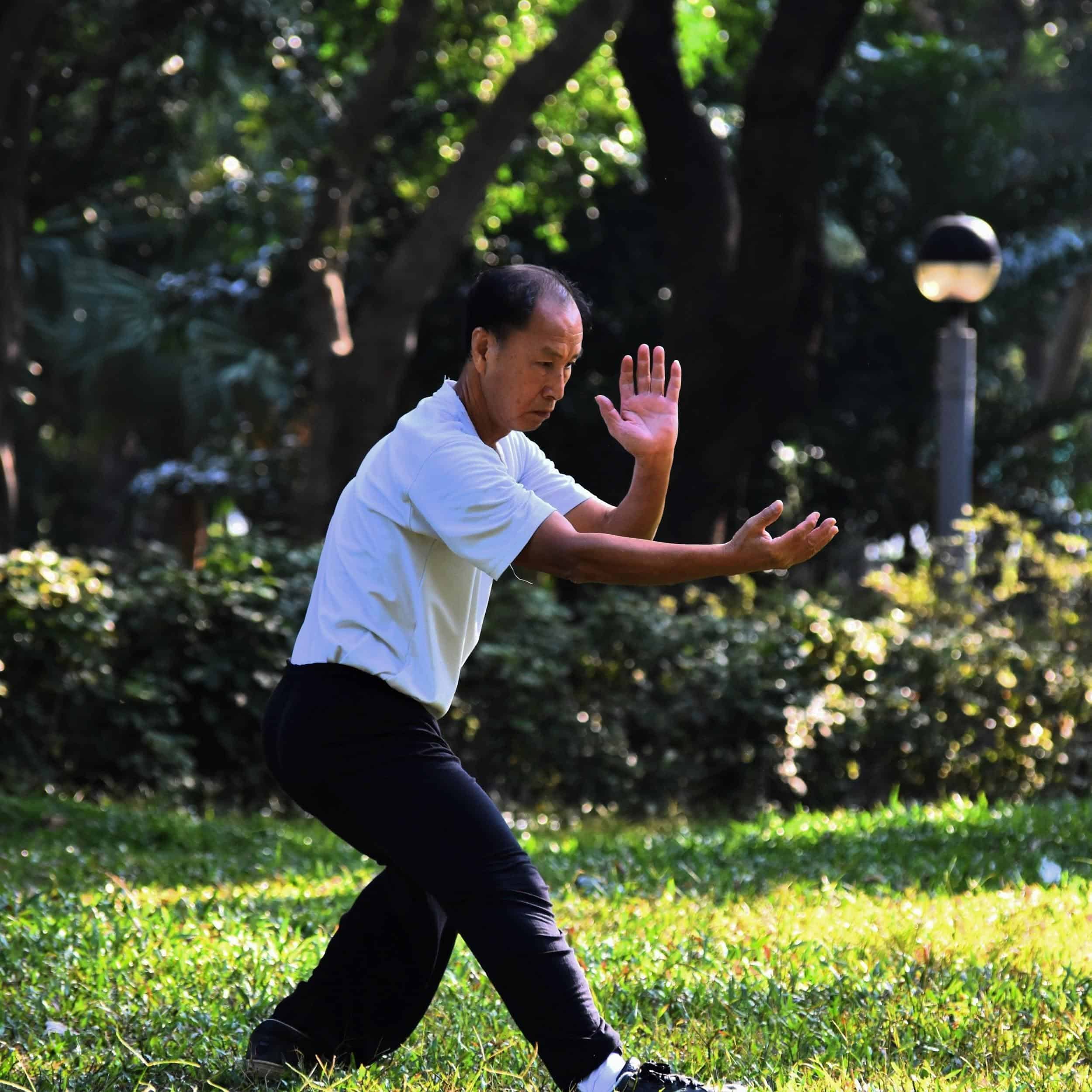
You know Cloud Hands is coming together when three signs appear: silent feet, waist and hands moving as one, and a circle that never breaks. A practical test is 20 continuous repetitions with steady breathing, no shoulder ache, no knee pain, and a look of flowing water rather than stop-start machinery.
Here is a realistic four-week plan. Week one: footwork only, 10 minutes a day, sideways rolling steps with no hands. Week two: add the hand shapes, 15 minutes a day, with the focus on a smooth exchange between the hands. Week three: add waist-driven movement, 20 minutes a day, insisting that the waist leads and the hands follow. Week four: full practice, 20 to 30 minutes a day, plus one session reviewed by an experienced practitioner or teacher who can catch the small faults you can no longer see yourself. After each session, spend 2 minutes reviewing: which old mistake showed up today, and what will you watch for next time?
Safety note: build up gradually, increasing the range of motion and practice time step by step rather than chasing a wide, low stance or long continuous sessions from the start. If you have old knee or lower-back injuries, or if you feel dizziness, chest tightness, or any discomfort during practice, stop and consult a qualified professional before continuing. This article introduces a traditional exercise method for general information only and does not promise any therapeutic effect.
Quick Answers
What is Cloud Hands in Tai Chi? Yunshou, or Cloud Hands, is a signature Tai Chi movement in which both hands trace a continuous vertical circle — one high, one low — while the body steps sideways and the waist rotates to drive the motion.
Why does my Cloud Hands look stiff? The usual cause is a frozen waist. If only the arms move while the waist and hips stay still, the movement loses its connected quality. Practice the hands-on-hips waist rotation drill daily until the waist leads and the hands follow.
How wide should Cloud Hands steps be? About 45 to 55 centimeters for the outward step, with the feet about one shoulder-width apart when they come together. The knee should not push past the toes, and the steps should land silently.
How do I stop pausing when my hands exchange? Time the exchange to the middle of your weight shift instead of the end of it. The hands should still be turning while the weight is moving, so the circle has no gap.
How long until Cloud Hands feels smooth? With daily practice, most people feel a clear difference in about four weeks: footwork first, then hand shapes, then waist-driven coordination. A short review by an experienced teacher in week four catches faults that are hard to spot alone.