It is 6:30 in the morning in a neighborhood park. More than twenty retirees have already taken their places on the open ground, standing in neat rows. The group leader calls out “Ready,” and everyone steps out with the left foot as their palms slowly turn over. In the third row, Aunt Li has just raised her hands — and her shoulders have crept up toward her ears while her knees cave inward. The move they are doing is called the Opening Form, or qishi — literally, “the posture that begins the form.” It looks like the simplest move in all of tai chi, yet it is the foundation of the entire routine. Get the Opening Form right, and Cloud Hands and Single Whip will flow naturally afterward. Start it crooked, and everything that follows will feel more and more awkward.
That is the paradox of the Opening Form. It lasts only about fifteen seconds. It contains no kicks, no turns, no dramatic gestures. Yet every principle of tai chi — weight shifting, relaxed shoulders, coordinated breathing, a stable stance — is packed into those few seconds. This guide breaks it down move by move: the footwork, the hand shapes, the breathing, and the four mistakes almost every beginner makes, with a fix for each one. Practice it the way described here, and a month from now you will feel the difference in every move that comes after it.
Step by Step: The Complete Opening Form
The Opening Form begins from wuji stance — the “empty” standing posture that comes before any movement. Stand with your feet together, toes pointing forward, knees slightly bent but never stiff. Let your weight spread evenly across the soles of both feet. Imagine a thread gently pulling the crown of your head upward, and tuck your chin in just a little. Let your arms hang naturally at your sides, palms resting against the outer thighs, fingers relaxed and slightly curved, eyes looking straight ahead. Hold this posture for three to five slow breaths. This quiet moment matters: it is where you settle your balance and your breathing before anything moves.
The first real move is stepping out with the left foot. Shift your weight onto your right foot first. Lightly lift your left heel, let the toe touch the ground, then slide the foot sideways to the left. When it lands, the toes should point forward, the ball of the foot touching down first, then the whole sole settling gradually onto the ground. The two feet should end up about shoulder-width apart — roughly 30 to 40 centimeters. The key is to “step out and press down”: let the sole glide along the ground. Do not lift the foot high and stamp it down. A quiet landing is a controlled landing.
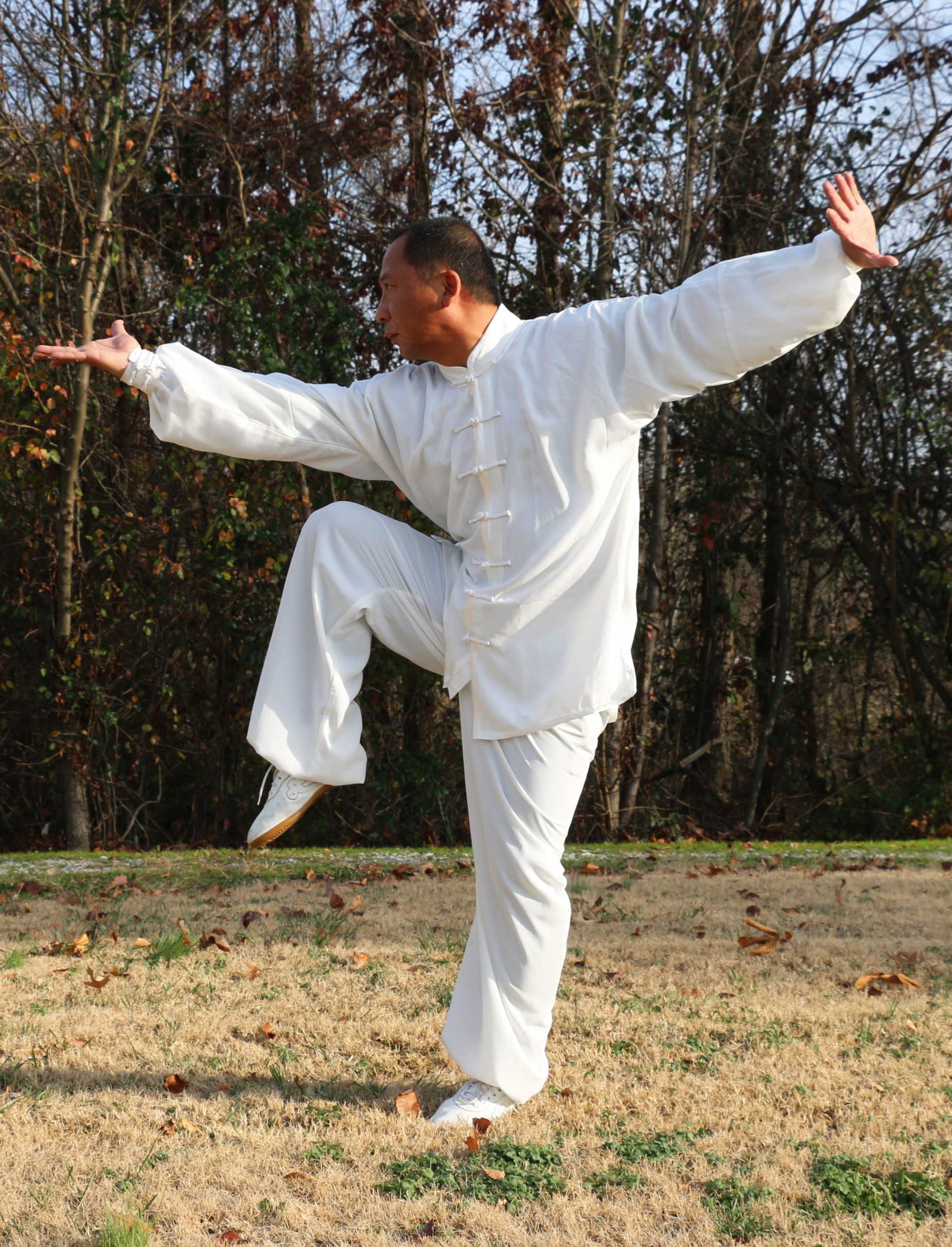
Once both feet are planted, the hands begin to rise. From your sides, lift both arms slowly forward and upward, palms facing down, fingers naturally extended — as if you were holding an invisible balloon. Stop when your hands reach shoulder height. Keep the elbows slightly bent, never locked straight. The whole lift takes about three to four seconds, matched to one slow inhale.
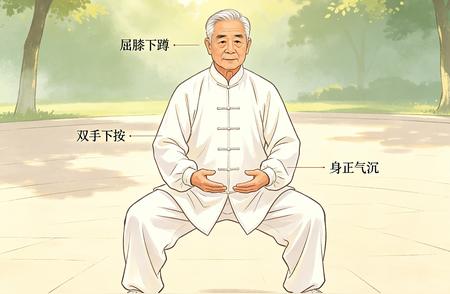
Then comes the sinking and pressing. Bend your knees slowly, letting your center of gravity drop by about 10 centimeters, while both hands press downward at the same time, palms still facing down, until they reach the level of your abdomen. The fingers stay relaxed, the fingertips point forward, and the wrists stay flat — neither drooping nor cocked upward. At this point the Opening Form is complete. Your body forms a stable structure: head lifted, knees settled, hands pressing down. Your breath has completed one full cycle of inhale and exhale.
That is the entire form. Four phases — stand, step, lift, press — and the whole thing takes less than twenty seconds. Simple to describe, but each phase hides a detail that beginners usually miss. The next two sections look at the two that matter most: the feet and the hands.
Footwork and Hand Shapes: Where Most People Go Wrong
Footwork: Learn to Tell Empty from Full
The heart of tai chi footwork is the shift between empty and full. In the Opening Form, when you step out, your right foot is the “full” foot — it carries your entire weight. Your left foot is the “empty” foot — its toe touches the ground, ready to move at any moment. Most beginners step out while their weight is still stuck in the middle, so the moment they lift the left foot, their whole body wobbles, and the foot lands with an audible thud.
The fix is to practice “distinguishing empty from full” as a drill of its own. Stand still and shift all your weight onto your right foot. Touch the ground with your left toe, then try lifting the left foot and holding it up for three seconds without swaying. Set it down gently. Repeat ten times a day. Within about ten days, the feeling of the weight transfer will start to become automatic — and your step will stop wobbling.
The angle of the landing foot matters too. The toes should point straight ahead, turned outward by no more than 15 degrees. If the toes turn out too far, the knees follow them inward, and over time the knee joints take unnecessary strain. The check is simple: after you land, glance down. If the toes of both feet point in roughly parallel directions, you are doing it right.
Hand Shapes: Relaxed and Rounded
The hand shape comes down to two words: relaxed and rounded. As the hands rise, do not clamp the fingers tightly together, and do not splay them wide like a fan. The correct shape is five fingers naturally separated, the web between thumb and index finger gently rounded — as if you were loosely holding an egg. The wrist stays level: when the palm faces down, the back of the hand and the forearm should form roughly one straight line. Do not cock the wrist upward into a “chicken claw,” and do not let it collapse downward into a “drooping wrist.”
The height of the hands is another common error. The standard is shoulder height, with the elbows lower than the wrists, forming a soft arc. Raise the hands too high and the shoulders shrug up with them, leaving your energy floating at the top. Raise them too low and the frame collapses. When you practice, ask a partner to watch, or practice in front of a mirror three times, and memorize the feeling of relaxed shoulders with the elbows pointing down.
Breathing: Getting Your Breath in Step with the Movement
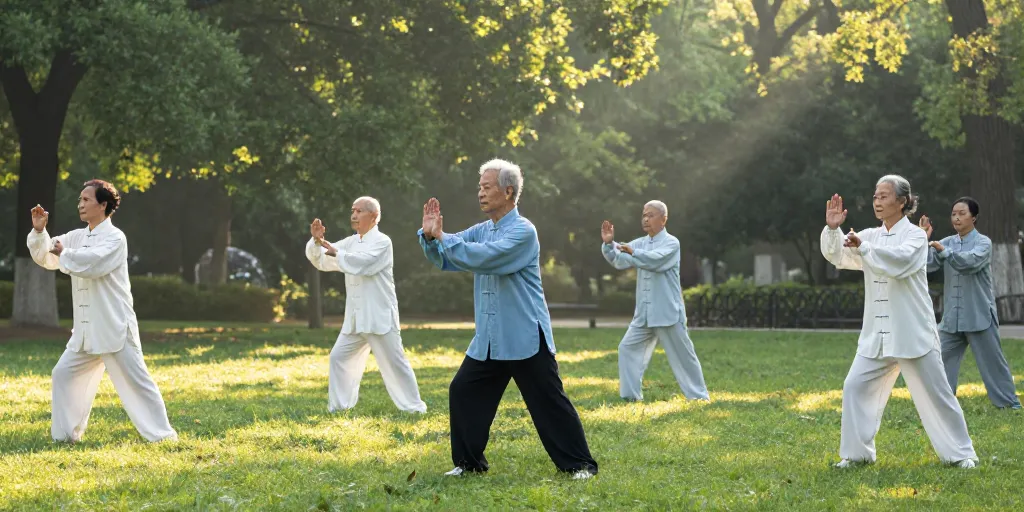
The breathing rule for the Opening Form is simple: inhale as you rise, exhale as you sink. As both hands lift, breathe in slowly through your nose. As the hands press down and the knees sink, breathe out slowly, letting the shoulders drop with the exhale. One complete Opening Form takes about one to two breath cycles. The rhythm of the breath must match the speed of the movement — you cannot have your hands already pressed to the bottom while your breath is still only halfway out.
The most common mistake for beginners is holding the breath. The moment the hands start to lift, the breath freezes, and the whole movement stiffens with it. The remedy is to slow everything down by half: take five seconds to lift the hands and five seconds to press them down, matching each second to an even, steady breath. Once the slow version feels natural, return to normal speed.
There is one more detail worth remembering. When the Opening Form ends, do not rush straight into the next move. After your hands press down to abdomen level, pause for one breath. Check that your weight is steady between your two feet. That single second of stillness is what lets the whole routine stand firmly from the very first move.
Four Common Mistakes — and How to Fix Each One
Mistake 1: Shrugging shoulders. The hands rise, and the shoulders follow them up toward the ears. The neck shortens, and the whole posture looks tense. To fix it, lower your arms first and take three deep breaths, letting your shoulders sink naturally. Memorize that position, then raise your hands again. Before every lift, check that your shoulders are relaxed.
Mistake 2: Knees caving inward. As you bend your knees to sink, they drift toward each other while the toes point in a different direction, and the inner knees start to ache. To fix it, let the knees travel in the same direction as the toes, and do not let them push too far past the toes. A useful drill: hold a thin sheet of paper between your knees as you sink. If the paper does not drop, your knees have not caved in.
Mistake 3: Leaning forward or backward. As you press down, your upper body tips forward, or your weight rocks back onto your heels. To fix it, imagine the thread pulling the crown of your head upward and tuck your tailbone in slightly. You can also practice standing with your back to a wall, heels about 15 centimeters from it: during the Opening Form, your back should neither press against the wall nor drift far away from it.
Mistake 4: Hands and feet out of sync. The hands have already pressed to the bottom while the knees are only just starting to bend — or the feet are planted while the hands are still halfway up. To fix it, break the movement apart: practice only the hands ten times, then only the feet ten times, then put them together at half your usual speed for three rounds. Once the hands, feet, and breath line up, speed up again.
A 15-Minute Daily Practice Plan
The Opening Form looks like only a few moves, but fifteen focused minutes a day will produce a visible change within a month. Here is a simple way to structure it. Spend the first five minutes standing in wuji posture, getting familiar with your balance and your breathing. Spend the middle five minutes repeating the Opening Form: three rounds broken into separate parts, then five rounds done continuously, focusing on whichever single mistake you make most often. Spend the final five minutes connecting the Opening Form into the next move — Parting the Wild Horse’s Mane, left and right — and walk through the transition twice, feeling how the moves join together.
Choose a flat patch of ground with no loose stones, and wear flat, soft-soled shoes. Practice in the park in the morning or in your living room in the evening — all you need is about a meter of space in front of you and behind you. On rainy days, do not practice outdoors on wet ground: knees and ankles are most easily injured on slippery surfaces.
The Opening Form is the first lesson of tai chi — and the one most worth polishing again and again. Once you have steadied this single move, the next several dozen moves all have a reference point: how the weight shifts, how the hands relax, how the breath matches the movement. All of it is hidden in those short fifteen seconds. Tomorrow morning, get up ten minutes early, go to the park, and do the Opening Form three times with full attention — feeling your feet press firmly into the ground and your hands slowly press down, and noticing the calm that comes with it.
Safety note: Go slow, and build up gradually. If you have knee discomfort or an old knee injury, reduce the depth of your squat — sinking just 5 centimeters is enough — and do not force the standard depth. If you feel sharp knee pain, dizziness, or chest tightness during practice, stop immediately and rest. If you have high blood pressure, heart disease, serious joint problems, or other health conditions, consult a doctor before starting, and adjust the intensity to your own situation. Tai chi is a form of daily exercise; it is not a substitute for medical treatment, and it makes no promise of any therapeutic effect.
Quick Answers
How wide should my step be? About shoulder-width apart — roughly 30 to 40 centimeters. Step out and press down; let the sole glide along the ground instead of stamping it.
How high should my hands go? Shoulder height, with the elbows lower than the wrists. Higher than that and your shoulders will shrug; lower and the frame collapses.
When do I breathe in and out? Inhale as the hands rise, exhale as the hands press down and the knees sink. Never hold your breath — if you catch yourself holding it, slow down by half.
Why do my knees ache? The usual cause is knees caving inward while the toes point straight ahead. Keep the knees traveling in the same direction as the toes, and do not let them push far past the toes. If discomfort persists, reduce the depth of the squat.
How long until it feels natural? Most people feel the weight transfer click after about ten days of daily practice — ten slow, careful repetitions a day. Give it a month, and the Opening Form will start to feel like a habit rather than a checklist.
Can I practice at home? Yes. All you need is a flat floor and about a meter of space in front of you and behind you. Flat, soft-soled shoes are ideal.