It’s 6:30 in the morning, in the quiet corner of a neighborhood park. A man in his fifties stamps his foot on the ground, and his arm snaps forward like a whip. The dry leaves at his feet jump. Someone watching nearby whispers: that’s Bajiquan. It doesn’t look flashy — but every single strike lands with real weight.
You’ve probably seen it before without knowing the name. No flowing robes, no slow circles, no dramatic leaps. Just a short, sharp burst of power, delivered from close range. Bajiquan is the most direct style in Chinese martial arts — and for a beginner, it is also one of the most approachable. You need no equipment, no large space, and no prior experience. A patch of ground two meters square is enough to start.
What Is Bajiquan?
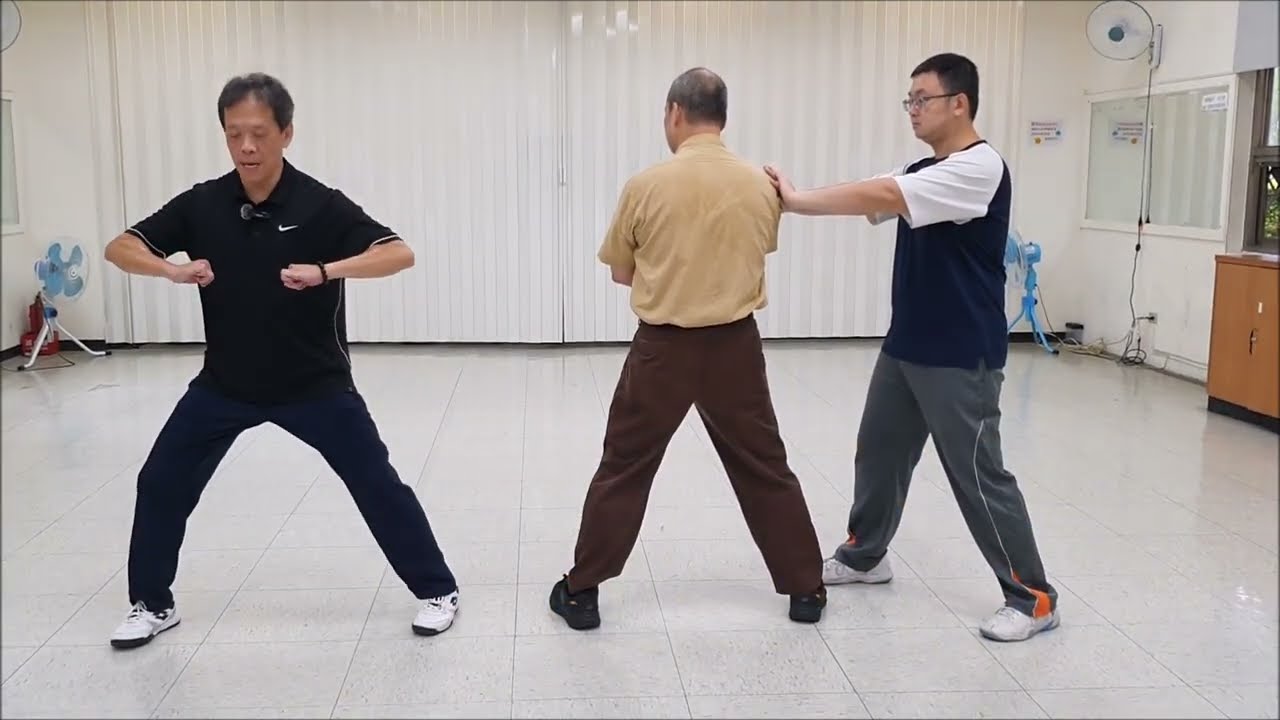
Bajiquan (八极拳, literally “Eight Extremes Boxing”) is a northern Chinese martial art built for close-range combat. Its defining qualities are simple: get close, generate power through the whole body, and finish the movement cleanly. The name “Eight Extremes” refers to the idea that force can be released in eight directions — forward, back, left, right, and the four diagonals — so that no matter where an opponent is, the body knows how to respond.
An old saying in martial arts circles captures its reputation: “With Taiji you can bring peace to the world through culture; with Baji you can settle the world through force” (文有太极安天下,武有八极定乾坤). Taiji is the scholar’s art — soft, circular, patient. Bajiquan is its opposite number: direct, explosive, and economical.
Unlike the long, flowing movements of Taiji, Bajiquan is mostly straight lines: collapsing (崩), shaking (撼), bursting forward (突), and striking (击). Every movement has a clear direction and a clear purpose. Its core form, the “Baji Small Frame” (八极小架), takes only three to four minutes to perform and contains fewer than sixty movements. There are not many moves to memorize — but each one has to be refined again and again.
Three hallmarks give Bajiquan away at a glance. The first is the foot stomp: the sole of the foot hits the ground with a dull thud, and the force travels upward from the floor through the waist and hips. The second is “sinking” (沉坠): shoulders relaxed and dropped, knees slightly bent, weight settled low between the legs. The third is closeness: Bajiquan doesn’t spar from a distance. It closes the gap, makes contact, and releases power at point-blank range.
For a beginner, this is good news. The form is short — most people can walk through the Small Frame after about three months of steady practice — and the training needs nothing more than a small patch of flat ground.
Ding Zhou: The Elbow, Your Closest Weapon
Ding Zhou (顶肘, literally “thrusting elbow”) is Bajiquan’s signature technique, and it works on a simple piece of logic: the elbow sits close to the body, so it travels a shorter distance than a fist, arrives faster, and is harder to defend against at close range. The old saying goes: “Better to take ten punches than one elbow” (宁挨十拳,不挨一肘) — a reference to the elbow’s penetrating power.
The standard movement has three steps. First, raise the elbow: bend the forearm, point the elbow tip forward, keep the upper arm glued to the ribs, and hold the other hand in front of the chest as a guard. Second, turn the hips: drive off the back foot, send the hip forward, and let the elbow travel with the body — this is not the arm pushing forward on its own. Third, step and settle: the front foot lands half a step forward, the weight presses through, and the elbow tip, shoulder, and hip line up in a single line. The power is released in one sharp instant at the moment of contact.
Beginners make three common mistakes. The first is moving only the arm and leaving the waist still — the elbow floats out like a hand pushing a door, with no power behind it. The second is raising the elbow too high, above shoulder level, which leaves the whole armpit exposed. The third is holding the breath while striking, so the face turns red and the power never comes out.
The fix is slow practice. Stand half a meter from a wall, with the elbow tip ten centimeters away from it. Practice turning the hips to send the elbow forward, letting the tip touch the wall lightly and then pulling it back. Do twenty reps per set, two sets a day. Within a week, most people start to feel what practitioners call “whole-body power” (整劲) — the sensation that the force comes from the ground up, not from the arm alone.
There are two basic versions. The straight elbow thrust travels in a line and suits a head-on, close-range situation. The horizontal elbow thrust carries a slight arc and works better for cutting in from the side. Learn the straight thrust first and make it solid; add the horizontal version once the waist and hips move freely.
Tie Shan Kao: Leaning Against the Mountain
Tie Shan Kao (贴山靠, literally “leaning against the mountain”) is the most visually dramatic technique in Bajiquan: the practitioner steps in close, and with one shoulder-and-back lean, the partner is driven two or three steps backward. It looks like a body check — but in practice it is a precise piece of technique, not a matter of throwing your weight at someone.
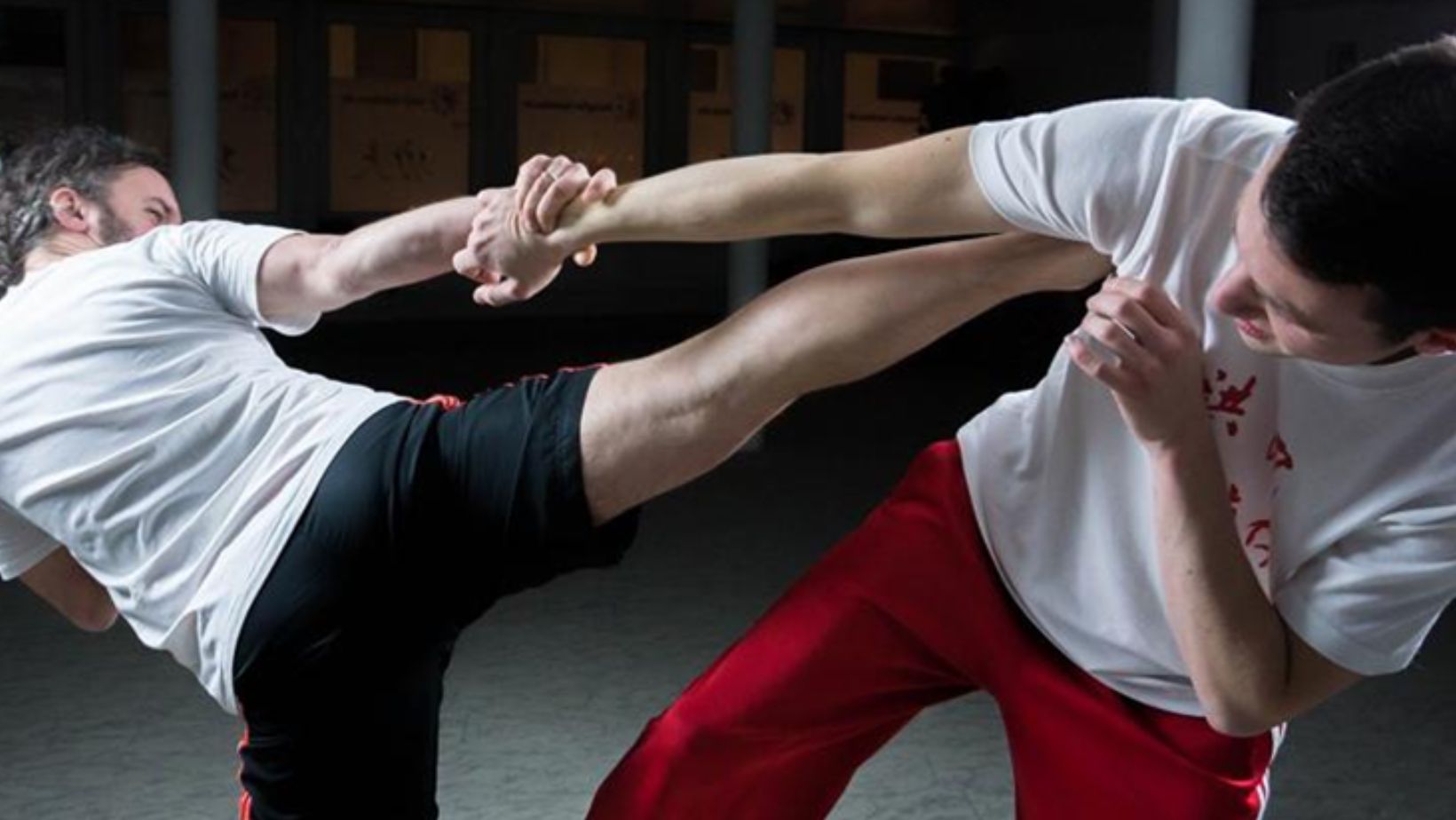
The power chain works like this: the back foot drives into the ground, the force rises from the sole through the knee, the hip, and the lower back, and concentrates into the shoulder and upper back, which lean forward and slightly upward together. The body opens like a door being pushed — it does not ram forward like a car. The shoulder is the point of contact, but the real source of power is the push from the feet and the drive from the waist and hips.
Start by practicing against a tree or a wall. Find a sturdy tree, stand sideways with your shoulder about fifteen centimeters from the trunk, and practice the connected sequence — drive from the foot, turn the hip, lean the shoulder — keeping the shoulder relaxed on contact and bouncing straight back to a stable stance immediately afterward. Start with twenty leans a day, with an old towel folded over the trunk as padding. After two or three weeks, when the shoulder stops aching and the movement stops falling apart, move on to light-contact practice with a partner holding a thick pad.
Three details decide whether you are doing it right. First, sink before you lean: bend the knees slightly and let the body compress like a spring. Second, tuck the chin slightly and keep your eyes forward — don’t drop your head to look at your own shoulder. Third, guard immediately after the lean: the other hand stays in front of the chest, and you return to a defensive stance at once. Collapsing into a loose heap after contact is one of the worst habits a beginner can build.
The most common beginner problem is leaning with the shoulder alone while the feet stay still — the result is that you wobble before your partner does. The fix is to break the movement apart: practice ten reps of only the foot drive, then ten reps of only the hip turn, and then combine them.
Foundational Training: Twenty Minutes a Day
Old teachers have a saying: “Practice the form without the foundation, and you’ll end up with nothing” (练拳不练功,到老一场空). No matter how well you know the Small Frame, if the fundamentals are weak, the power stays scattered. Bajiquan’s foundational training is unglamorous — standing, stepping, and a few single movements repeated until they are part of you.
1. Standing Practice (Zhan Zhuang)
Stand with feet shoulder-width apart, knees slightly bent, and arms held in front of the chest as if hugging a large water jar. Hold the posture for ten minutes. Standing practice builds a stable lower body and calm, deep breathing. Beginners often find their legs shaking after three minutes — that is completely normal. Most people can hold eight minutes after two weeks of steady practice. Keep the knees behind the toes, don’t let the lower back sag, and breathe naturally. Never force yourself to hold your breath.
2. Bow Stance and Horse Stance Transitions
In a bow stance, the front leg bends and the back leg drives straight. In a horse stance, the legs spread and sink down as if riding a horse. Shift back and forth between the two, twenty transitions per set, two sets. This trains leg strength and the ability to switch your center of gravity — and the footwork for both Tie Shan Kao and Ding Zhou comes from here. Keep the upper body upright as you shift; don’t rock from side to side.
3. Single-Movement Repetition
Each day, pick two movements and repeat them: twenty elbow thrusts, twenty chopping palms, for example. The number of movements doesn’t matter — repetition does. An old master from Cangzhou, the birthplace of Bajiquan, practiced by the rule of “one movement, a hundred times”: a hundred elbow thrusts a day, in five sets, and after three months the movement simply lived in his body. Beginners can start at thirty reps per movement per day and work up to fifty.
4. Leg Stretches and Waist Turns
Stretch each leg for one minute per side, and turn the waist twenty circles in each direction. Bajiquan’s power runs through the waist and hips, and if the waist is stiff, the force can’t travel upward. This is the least glamorous part of the routine — and the part that makes everything else work.
Your First Four Weeks: A Beginner’s Plan
Week 1: Stance and steps only. Stand for ten minutes a day and do two sets of bow-stance and horse-stance transitions. The goal is steady legs. Don’t touch the form this week.
Week 2: Add single movements. Thirty elbow thrusts and thirty chopping palms a day, done slowly, with half the time spent in front of a mirror checking the position of the elbow and shoulder. Increase standing practice to twelve minutes a day.
Week 3: Learn the first half of the Small Frame. Work with a teacher or a good instructional video, learning two or three movements a day, then stringing the earlier ones together and walking through them twice. Keep the single-movement practice going, and raise the elbow thrusts to fifty a day.
Week 4: Walk the whole form. Don’t aim for speed — aim for every step to land steady and every movement to release cleanly. The full form takes three to four minutes; walk it three times a day, with standing practice and single movements in between.
Twenty to thirty minutes a day is enough, in the morning or the early evening. Avoid training within an hour after a meal.
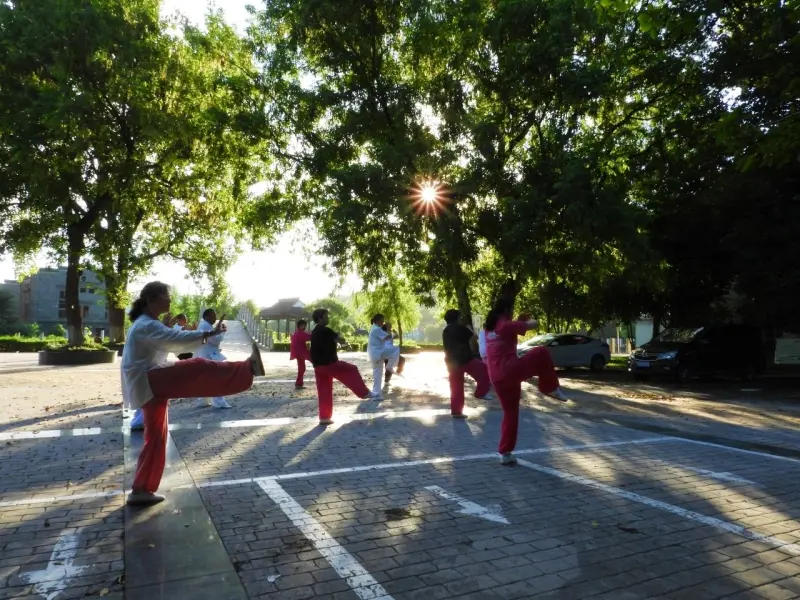
Bajiquan has no shortcuts: one movement at a time, one day at a time. Stand steady first, master the elbow thrust and the mountain lean, and then string the Small Frame together.
The simplest way to begin is today. Find a patch of open ground, stand for ten minutes, do twenty slow elbow thrusts, and notice how your body feels. Come back at the same time tomorrow. Keep it up for four weeks, walk the Small Frame all the way through, and then find a reliable teacher to correct your form in person — one sentence of guidance from an experienced teacher is worth a month of practicing alone.
Quick Answers
Do I need any equipment or a large space to start Bajiquan? No. A flat patch of ground about two meters square, a pair of comfortable flat shoes, and loose clothing are all you need. The Small Frame and the foundational drills were designed to be practiced in a courtyard or a park corner.
How long before I can perform the Small Frame? Most beginners can walk through the full form after about three months of daily practice. The first four weeks in this guide get you standing steadily, moving cleanly, and learning the first half of the form — speed and power come later.
Is Bajiquan suitable for older beginners? The foundational training — standing, stepping, and slow single movements — is gentle and adjustable, and many practitioners start in their fifties or later. The explosive techniques like Tie Shan Kao should be learned slowly and only with guidance; the pace and intensity are always up to you.
What’s the difference between Bajiquan and Taiji? Taiji is circular, slow, and continuous, with power released softly. Bajiquan is direct, short, and explosive, with power released in a single burst at close range. They come from the same northern Chinese martial arts tradition but train the body in opposite ways — many practitioners eventually study both.
Do I need a teacher, or can I learn from videos? Videos can teach you the shapes, but they can’t tell you when your shoulder is too high or your weight is in the wrong place. Learn the basics on your own for a few weeks, then have a teacher or an experienced practitioner check your form in person at least once.
Safety note: Practice slowly first, and increase power gradually only once the movements feel familiar. Find a coach or an experienced training partner who can correct your form in person. Train on flat, non-slip ground and wear suitable shoes. If you have health conditions — such as lower back or knee problems, or heart and blood pressure issues — consult a doctor before starting, and adjust the intensity to your own condition. Stop immediately and seek medical advice if you feel pain, dizziness, or chest discomfort during practice. This article is for cultural and educational purposes only and makes no promise of fitness or health benefits.