Picture this: a spear taller than you, leaning against the wall of a village courtyard. It looks heavy, awkward, almost impossible to control. Then an old practitioner picks it up, and suddenly the long shaft moves like an extension of his arms – steady, smooth, and surprisingly fast. That weapon is the daqiang, the Chinese long spear, and here is the good news for beginners: handling it well has very little to do with brute strength. It comes down to how you hold it, three core hand techniques, and footwork that keeps up with your hands.
This guide covers exactly those basics: the grip, the three essential moves – lan, na, and zha – and the footwork that ties everything together. No routine, no sparring, no fancy flourishes. Just the foundation, done properly.
First, Know Your Spear: Length, Weight, and Grip
The daqiang, literally the “big spear,” is a long-shafted weapon used in traditional Chinese martial arts. A classic training spear measures between 2.4 and 3 meters long, with a wooden shaft – often white wax wood – and a spearhead at one end. For a first spear, go with something around 2.4 meters and on the lighter side. A spear that is too long puts its center of gravity too far forward and becomes very hard to control; one that is too short never teaches you the famous advantage of the weapon, summed up in the old saying “one inch longer, one inch stronger.”
For weight, here is a simple test: hold the spear level with both hands, arms extended, for 30 seconds. If you can do that without shaking, that weight is a good starting point. You can always move up to a heavier shaft later, once your grip and stance are solid.
The grip is where everything starts. Place your front hand about one-third of the way along the shaft from the tip, and your rear hand near the butt end, roughly one arm’s length apart. Two mistakes show up immediately in beginners. Grip too close together and the tip dives the moment you move; grip the rear hand too tightly and the spear locks up, unable to slide or turn. The right feeling is this: the front hand steers, the rear hand drives, and the two hands work like a pair of living pivots, letting the shaft slide slightly through your palms as you adjust.
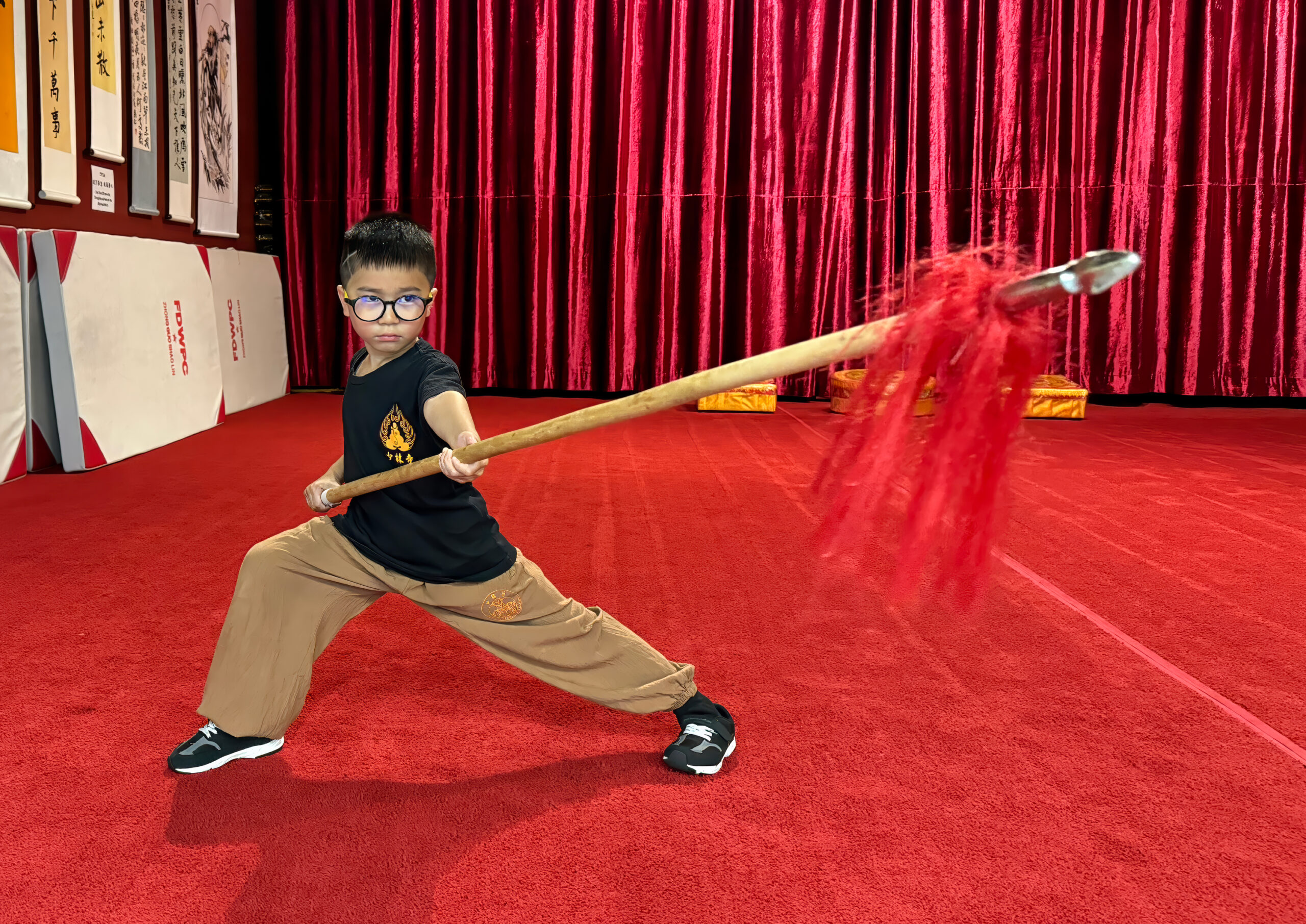
Before you move at all, learn the ready stance. Stand with your feet about one and a half shoulder-widths apart, front foot pointing forward, rear foot turned out about 45 degrees, weight settled between your feet and slightly toward the rear. Hold the spear with the tip just above eyebrow height and the butt end close to your waist. If you can stand like this for three minutes without wobbling, your stance and grip have passed their first test.
Lan, Na, and Zha: Three Moves, Learned One at a Time
Lan, na, and zha are the three core hand techniques of the long spear. Learn each one separately, slowly, and only combine them once each move feels clean on its own.
Lan: Deflecting the Opponent’s Spear Outward
Lan means to block or parry outward. When an opponent’s spear tip comes toward you, use your front hand as the pivot and pull your rear hand inward, so the shaft sweeps sideways and deflects the incoming spear. You do not need a big motion – pushing it 20 to 30 centimeters off line is plenty. A good solo drill is to stand in front of a tree or a post and imagine an attack arriving along your centerline. Sweep your shaft in a small arc from the center outward, carrying the imaginary spear past your body. Timing is the real skill here: too early and your opponent changes line; too late and you are already hit. Aim to move when the incoming tip is about half a meter from your chest, and the rhythm will start to feel right.
Na: Pressing the Opponent’s Spear Down
Na means to press downward. When an opponent’s shaft bears down on you or chops from above, use the middle section of your spear to sink their tip toward the ground. Let your waist sink slightly with the motion. If you press down with your arms alone, you will not generate enough force, and you will leave your own center exposed. In partner practice, one person presses slowly downward while the other practices na; the rep counts as a success when the pressing tip is driven below waist height.
Zha: Thrusting Straight and Fast
Zha is the straight thrust, and it is the spear’s main scoring technique. Drive with your rear hand, let your front hand slide forward along the shaft, and send the tip in a straight line to the target. The power should travel from your heels, through your waist and back, and out to the tip – not from your arms alone. Beginners should start with fixed-point thrusting: stick a fist-sized mark on a wall, stand two meters away, and thrust 50 times. When you can hit the mark 40 times or more, step back and increase the distance. And always recover: the moment the tip reaches the target, pull it back half a foot and return to your ready stance. A thrust you cannot retract leaves your shaft in your opponent’s hands.
Footwork: If Your Feet Lag, Your Hands Mean Nothing
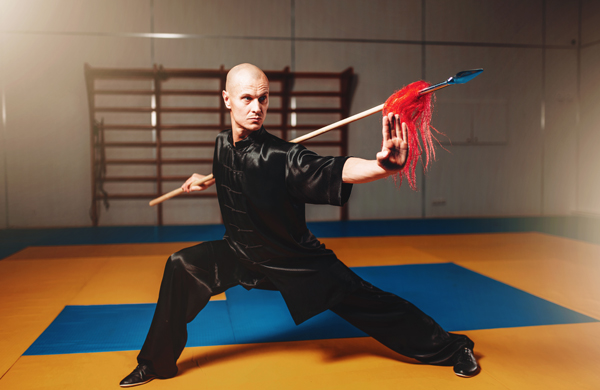
The long spear is a long weapon. If you do not move, you cannot reach anyone; if you move wildly, you lose all accuracy. Start with three steps.
- Advance step: Step forward about 30 to 40 centimeters with your front foot, bring the rear foot up half a step, and thrust as you move. Advance plus thrust is the most common attacking combination in spear work.
- Retreat step: Step back first with your rear foot, bring the front foot along, and pull the spear back into a lan or na. Retreating is not running away – it is creating distance so you can attack again on your own terms.
- Switch step: Swap your front and rear feet, often with a turn or a sidestep, to change your angle. Draw a straight line on the ground and practice advancing three steps and retreating three steps along it. If your feet stay on the line, your footwork is going straight.
A practical combination drill is “advance and thrust, retreat and deflect”: thrust once as you advance, deflect once as you retreat, and repeat for ten rounds. Do three sets a day, resting a minute between sets. Start slow and only speed up once the movement feels smooth. When feet, hands, and spear finally move together, you will feel it: the tip goes where you look, and your body follows, instead of your hands and feet each doing their own thing.
Four Beginner Mistakes and a One-Week Starter Plan
Almost every beginner runs into the same four problems. First, gripping too tightly: ten minutes in, your palms blister. Wear thin gloves and grip only firmly enough that the shaft will not slip. Second, practicing with the arms but not the waist: thrusts powered by the arms alone leave your shoulders aching, so consciously turn your waist and hips into every thrust. Third, dragging footwork: the rear foot trails on the ground during an advance. Fix it by lifting the heel first and letting the toe brush lightly forward. Fourth, rushing ahead: trying to learn a full routine in the first week, and ending up with no single move done correctly.
Here is a saner first week. Spend the first three days on just the ready stance and fixed-point thrusting, 30 minutes a day. On days four and five, add slow lan and na practice, either with a partner or against a post. On the weekend, practice the “advance and thrust, retreat and deflect” combination for 20 minutes, followed by 10 minutes of stretching. Train on flat, open ground with at least three meters of clear space around you, no passersby or obstacles nearby, and use a practice spear with a covered or blunt tip so nobody gets hurt by accident.
Quick Answers
How long should my first spear be? About 2.4 meters, with a lighter shaft such as white wax wood. Longer and heavier spears are for later, once your grip and stance are reliable.
Do I need a partner to start? No. The stance, fixed-point thrusting, and the lan and na drills against a post can all be practiced solo. A partner becomes useful once you start timing drills, but the foundation is solo work.
How much time does it take to feel comfortable? With 30 minutes a day, most beginners feel the spear starting to “obey” within about a month. The basics reward steady repetition, not talent.
What should I watch out for when choosing a practice space? Flat ground, three meters of clearance in every direction, and a blunt or covered tip. Never practice with a sharp spearhead around other people.
Is the long spear only for strong people? No. The techniques in this guide rely on body mechanics – waist, legs, and leverage – rather than arm strength. That is precisely why beginners are told to stop muscling the spear and start moving from the waist.
There is no shortcut to spear basics, and that is the point. A steady grip, clean lan, na, and zha, and footwork that keeps up – get those three things solid, and every routine and sparring drill you learn afterward will come much more easily. Give it 30 minutes a day, in the order above, and a month from now the spear will feel like it belongs in your hands. Warm up your shoulders, waist, and knees before each session, stretch afterward, and build range and intensity gradually.
Safety note: Long spear practice is a moderately intense physical activity involving a long implement. Go at your own pace, build up gradually, and do not train through an injury. If you have heart disease, high blood pressure, joint problems, or any other pre-existing condition, or old injuries to your waist, shoulders, or knees, please consult a doctor or a qualified instructor before starting systematic practice. Stop immediately and rest if you feel pain, dizziness, or a racing heartbeat during practice. This article is an introduction to a traditional weapon art for cultural and educational purposes and makes no promise of fitness or health results.