A friend moved house last year and picked a random weekend. The day turned out to clash with his zodiac sign — and the next six months at work were one thing after another. “If only I’d checked the date,” he tells everyone now. Moving is a life event, and tradition wants the “joy of relocation” to start on a good note. This guide lays out how date selection works and the most common traps, so you can dodge the trouble that’s dodgeable.
What Are You Actually Selecting?
In one line: avoid days that clash with you, and pick a moment when heaven, earth, and people “cooperate.” Traditional date-selection theory holds that every day carries its own stems, branches, and lucky or unlucky spirits. For a major move, you avoid “clash, affliction, punishment, harm” and choose “triple harmony, double harmony, yellow-path lucky days.”
It sounds mystical, but unpacked it’s three layers of filtering: first, is the day itself good or bad (the yellow and black paths of the almanac); second, does the day suit you (zodiac clashes); third, is the hour right (a lucky hour for entry). Pass all three, and you’ve got a good day.
The 5 Most Common Traps
Trap 1: Seeing “suitable for moving” on the almanac and locking it in. The almanac is the generic edition — it says the day is broadly fine for moving, but it doesn’t know who you are. It’s like a weather forecast saying “mostly sunny nationwide” — that doesn’t mean it won’t rain on your city. The almanac is only the first filter.
Trap 2: The day clashes with your or a family member’s zodiac sign. This is the deadliest one. Born in the Year of the Tiger and you pick a Monkey day (Tiger and Monkey clash)? The traditional verdict is “day clash” — a major taboo. A family of three with three different signs needs a day that clashes with none of them; if that’s impossible, at minimum the head of household must not be clashed.
Trap 3: Hitting a blacklist inauspicious day. The tradition keeps a blacklist: the Thirteen Yang Gong Taboo Days (thirteen days a year said to suit nothing at all), the Four Separations and Four Extinctions (the days flanking the solar-term starts of spring, summer, autumn, and winter), and Year-Breaker and Month-Breaker days. The almanac may still mark them “suitable for moving,” but careful families steer clear on their own.
Trap 4: Right day, wrong hour. Many people pick the day and ignore the hour, assuming “daytime is fine.” Tradition calls for a “lucky hour of entry” — usually the morning yang hours (the Chen hour 7–9am, the Si hour 9–11am), symbolizing rising fortune. Afternoon moves and nighttime entries read as inauspicious in the traditional view.
Trap 5: Ignoring the new home’s orientation. The advanced layer: the house’s facing direction has its own afflicted sectors. In 2026 the 5 Yellow sits in the south — if the new front door faces south, the moving day needs to be extra solid. Most people miss this layer entirely.

“Relocating” vs. “Settling In” — the Same Thing?
Check the almanac and you’ll see two terms: yixi (relocation) and ruzai (settling in). Tradition distinguishes them slightly: relocation means the act of moving things over; settling in means officially living there. Careful families pick separate days — one for moving belongings, another for the formal move-in with the fire-lighting and house-warming rites.
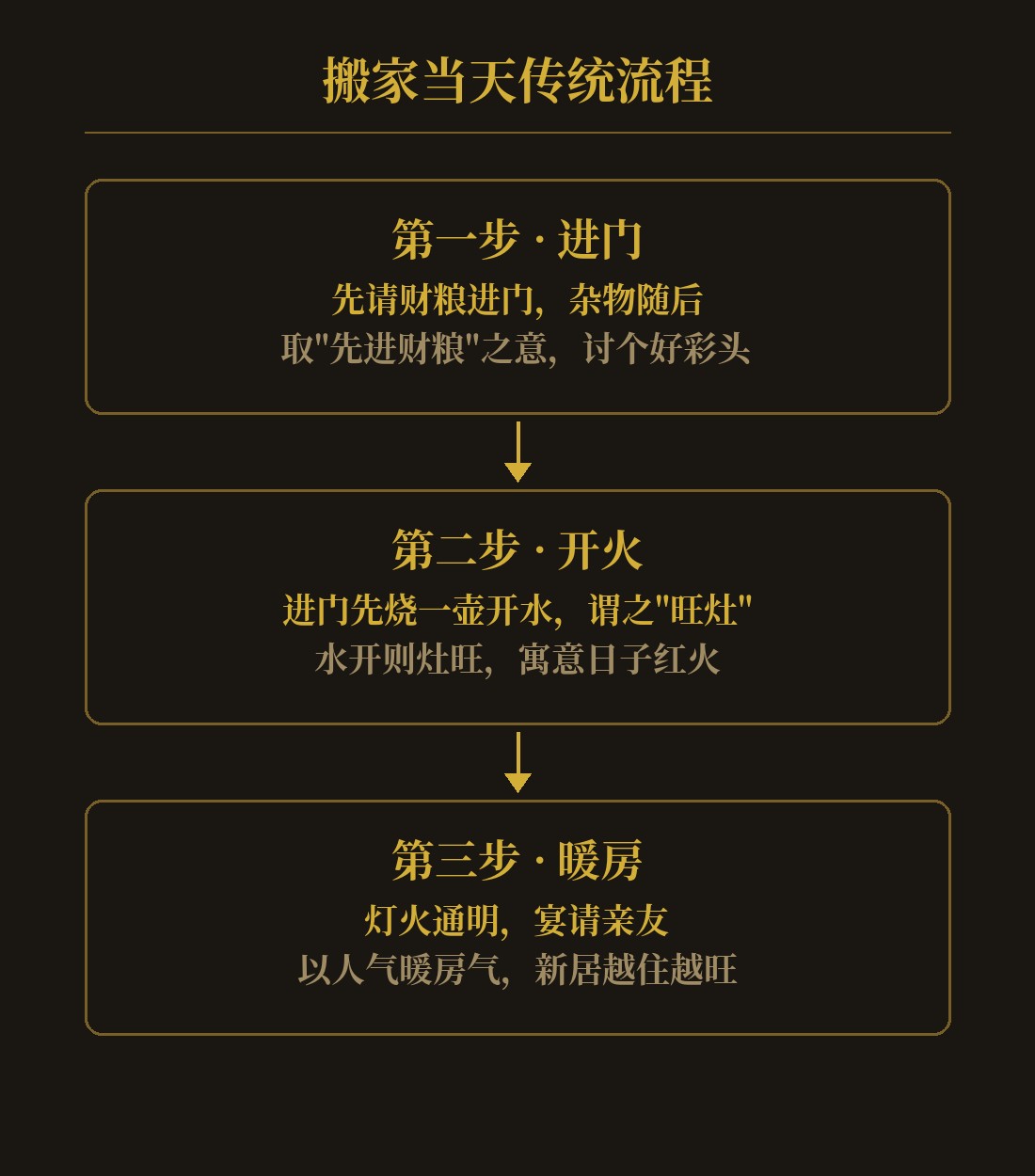
Modern life rarely bothers with the split — one day does it all. But knowing the difference is useful: if you move over two days, put the valuables and the “first fire” rite on settling-in day, and move only furniture and odds and ends first. One more detail: on move-in day, the rice jar and the bedding — the “anchor” items — should enter first. The old saying goes: “wealth and grain first, clutter after.”
The 4-Step Date Method
- Step 1: Shortlist yellow-path lucky days. Check the almanac for days marked “suitable for relocation” or “suitable for settling in,” and list 3–5 candidates. (Relocation and settling-in differ slightly, as above — in practice one day usually covers both.)
- Step 2: Rule out clashes. Check each candidate one by one: does it clash with the head of household’s sign? Is it a Yang Gong taboo, a Four Separation/Extinction, a Year or Month Breaker? Hard fails get crossed straight off.
- Step 3: Match the BaZi’s favorable elements (advanced). Careful families check whether the day’s stems suit the head of household’s chart — someone whose chart favors water picks Ren/Gui/Hai/Zi water-strong days, for instance. You can ask a practitioner, or skip this — the first two steps already put you ahead of most people.
- Step 4: Fix the lucky hour. Within the chosen day, pick the entry hour — morning is the rule. Check the day’s hourly luck table and dodge any hour that clashes with the day stem.
Moving-Day Traditions
The day is set — and tradition has a whole choreography for the day itself, all for good fortune:
- The head of household enters first. Tradition says the head of the family goes through the door first, carrying valuables or the rice jar — “bringing wealth into the home.”
- Light the stove, boil water. The first job through the door is firing up the stove and boiling a kettle — “kindling the hearth.” Boiling water symbolizes life getting hotter and hotter.
- Expectant mothers step aside. Folk belief holds that moving stirs up the ground’s energy, so careful families have pregnant women sit this one out. It’s folk custom — believe as you will.
- Speak lucky words, keep the lights on. Say auspicious things all day, and light up the whole house at night — “kindling the home.” Plenty of families keep every light blazing for three nights running.
- House-warming. If you can, invite friends and family over for a meal on moving day or soon after. The more human warmth, the better — the most widespread custom of them all.
- Worshipping the four corners (optional). Popular in Guangdong and Hong Kong: before settling in, set out incense and offerings at the four corners and the center of the home, praying for peace in the new place. Strongly regional — follow it if it’s your local custom; no need to force it otherwise.
Bottom line: date selection is really about peace of mind. A well-chosen day puts the whole family’s energy in a different place — that “everything is ready” feeling is itself the beginning of good luck. Bookmark this piece and walk through it before your next move: four steps to fix the day, the choreography on the day, five traps dodged — and the joy of relocation doubles. A good day plus a good mood: the new home can only get better from here.
Quick Answers
What if every candidate day clashes with someone in the family? With four or five signs under one roof, a clash-free day isn’t always possible. Priority order: the head of household must not be clashed, then the person spending the most time in the new home. Anyone who does get clashed simply stays away on moving day and enters the next day — the old workaround is “the clashed one arrives late.”
I’m renting — do I need all this? The full four-step method is for buyers settling long-term. Renters can run the lite version: almanac shortlist plus the clash check (steps 1–2). A rental is a shorter commitment, so the “stakes” — and the ritual — scale down accordingly.
Does this apply to moving offices? Yes, with one tweak: the “head of household” becomes the company’s legal representative or the team lead, and step 3 (matching BaZi elements) is usually skipped. The moving-day choreography adapts too — the boss enters first carrying the company seal or the account books, the office equivalent of the rice jar.
Can I trust almanac apps? For steps 1 and 4 (listing “suitable for moving” days and hourly luck), reputable apps are fine — they all compute from the same traditional calendar. Where apps can’t help is step 2’s judgment calls and step 3’s BaZi matching. Use the app as a calculator, not as the decision-maker.
中文版:搬家择日避坑指南