Next time you stand in front of a mirror, take a proper look at your ears. Most of us wash our faces, comb our hair, and put in earbuds every day, yet our ears barely get a second glance. In traditional Chinese face reading, though, the ears are the first feature a practitioner studies. An old saying calls the ear “the official of hearing” — in Chinese, er wei cai ting zhi guan — and the shape, thickness, and position of a person’s ears were said to reveal fortune, longevity, and character. This article unpacks that old body of knowledge the way the ancients told it. Treat it as a cultural tour, not a verdict on your life.
Why Face Readers Look at the Ears First
Chinese physiognomy divides the face into five features — eyebrows, eyes, nose, mouth, and ears. The ears come last on the list, but they hold a special status: they are the only pair of symmetrical features sitting on the sides of the face. The old rule was “look at the ears first, then the face,” and the reasoning was practical. An ear’s shape is largely fixed from birth — unlike eyebrows, which can be trimmed, or complexion, which changes with sleep and stress. The classic manual Mayi Xiangfa (The Physiognomy of the Hemp-Robed Sage) calls the ear “the opening of the kidneys” — in traditional Chinese medicine, shen zhi qiao means the ear is the outward gateway of the kidney system, the organ system believed to store a person’s inborn vitality.
There was a saying in old Beijing fortune-telling shops: when sizing someone up, check first whether the ears hug the head. Ears pressed close to the skull are called “close-to-head ears”; ears that stick out are “wind-catching ears.” In the days of arranged marriages, a matchmaker stepping into a home would glance at the ears before anything else. This was not pure superstition. The ancients treated the ear as a rough signal of how sturdy a person was — someone with thick ear rims and full earlobes was thought to have a strong constitution and the resilience to handle hardship.
To a modern reader, that sounds mystical. Look at it from another angle, though: the cartilage and skin of the ear genuinely reflect something about the body. Doctors do pay attention to creases on the earlobe and changes in ear color. So the habit of “ears first” was half culture and half plain, hands-on observation.

Five Common Ear Shapes, and What the Old Books Say
The old manuals sort ears into several types. Five are the most common — hold a mirror up and see which one sounds familiar.
Bead-drop ears: large, round earlobes that hang like a pearl. This is the shape folk tradition loves most, calling it a sign of good fortune. Look at temple statues of the Buddha or paintings of the God of Wealth — every one of them is drawn with long, drooping earlobes. In everyday life, people with large earlobes are common enough, and earrings suit them well. The old books linked this shape with a secure later life: a person might hustle when young, but life grows steadier with age.
Close-to-head ears: ears that hug the skull so tightly you can barely see the rim from the front. The manuals rate this shape highly, describing its owner as clever, steady, and good at holding on to money. There is a charming story from old private schools: when a teacher took on a new pupil, he would check whether the child’s ears sat close to the head. A child with close-to-head ears was thought to sit still and listen properly. It was a hiring rule of its time, of course — modern education pays no attention to it.
Wind-catching ears: ears that flare outward, plainly visible from the front. A folk saying goes, “wind-catching ears catch both wind and wealth” — though the books disagree with each other. Some say people with this shape are outgoing, sociable, and bold, well suited to field work or business. Others say they spend money freely. The two readings contradict each other, which neatly proves the point: ear reading was never a single, fixed system.
Small ears: ears that are small overall, with earlobes that barely show. The manuals are cautious about this type, describing the owner as fine-grained in thought, sensitive, and prone to overthinking. But the same books add a qualifier: small ears paired with full earlobes are still a good sign. The ancients, it turns out, judged the whole ear rather than size alone.
High ears and low ears: ears whose top edge rises above the eyebrows are called “high ears”; ears that sit below the eyes are “low ears.” The books claim high-eared people find success young, with good fortune in study and exams, while low-eared people are late bloomers who endure more setbacks early on and find their stride in middle age. Tying ear position to the rhythm of a life is a classic piece of traditional lore — hear it out, but don’t take it personally.
Earlobes, Ear Rims, and the Outer Ear: Reading the Details
Once the overall shape is settled, the old readers zoomed in on three parts of the ear — the earlobe, the ear rim (helix), and the outer ear — each with its own set of claims.
Earlobes: fortune and later life. A thick, large, fleshy earlobe is one of the most praised features in the manuals, called “shoulder-reaching” or “bead-drop.” Longevity gods in old paintings have earlobes that nearly touch their shoulders. By contrast, thin, small, almost absent earlobes were said to mean a hard-working youth, with everything earned through one’s own effort. Interestingly, earlobes change with age — they grow longer and thinner as we get older — so the claim that “long earlobes mean long life” may partly mistake an effect for a cause.
Ear rims: character. The ear rim is the rolled ridge of cartilage around the outer edge of the ear. A clear, smooth, unbroken rim was said to mark someone broad-minded and trustworthy; a rim with nicks or an uneven outline was read as a sign of an impatient, stubborn streak. Neighborhood folk wisdom went further: people whose rims flare outward love to meddle, while those whose rims tuck inward are quiet and observant. These are sayings passed down by word of mouth — not necessarily accurate, but full of everyday flavor.
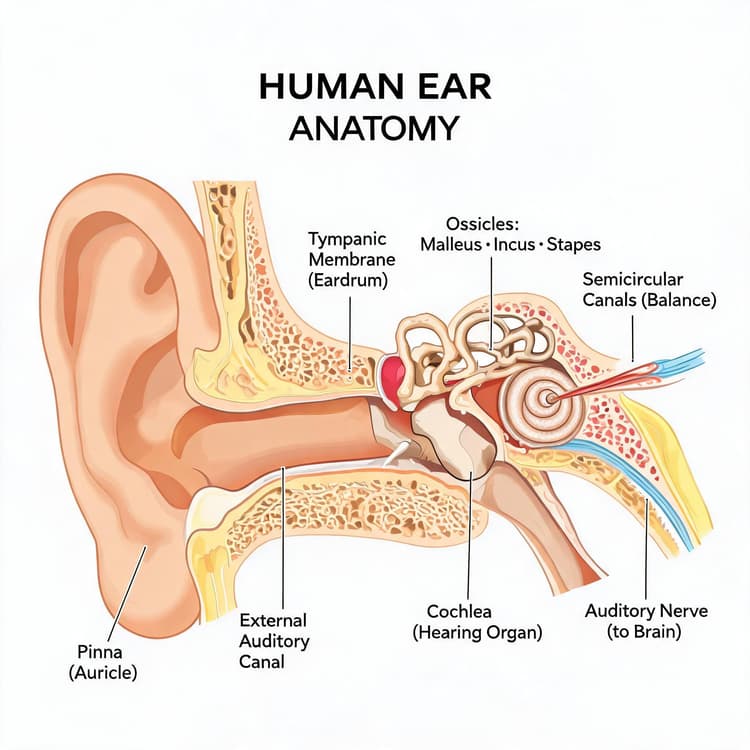
Outer ear and ear color: health. A full outer ear with a healthy, rosy tint was taken as a sign of strong blood and vitality; ears that looked pale, bluish, or dry prompted the old readers to warn about health. This is where tradition meets modern medicine: the skin of the ear is thin and rich in blood vessels, so people with anemia or poor circulation really do have paler ears. In 1973, the American physician Sanders T. Frank noticed that people with a diagonal crease across the earlobe had a higher rate of coronary heart disease. The crease later became known as “Frank’s sign.” A single crease is not a diagnosis, of course — at most, it is a nudge to get a check-up.
Ears and Health: How Much of the Old Observation Holds Up?
Chinese medicine takes the ear very seriously. It holds that “the ear is the official of the kidneys,” and that six of the body’s twelve meridians — the channels through which qi, or vital energy, is said to flow — pass through the ear. Ear acupuncture grew out of this theory: more than a hundred acupoints are mapped across the ear, each linked to a different organ, and stimulating them is said to regulate the body. The practice is still used in acupuncture clinics today, and ear-seed therapy clinics in many Chinese hospitals have queues out the door.
Modern medicine has found its own reasons to treat the ear as a “health window.” The link between earlobe creases and cardiovascular risk has decades of research behind it; changes in hearing can reflect blood circulation in the inner ear; even whether your earwax is wet or dry is genetic — dry earwax is found in more than 80 percent of East Asians. These findings give the ancient claim that the ear is a window onto health a measure of scientific support.
But the boundary matters: ears can hint at health signals; they do not decide a person’s fate. People with large earlobes are not guaranteed long lives, and people with small earlobes are not doomed to poor health. What really shapes health is sleep, diet, exercise, and mindset. When the old books read “lifespan” from the ear, they were mostly projecting a person’s state of health onto the ear — and it helps to know which way the cause and effect run.
How to Read Ear Physiognomy: Culture, Not a Court Verdict
Ear reading has circulated for over a thousand years and has become part of Chinese folk culture. You can see its fragments everywhere: the fortune-teller’s stall at a temple fair during Spring Festival, the physiognomist in an old movie, a grandparent remarking casually that “this child has fortunate ears.” Like New Year woodblock prints or paper cutting, it carries the ancients’ hopes for a good life rather than a precise science.
There are three levels to reading it. The first is fun: look at your own ears in the mirror, learn what the old books called your type, and gain a conversation piece for the dinner table. The second is knowledge: understanding the ideas behind phrases like “the ear is the official of hearing” and “the kidneys open into the ears” — the medical theory and folk logic they came from. The third is self-reflection: letting the state of your ears remind you to look after your health. Ringing that lasts for weeks deserves a hearing check; persistently pale ears are worth mentioning to a doctor. That is far more useful than worrying about whether you have “fortunate” ears.
One warning is worth repeating: any claim that ties ear shape directly to a person’s destiny is not to be believed. The shape of your ears was mostly settled at birth; what you can change afterward is how you care for them and your overall health. Whether life goes well depends on choices, effort, and circumstance — not on whether an earlobe is a millimeter longer or shorter. Using ear reading to pass judgment on someone is neither scientific nor kind.

Quick Answers
Do big earlobes really mean good fortune? In folk tradition, yes — large, round earlobes are the classic “fortunate” sign, which is why statues of the Buddha and the God of Wealth are drawn with them. Scientifically, earlobe size says nothing about your luck; it is mostly a matter of genetics and age.
What is Frank’s sign? A diagonal crease across the earlobe, first linked to coronary heart disease by Dr. Sanders T. Frank in 1973. Studies since then have found a real statistical association, but a crease alone is not a diagnosis — it is a reason to get your heart checked, not a verdict.
Can you change your ear shape? No, not in any meaningful way. Ear shape is set early in life. What you can change is ear health: protect your hearing, keep volume moderate, and see a doctor promptly if something changes.
Is ear reading the same as palm reading? They belong to the same tradition of Chinese physiognomy, but they read different features. Ear reading focuses on inborn constitution and later life; palm reading looks more at lines said to change over time. Both are cultural practices, not medical or scientific methods.
A Final Look in the Mirror — Then Get On With Life
Ear face reading is, in the end, an old way of looking at people. It has cultural value, a handful of genuine health observations, and a large amount of forced association. The right attitude is to take the cultural flavor and leave the fatalism behind.
Three small things you can do today: first, look at your ears in the mirror and learn what type the old books would call them — knowing is enough, no need to take it seriously. Second, pay attention to what your ears are telling you about your health: ringing that lasts more than a week, a sudden drop in hearing, or persistently pale ears all deserve a trip to the doctor. Third, protect your ears — keep headphone volume below 60 percent of maximum, don’t wear earphones for more than an hour at a stretch, never use hard objects to clean inside your ears, and wear ear muffs when you go out in winter. That kind of practical care is worth more than any “fortunate” ear shape.
Ears are for listening to the world, not for passing judgment on a life. Hearing clearly and listening well matter far more than looking “blessed.” This article presents traditional cultural knowledge for reference only.
Disclaimer: this article is a cultural introduction to traditional Chinese physiognomy and is for reference only. It is not medical advice; consult a qualified professional for any health concerns.