Seven in the morning, in a small park pavilion. A man in his seventies has just finished the first five movements of his morning routine when he reaches the sixth: he clenches both fists, fixes his eyes on a point in the distance, and suddenly looks like a different person — taller, steadier, full of quiet energy. A young man watching nearby tries to copy him. He makes the fists, he makes the face — but his shoulders creep up toward his ears, his breath catches, and his cheeks turn red. The punch looks right. The rest of it doesn’t.
This is Baduanjin — literally “Eight Brocades,” an 800-year-old set of eight gentle qigong movements that has survived precisely because almost anyone can do it — and the sixth movement, “Clench Fists and Glare to Build Strength” (Zanquan Numu). It looks like the simplest move in the set: make a fist, punch forward, look fierce. Done well, it connects your arms, waist, back, and breath into a single line of force. Done badly, it is wasted effort that strains the shoulders and neck. This guide walks through it step by step, so you can tell the difference in your own body.
It Starts at Your Feet, Not Your Fists
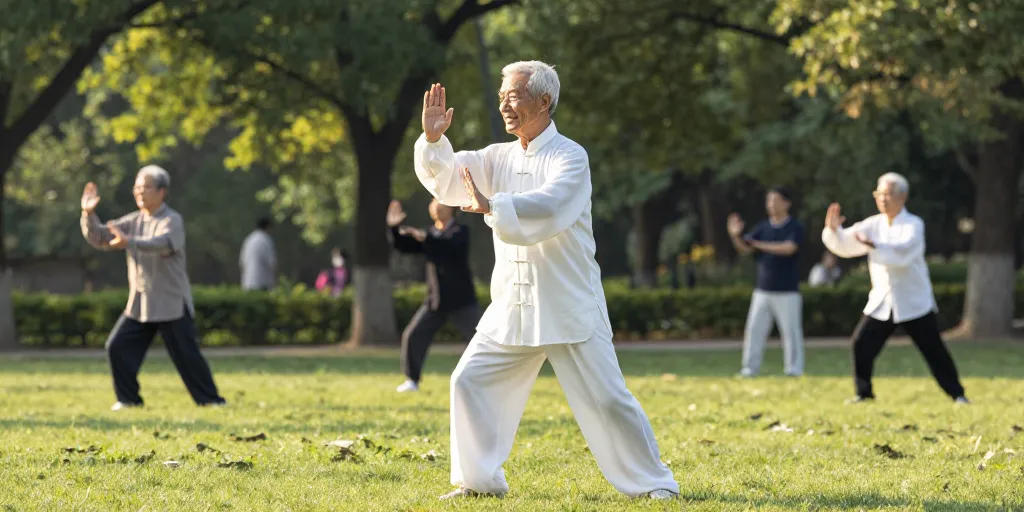
The punch is the last thing that happens in this movement, not the first. Begin with your stance. Stand with your feet a little wider than your shoulders, toes turned out about 15 degrees. Bend your knees slightly — not a deep squat. Aim for roughly a 130-degree angle at the knee, just enough that the fronts of your thighs feel a mild burn, but not so much that your legs tremble. Keep your weight centered between the soles of your feet, heels on the ground, toes lightly gripping the floor, as if you were steadying yourself on a wet stone slab.
Straighten your back without puffing out your chest. Imagine a thread gently pulling the crown of your head upward, tuck your chin slightly, and draw your tailbone a fraction inward, so your spine stands like a bamboo stalk — upright, but not rigid. Beginners usually make one of two mistakes here: they hunch forward as they punch, or they let their lower back collapse. Either way, the force never reaches the fist, because it has nowhere to travel from.
Before you punch, bring both hands to your waist in fists, palms facing up, the “eyes” of the fists — the opening formed by thumb and index finger — facing toward you, elbows tucked close to your ribs. Hold this ready position for 3 to 5 seconds and take two slow, even breaths. Feel your feet planted and your hips relaxed. Then, and only then, punch. Punching from an unsteady stance is like writing on a wobbling table: even a beautiful stroke comes out crooked.
The Punch and the Gaze: Your Eyes Lead the Fist
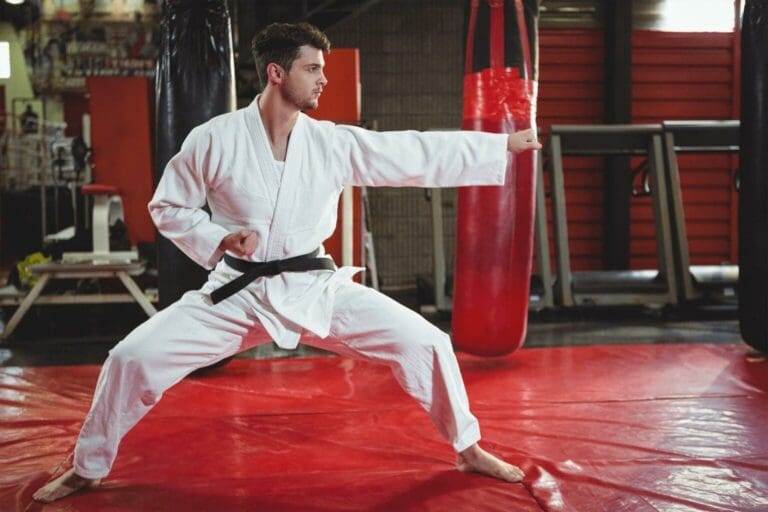
Send your left fist forward from your waist — slowly. The key word is slowly, not suddenly. Drive the fist along a straight line, level with your chest, elbow slightly bent. Keep a little bend in reserve; locking the elbow straight cuts the force off at the joint. At the farthest point, turn the fist so the palm faces down and the knuckles face forward, as if you were gently pressing a wooden board away from you rather than smashing it.
The eyes are the part most people skip, and they are the whole point of the word “glare” in the name. In traditional Chinese practice, “glaring” is not about intimidating anyone — it is about focus. Your gaze follows the fist to where it lands, settling on a point in the distance beyond it, eyes bright and concentrated, eyebrows lifting slightly. Many practitioners move the hands but leave the eyes behind, still staring at the ground. When that happens, the movement loses its spirit: the body punches, but the attention never arrives.
As the left fist goes out, the right fist returns to the waist, palm turning upward, elbow sliding back against the ribs. One left punch and one right punch make a complete round. Do 3 to 5 rounds at first; once you are comfortable, you can build up to 7. Keep the whole movement to 2 or 3 minutes: about one second to punch out, one second to pause, one second to draw back, in an even rhythm.
The fist itself deserves attention. Curl your fingers in, with the thumb pressing across the second joints of the index and middle fingers. Grip firmly but not rigidly — the old image is holding a small bird: squeeze too hard and you crush it, hold too loosely and it flies away. A death grip tires the forearms within a minute; a loose fist lets the wrist wobble on impact.
Breathing: Exhale as You Punch, Inhale as You Draw Back
Breath is the engine of this movement. Get the breathing wrong and you have only half a movement. The basic rule is simple: exhale as the fist goes out, inhale as it comes back. As the fist travels forward, breathe out slowly and evenly through your nose — long, fine, and steady, not in one sudden gust. In traditional terms, the breath rises from the dantian, the energy center just below the navel, and pushes upward in step with the fist. As the fist returns to the waist, breathe in through your nose, let the breath sink down, and feel your shoulders drop with it.
Never hold your breath to punch. It is the most common mistake in any training hall: the fist shoots out, the breath locks, the face flushes red, and the practitioner finishes dizzy. Holding your breath spikes blood pressure briefly and puts extra load on the heart — a particular concern for older practitioners and anyone with cardiovascular issues. The rule to remember: the breath travels as far as the fist does, and they arrive together and return together.
If your breathing cannot keep up with the movement, slow the movement down by half. One round per minute with calm breathing beats five rounds done breathless. After two or three weeks of practice, breath and movement start to sync on their own, and exhaling with the punch becomes instinct rather than something you have to think about.
Five Common Mistakes — and How to Fix Them
If you have practiced for months without feeling any change, you are almost certainly making one of these five mistakes.
- Shrugging as you punch. The moment you exert force, your shoulders rise to your ears and your neck disappears. The fix: before you punch, drop your shoulders — sink them down an inch, as if two bags of rice were pressing on them — and keep them perfectly still as the fist goes out.
- Only the arms move. The fist extends, but the waist and hips stay nailed in place. In fact, the force starts at the feet, travels through the waist and hips, and only then reaches the shoulders and arms. As the left fist goes out, let the waist and left hip turn slightly forward to send it. The power follows the twist.
- The eyes don’t follow the fist. You punch, but your gaze stays on the ground or wanders around the room. Before each punch, set your eyes on the direction the fist is heading, then let the eyes lead the fist there.
- Punching too high or too low. Some people punch up to chin height; others drop to navel height. The correct line is level with the chest, roughly at the height of the Shanzhong point (the center of the chest, known in acupoint theory as the “sea of qi”). Too high strains the shoulders; too low and the force disperses.
- Snapping the arm back. Drawing the fist back is not flinging your arm to your waist. It is like drawing a bowstring: slow, controlled, elbow sliding along the ribs, the arm muscles still working gently on the way in.
Don’t try to fix all five at once. Pick one per week. This week, only work on dropping the shoulders. Next week, only work on the eyes following the fist. Within a month, most of the five will be largely corrected. The biggest trap in practice is greed — one fault fixed thoroughly beats five faults practiced halfway.
How to Fit It Into Your Day: Start With 3 Minutes
This movement needs no special block of time. Practice once in the morning and once in the evening, 3 to 5 minutes each time, 3 to 5 rounds. It works even better as part of the full Baduanjin set, but it stands alone too: three minutes of standing warm-up, five rounds of punching, one minute of relaxed breathing to finish.
What should it feel like afterward? Your arms slightly warm, your waist and back mildly tired in a good way, your breathing deeper and longer than before, your mind clearer. If your shoulders ache, you feel dizzy, or your chest feels tight, something is off — in the posture or the breathing. Stop, check the five mistakes above one by one, or slow down and do fewer rounds.
It is especially friendly to people who sit at a desk all day. Eight hours in front of a computer leaves the neck stiff, the lower back weak, and the breathing shallow. Three minutes of this movement after work is like switching the power back on in the upper body. Many people who keep it up for three months report that their shoulders stiffen less easily and their arms feel stronger when lifting things. These are practitioners’ own experiences, of course — every body responds differently, and there is no reason to measure yourself against someone else’s results.
Quick Answers
How many rounds should a beginner do? Start with 3 to 5 rounds, once or twice a day, 3 to 5 minutes total. Add rounds only after your breathing stays calm throughout.
Why do my shoulders hurt after practicing? Almost always because they rise as you punch. Sink the shoulders before every punch and keep them down; if the ache persists, reduce the reps and check that your punch stays at chest height.
Is the “glare” really necessary? Yes — but think focus, not fury. The gaze directs your attention to the end of the punch; without it, the movement is just arm exercise. Keep the eyes relaxed and the gaze steady, never strained.
Can I practice this movement on its own? Absolutely. It works as a standalone 3-minute routine, though pairing it with the full Baduanjin set gives the breathing and stance work more context.
When will I notice a difference? Shoulder and upper-back ease can show up within a few weeks; the coordination of breath, eyes, and waist takes longer — usually a month or two of steady practice. Anyone promising instant results is selling something.
Three ideas carry the whole movement: stand firm at the feet, let the eyes lead the fist, and match the breath to the punch. The stance is the foundation — it decides whether force can travel from the floor to the fist. The gaze is the direction — it decides whether the movement keeps its spirit. The breath is the engine — it decides whether you finish refreshed or dizzy. Get those three right, and you have truly begun.
Start today: find a clear patch of floor, stand with your feet set, fists at your waist. Send the left fist out slowly, follow it with your eyes, breathe out; draw it back, breathe in. Do 3 rounds. Remember: drop the shoulders, don’t hold your breath, eyes on the fist. Same time tomorrow, 3 rounds again. After two weeks, when the speed and breathing fall into step, build up to 5 rounds. This kind of practice never rewards rushing — only showing up.
Safety note: Practice within your limits and keep every movement comfortable, never forced. If you have high blood pressure, heart disease, a neck or spinal condition, or you are taking medication, talk to your doctor before starting. Stop immediately and rest if you feel dizzy, short of breath, chest tightness, palpitations, or joint pain, and seek medical care promptly if symptoms persist or worsen. This article is cultural and educational information about a traditional practice. It makes no promise of health benefits and is not a substitute for medical advice.