You have just finished a hot pot dinner. Your stomach feels like an overinflated balloon, and no matter how you sit or stand, the pressure will not go away. Then a friend reaches over and presses a spot on the outside of your lower leg a few times — and slowly, the bloating starts to ease. The spot he pressed was almost certainly Zusanli.
Zusanli, known in English as ST36 (Stomach 36), is one of the most widely used acupressure points in traditional Chinese medicine. It sits on the Stomach meridian, a channel in Chinese medical theory that runs along the front of the body and is associated with digestion. For centuries, people in China have pressed this point for bloating, poor appetite, and tired legs. You do not need any equipment or training to try it — just your thumb, five minutes, and the ability to find the right spot. This guide shows you how.
Finding Zusanli: Three Cun Below the Knee, One Finger Off the Shin
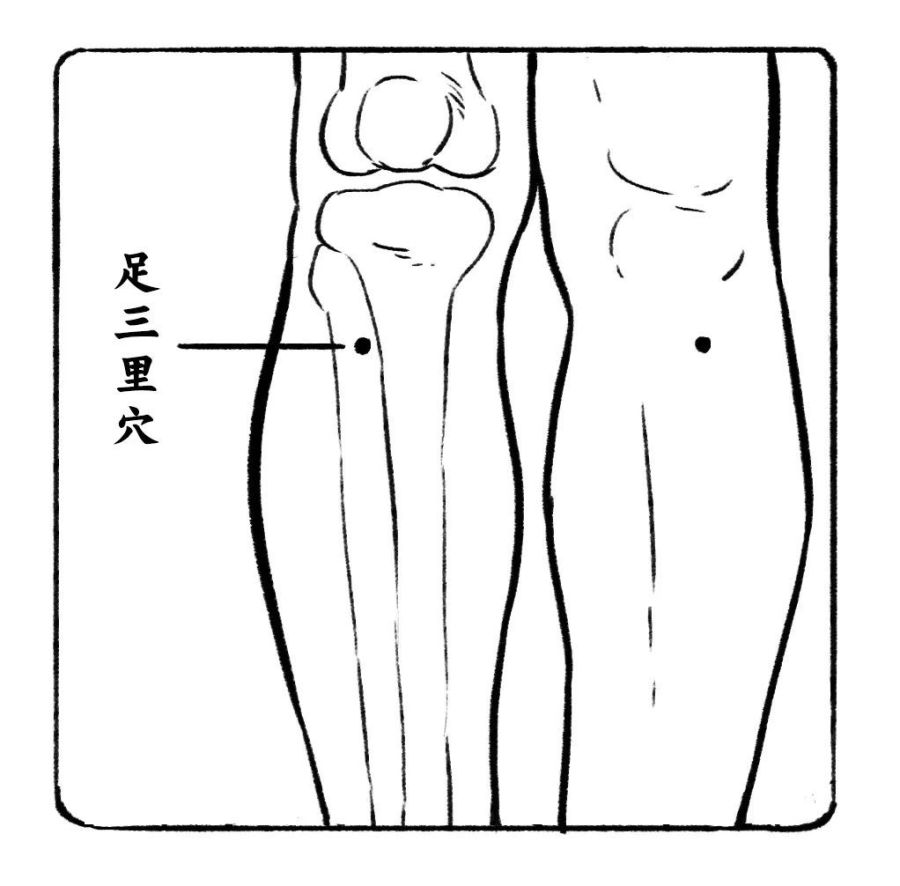
Zusanli sits on the outer front of the lower leg. Sit down and bend your knee to about 90 degrees. Feel for the bony bump just below the kneecap — this is called the “Dubi,” the hollow on the outer side of the knee. From there, measure three cun downward. The point lands roughly just below the widest part of the calf.
A cun is a traditional Chinese unit of body measurement, not a fixed number of centimeters. The easiest way to find three cun is the “four-finger method”: press your index, middle, ring, and little fingers together — the width of those four fingers is roughly three cun on your own body. Your hand is your ruler, and because it scales with your body size, it works whether you are tall or short.
Once you have the height, slide one thumb-width outward from the shin bone. The shin bone has a hard ridge running down the front of the leg; move one thumb’s width to the outside of that ridge. Press down and you should feel a muscle. Flex your foot upward and the muscle bulges — the sorest, most tender spot there is the point. There is one on each leg, so find both.
Most beginners land on the bone itself. If pressing feels hard and sharply painful, you are too close to the bone — shift half a finger outward and try again. The right spot feels sore, heavy, and slightly tingly, like pressing on a taut cord. It should never feel like a sharp stab.
What It Can Help With: Everyday Digestive Moments
In Chinese medicine, Zusanli is sometimes called the “longevity point,” because it is the most direct point for supporting the stomach and spleen — the spleen, in this tradition, refers to the digestive function rather than the anatomical organ alone. It is not a cure for anything. It is a small, practical tool for the everyday moments when your digestion feels off. Three situations come up most often.
The first is overeating. After a big meal — a holiday dinner, a buffet, a hot pot night — your stomach feels stuffed and you cannot quite burp. Press and rub Zusanli for three to five minutes, and many people let out a belch or two and feel the pressure drop. The second is a weak appetite. If you have gone several days with little interest in food and everything tastes bland, try pressing the point about half an hour before a meal; some people find they eat noticeably more at the next sitting. The third is heavy, tired legs. After a full day of sitting, your calves feel sore and swollen. A few minutes of rubbing before bed can make them feel lighter.
People with weak digestion often notice another pattern: loose stools, or a sticky feeling in the mouth when they wake up. Zusanli is not medicine, and a few days of pressing will not fix those things. But press it daily for two or three weeks alongside regular meals, and many people report their digestion feels a little more “solid” — less sluggish, more reliable. Long-distance drivers and office workers who live on takeout are the people who get the most out of making this a daily habit.
One line matters more than the rest: this point is for functional, everyday discomfort. Severe stomach pain, vomiting blood, black stools, or losing more than five kilograms in a short time are not “press it and see” situations. See a doctor.
How to Press It: Three Techniques
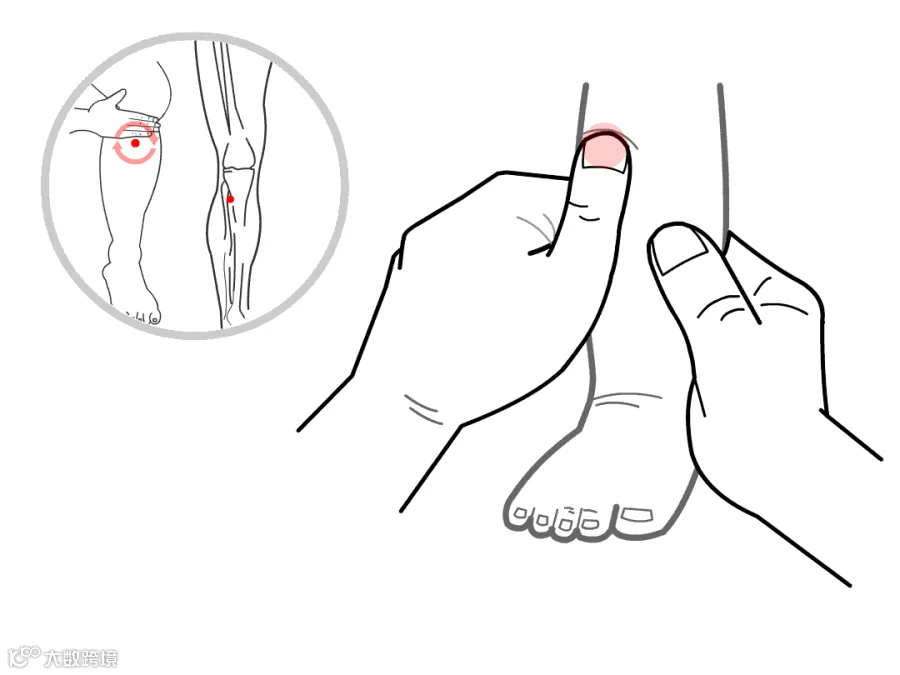
The most basic technique is steady thumb pressure. Place the pad of your thumb — the fleshy part, not the tip — on the point and press slowly until you feel that sore, heavy sensation. Hold for five seconds, then release slowly. Repeat eight to ten times. The advantage is control: the pressure builds gradually, so beginners rarely hurt themselves. Keep your nails short, and use the pad of the thumb, not the nail edge.
The second technique is circular rubbing. Keep your thumb on the point and make small circles, thirty clockwise and then thirty counterclockwise, at about one circle per second. Rest your palm lightly on the calf for support and keep your shoulder relaxed — do not wrestle with your fingers alone. Rubbing suits bedtime best. Pair it with slow breathing, and afterward the calf often feels warm, a sign that local blood flow has increased.
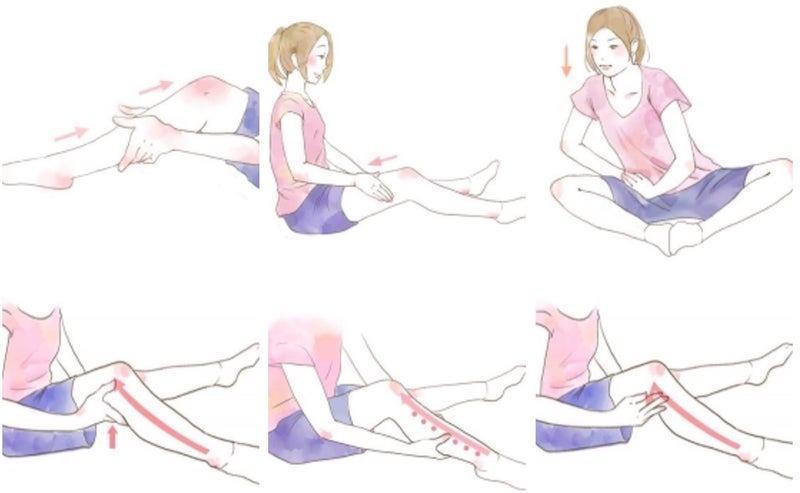
The third is a combination: ten presses, then one minute of rubbing, alternating for three rounds — about five minutes in total. Sitting is the easiest position. Sit in a chair, cross one leg over the other, and your thumb will land right on the point. You can also sit cross-legged on a bed. Standing is not recommended: it is hard to apply steady pressure, and you end up leaning your weight to one side.
Moxibustion — warming the point with a burning mugwort stick held about three centimeters above the skin — is also a traditional method. The warmth should feel comfortable, never burning, for ten to fifteen minutes. If you have no experience with it, have someone with you the first time, move the stick away the moment the skin turns red, and never let it blister. This guide describes the method only; it does not recommend any specific product.
Frequency and Pressure: Five Minutes a Day Is Enough
For general self-care, once a day is enough: three to five minutes per leg, no more than ten minutes for both. Wait at least half an hour after eating — pressing right after a meal can make bloating worse. Pressing before bed helps many people relax; if you feel sleepy afterward, that is normal.
Pressure comes in three levels. Light means “I can feel it, but it does not hurt” — the right starting level, and the best choice for sensitive skin. Medium means “clearly sore, but tolerable” — the level most people use daily. Afterward the skin around the point turns slightly pink and warm, fading within half a minute. Strong means “intensely sore, almost painful” — only for people with high tolerance, and not every day; two or three times a week is plenty. If the skin bruises, or the spot still hurts half a day later, the pressure was too much. Halve it next time.
Consistency beats intensity. Pressing hard once in a while for a month achieves less than five gentle minutes every day for two weeks. Attach the habit to something you already do — after brushing your teeth, after soaking your feet — so it becomes part of the routine. It also helps to keep a short note: did the bloating ease today, did your appetite improve? Two weeks later, that note is a far more honest record than memory.
Who Should Be Careful
Pregnant women should be cautious. Zusanli is traditionally believed to promote the movement of qi and blood, and pressing it during pregnancy — especially in the first trimester — may carry unnecessary risk. Ask an obstetrician first. Never press directly on broken skin, an eczema flare-up, or an area with prominent varicose veins; work around the affected skin instead.
People with high blood pressure or heart conditions should use only light pressure and keep each session under three minutes. If you feel dizzy or your heart races while pressing, stop immediately. People with diabetes often have reduced feeling in their feet and legs, which makes it easy to press too hard without noticing — use the lightest pressure, or ask a family member to watch the skin for redness or bruising.
Timing matters too. Do not press right after a meal, after drinking alcohol, or immediately after intense exercise. After eating, blood is concentrated in the stomach, and pressing the leg can make discomfort worse. After drinking, your skin feels less, so the risk of pressing too hard or burning yourself with moxibustion goes up. After exercise, the muscles are already flushed with blood, and extra rubbing tends to make soreness worse, not better.
Acupressure is not a cure-all. It can ease functional bloating, a poor appetite, and heavy legs, but it cannot replace regular meals or a doctor. If two weeks of daily pressing brings no improvement, or if symptoms keep getting worse, get checked — do not spend your time on self-massage while a real problem goes undiagnosed.
Quick Answers
How do I know I found the right spot? Pressing it should feel sore, heavy, and slightly tingly — never sharp. If it feels hard and stabbing, you are on the bone; shift half a finger outward. Flexing your foot should make the muscle under your thumb bulge.
How long before I notice anything? Bloating relief can come within minutes of a session. Appetite and general digestion changes usually take one to two weeks of daily practice. Anyone promising overnight results is overselling it.
Can I press it every day? Yes — light to medium pressure, once a day, five minutes per leg, is a sustainable routine. Strong pressure should be limited to two or three times a week.
Does it matter which leg I do first? No. Do both legs, one after the other. Most people find one side is more tender than the other; that is normal and not a sign of a problem.
Can I do it at work? Yes. Sitting in a chair with one leg crossed over the other is discreet enough for an office, and five minutes fits into a lunch break — just wait half an hour after eating.
The Three Numbers to Remember
Three cun below the knee, one finger-width outside the shin, five minutes a day. That is the whole method. Try it tonight before bed: sit down, cross your leg, find that sore spot, press ten times, rub for a minute, then switch legs. Stand up, take a couple of steps, and notice whether your calves feel warm and your stomach feels a little looser.
If it feels good, make it a habit — half an hour after dinner or before bed, once a day, for two weeks. Then look back at your appetite and bloating and judge for yourself. Your body keeps the most honest record.
Disclaimer: This article is for general information only and is not a substitute for medical advice. It does not promise any therapeutic effect. If you are pregnant, have broken skin, or live with a serious medical condition, use caution or consult a doctor first. Seek medical care promptly if you experience severe pain, persistent discomfort, or worsening symptoms.