At 6:30 on a quiet morning, in an open space behind a housing block, a 60-year-old man named Lao Chen plants a two-meter waxwood staff on the ground. The tip reaches exactly to his eyebrows. He grips it with one hand in front and one behind, steps forward and back, and the tip whistles past the grass less than a hand’s width above the ground. Three blades of grass snap cleanly. A young onlooker asks how long he has been training. Lao Chen laughs: “The staff does not care about your age. It only cares about thirty minutes of honest practice every day.” The long staff, known in Chinese as changgun, is one of the easiest long weapons in traditional Chinese martial arts to pick up. But if your grip, your strikes, or your footwork is wrong in even one place, you can train for six months and still never feel the whole-body power that makes staff work look effortless. This guide covers the fundamentals so your first session already feels right.
Start With the Right Staff
In Chinese martial arts, the long staff is a straight wooden pole, usually between 1.7 and 2 meters long, wielded with both hands. Unlike a walking stick or a short baton, it is a two-handed weapon: its power comes from the distance between your hands and the leverage that distance creates. Choosing the right length is the first decision, and there are two simple rules. Stand the staff upright on the ground: the tip should reach roughly to your eyebrows. Or, as a shortcut, pick a staff about as tall as you are. A person who is 170 centimeters tall will usually feel most comfortable with a staff between 170 and 175 centimeters. Someone over 180 centimeters can go up to about 190 centimeters. Too long, and the tail end will clip your own body when you turn. Too short, and you lose the very thing that makes a long weapon special: the reach advantage summed up in the old saying “an inch longer, an inch stronger.”
For material, beginners should start with waxwood, a pale, springy wood that bends slightly under force instead of snapping. Rattan is lighter but softer and less crisp. Do not start with heavy solid hardwood: it tires the wrists, and impact shock travels straight into the web of your thumb. The diameter should be about 2.5 to 3 centimeters, slim enough that your fingers can wrap around roughly two-thirds of the circumference when you grip it with one hand.
When you buy a staff, do three checks before you train with it. First, run your hand slowly along the whole shaft, feeling for cracks, insect holes, and splinters. Second, hold both ends and bend it gently, listening for any cracking sound. Third, sand down any rough spots with fine sandpaper. A staff with a crack is not a bargain, no matter how cheap it is. Under force, a cracked tip can break off and fly away like a projectile.
The Grip: Yin-Yang Hands and Shoulder-Width Spacing
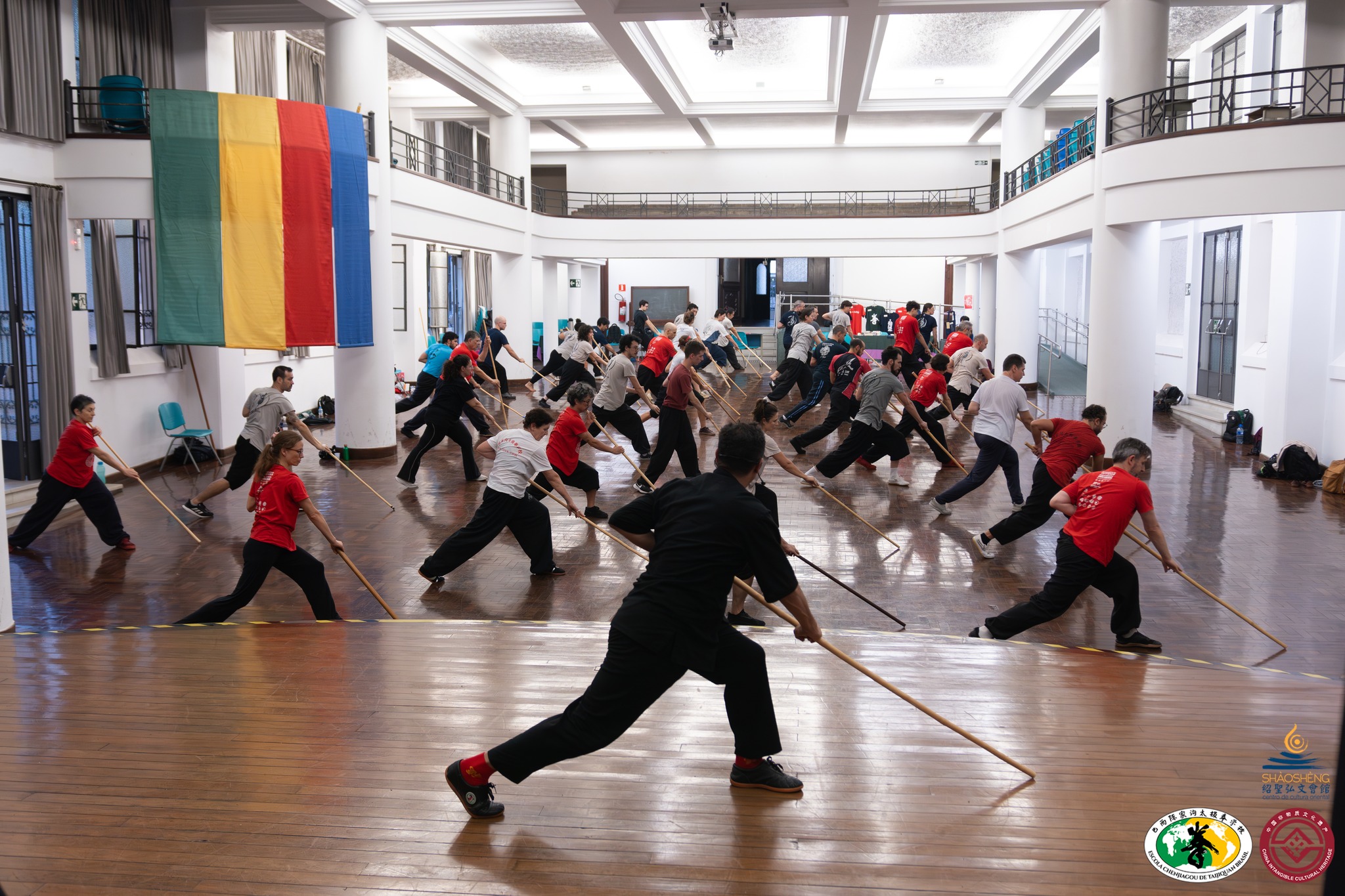
The standard grip for the long staff is called the yin-yang grip. Yin and yang, the paired opposites in Chinese philosophy, here describe two hands working in opposite directions: one palm faces down and the other faces up, so the hands twist against each other like wringing out a towel. That opposing twist is what keeps the staff from spinning or slipping in your hands. In practice, if your right hand is in front, it grips palm-down, while your left hand behind holds palm-up near the tail end. The distance between your hands should be about shoulder width, roughly 40 to 50 centimeters.
Hand spacing is where most beginners go wrong. Grip too wide, and the staff becomes stiff and hard to turn. Grip too narrow, and your strikes land soft and limp. Shoulder width is the sweet spot: wide enough for leverage, narrow enough for quick direction changes. Spend your first few sessions just holding the staff until this spacing feels natural, before you worry about speed.
Four Core Techniques: Master One Per Day
The long staff has dozens of named techniques, but a beginner only needs four: the downward chop, the low sweep, the straight thrust, and the deflecting parry. A good daily routine is 100 repetitions of a single technique, so that four techniques practiced across four days make a complete morning workout. Learn each one slowly before chaining them together.
The Downward Chop: Power From the Ground Up
Raise the staff overhead with the tail end pointing up and back, then drive it down like an axe, aiming at a spot about one meter in front of you on the ground. The key mistake is swinging with the arms alone. Real power comes in a chain: your feet push off the ground, your waist twists, and your hands follow through, so that three forces arrive as one. When you practice on open ground, listen to the sound of the tip cutting the air. The crisper the whistle, the more unified your power.
The Low Sweep: A Wide, Ground-Hugging Arc
Drop into a slight crouch, hold the staff level about 20 centimeters above the ground, and let your waist drive your arms so the shaft sweeps a wide semicircle. The sweep trains the coordination of waist and stance: if your legs stay still and only your arms swing, the staff floats weakly through the air, but the moment your waist turns and your stance sinks, the tip starts to hum. A useful drill is to set three water bottles on the ground and sweep them down in sequence, one after another, which trains the smooth, continuous waist power the technique depends on.
The Straight Thrust: Speed In, Speed Out
Loosen the front hand and push with the back hand, sending the tip straight forward to a point about two meters ahead. The rule for the thrust is simple: out fast, back faster. Never let the tip linger outside after you strike. Hang a cloth target about the size of a fist from a tree and thrust at it 50 times a day, aiming to hit the center at least 40 times. As your hit rate climbs, your hand-eye coordination sharpens on its own.
The Deflecting Parry: Soft Defense, Fast Counter
When an opponent’s staff comes at you, do not meet it head-on. Instead, use the middle of your own shaft to nudge the incoming strike aside by about 30 degrees, then ride that momentum straight into a chop or thrust of your own. The parry should be small and clever, not big and forceful: the smaller the deflection, the faster your counterattack. For safe partner practice, one person attacks slowly while the other only parries, starting at about 20 exchanges per minute and building gradually to 40. This is the safest way for beginners to experience partner work.
Footwork: Horse Stance and Bow Stance Are the Root
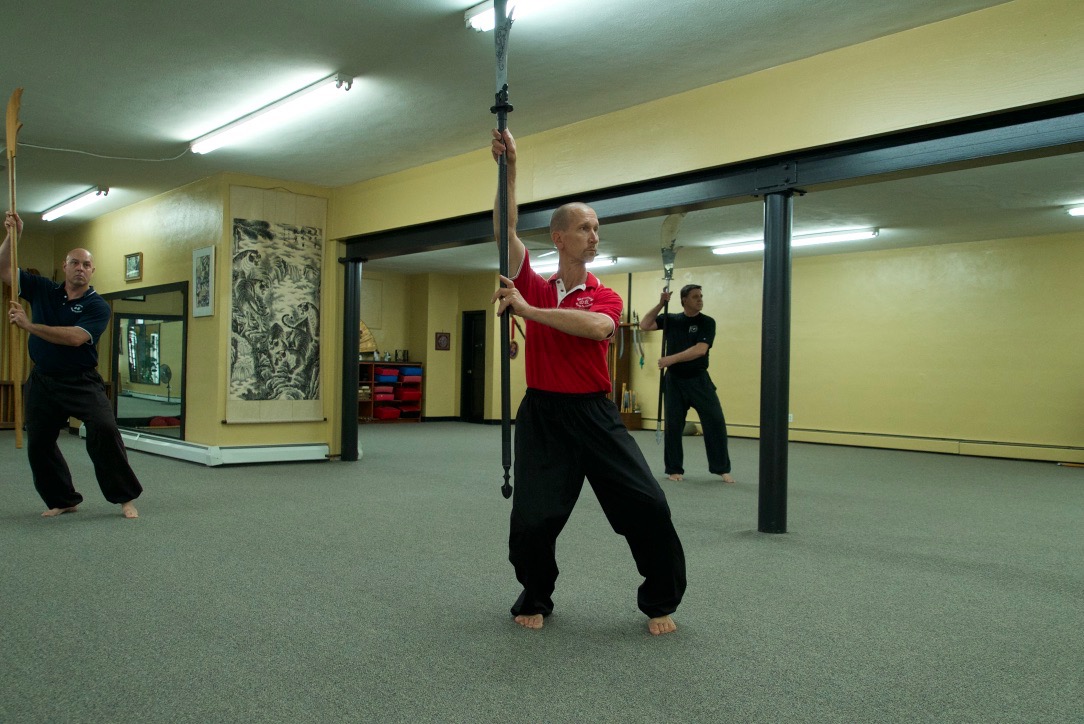
Beautiful staff technique means nothing if your feet are unstable. Beginners should master two stances first. The horse stance, or mabu, is a wide, square stance: feet parallel, about two and a half shoulder-widths apart, knees bent until the thighs are nearly level, as if you were riding a horse. The bow stance, or gongbu, is a long forward stance: one leg bent in front, the other straight behind, feet about one and a half steps apart, with roughly 70 percent of your weight on the front leg.
Each technique pairs naturally with a stance. The downward chop pairs with the bow stance: the front leg drives, the body surges forward, and the staff borrows that forward momentum. The low sweep pairs with the horse stance: the center of gravity drops, the waist turns, and the shaft can trace its circle close to the ground. The thrust pairs with a forward step: the front foot slides ahead and the tip travels with the body. The parry pairs with a retreating step: the back foot pulls back half a step to absorb force before you turn and counter.
A practical daily routine: hold the horse stance for 3 minutes, hold the bow stance for 30 seconds on each side, and repeat for 3 sets. Then practice walking drills, one step and one strike, moving 20 meters forward and 20 meters back, for 3 sets. After two weeks, your leg strength, coordination, and steadiness with the staff will all improve noticeably.
A Four-Week Beginner Plan
Week one is grip and stances only, 20 minutes a day. The goal is a correct grip and stable stances, nothing more. In week two, add the downward chop and the low sweep, 30 minutes a day, 100 repetitions of each. Slow is fine; getting the path of the movement right matters more than speed. In week three, add the thrust and the parry, still 30 minutes a day, cycling through all four techniques and beginning to coordinate them with footwork, one step per strike. In week four, string all four techniques into one flowing sequence, chop, sweep, thrust, and parry, and practice 10 full rounds a day, plus slow partner parry drills with a training partner.
Three Safety Rules You Must Never Break
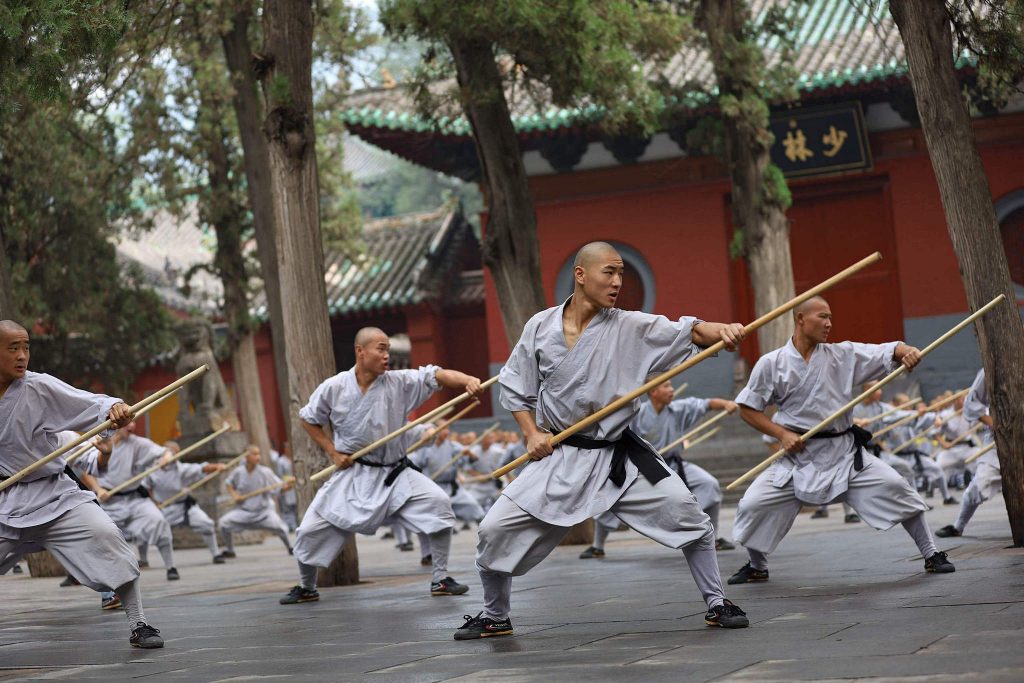
First, train in open space. Keep at least 3 meters of clear ground in every direction, away from people, parked cars, glass windows, and clotheslines. The arc of a staff tip is much larger than most beginners expect. Second, inspect the staff before every session. If you find a crack, a loose section, or a splinter, stop using it immediately and do not gamble on it holding. Third, never point or swing a staff at another person, not even slowly, and not even with their permission. One mistake can cause a serious injury. Partner practice should cover parrying only, never full-contact strikes.
Warm up for 10 minutes before training: loosen the wrists, shoulders, waist, and knees, and stretch the inner thighs, the most common strain site in the horse stance. Cool down for 5 minutes afterward. If you have an old injury or unstable blood pressure, check with a doctor first, and keep the intensity at a light sweat, not gasping for breath.
Quick Answers
How long should my first staff be? About eyebrow height when stood on the ground, or roughly your own height. For a 170-centimeter person, 170 to 175 centimeters is a good starting point.
What wood should a beginner choose? Waxwood. It flexes under force instead of snapping, which is forgiving while you are still learning control. Avoid heavy hardwood until your wrists are stronger.
What is the yin-yang grip? A two-handed grip with one palm facing down and the other facing up, so the hands twist against each other and lock the staff in place. Keep the hands about shoulder width apart.
Which four techniques should I learn first? The downward chop, the low sweep, the straight thrust, and the deflecting parry. Practice 100 repetitions of one technique per session, then combine them in week four.
How much time does it take to feel real progress? About four weeks of daily practice. Lao Chen’s advice holds: thirty minutes a day of patient repetition beats occasional bursts of hard training. Stick with it for a month, and the staff stops feeling like an object in your hands and starts feeling like an extension of your body.
Your first step is simple: pick a staff that matches your height, check it for cracks, sand it smooth, and find open ground. Hold a horse stance for 3 minutes, then practice 30 downward chops. Note how it felt, and compare next time. Small, steady corrections are how real skill is built.
Safety note: Always practice in an open area, wear non-slip sports shoes, and consider protective gear when training with a partner. Check the staff for cracks before every session, never swing it toward another person, train within your own limits, progress gradually, and stop immediately if you feel pain or discomfort.