It was 2 a.m. in a hotel room, and Xiao Lin was wide awake on a business trip. Her chest felt tight, her stomach kept churning upward, and even though she was exhausted, sleep would not come. Then she remembered something her grandmother used to say. She held out her left hand, found the spot between the two tendons on the inside of her wrist, and rubbed it slowly with her thumb for three minutes. The tight, bloated feeling eased a little, and her body finally began to settle. That spot is Neiguan, known in acupuncture as PC6.
Neiguan (PC6) is an acupoint on the Pericardium meridian. In traditional Chinese medicine, a meridian is a pathway through which vital energy, called qi, is believed to flow through the body, and an acupoint is a specific point along that pathway where stimulation is thought to influence the related organ system. You do not need to believe in the theory to use the technique, though: millions of people press this point simply because it gives them a practical, drug-free way to calm nausea, tension, or a racing mind.
Where Is Neiguan? The Three-Finger Method
Neiguan sits on the inner side of the forearm, on the center line, about two cun above the wrist crease. A cun is a traditional Chinese unit measured using your own fingers, so it scales to your body size. Forget rulers. Your own three fingers are the measuring tool.
Find It in Three Steps
- Turn one palm upward and let the wrist relax. Do not tense it.
- Place the index, middle, and ring fingers of your other hand together, flat against the inner wrist, starting at the wrist crease and moving upward.
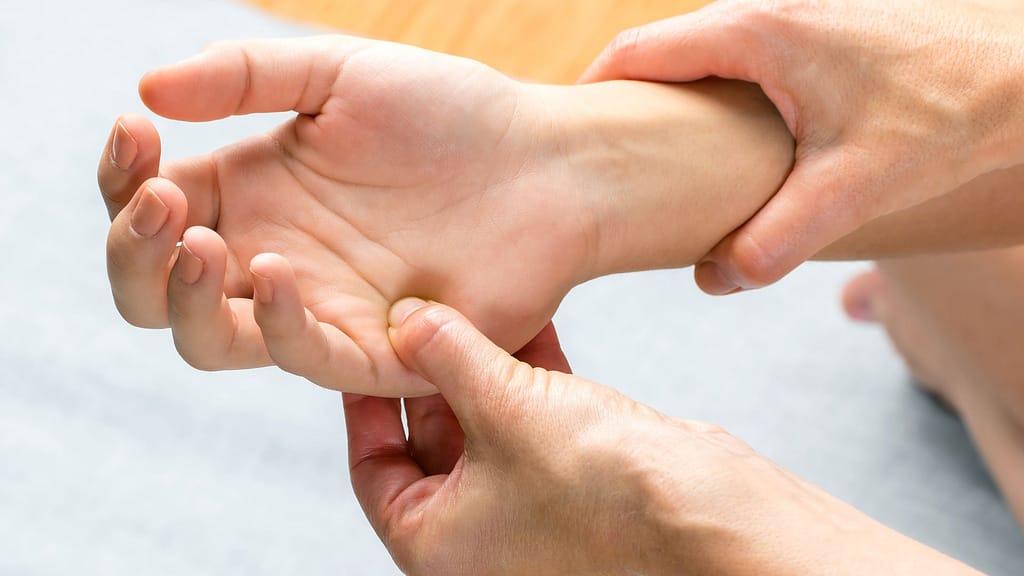
- The point is at the center of the upper edge of those three fingers, in the dip between the two large tendons. Press gently and you should feel a mild soreness, heaviness, or tingling. That is Neiguan.
There is one on each wrist, and either side works. Use whichever hand feels more natural, because the hand you reach for easily is the one you will actually keep using.
The most common beginner mistake is tensing the wrist. When the wrist is stiff, the two tendons bulge and hide the dip between them. Rest your wrist on your knee or a table, let your fingers curl naturally, and the hollow will show itself. The sensation is your best check: the right spot gives a dull ache or fullness, while a spot that is off target gives only surface pressure pain. Noticeable soreness without sharp pain means you have found it.
How to Press It: Pressure, Duration, and Frequency
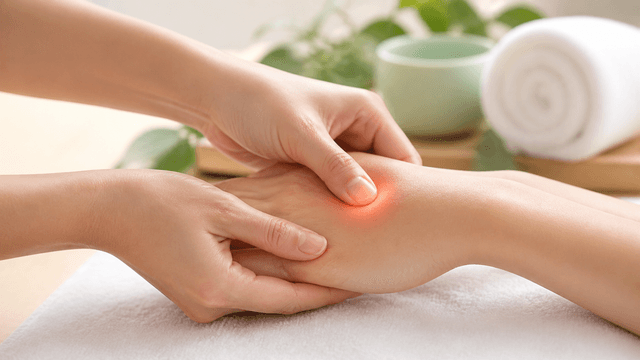
The most common method is thumb kneading. Press the pad of your opposite thumb onto the point, starting light and gradually increasing pressure until you feel that characteristic soreness. Do not force it from the start. Move in small circles, about one to two circles per second, with a circle roughly one centimeter across. Big, sweeping circles are unnecessary.
Aim for three to five minutes per hand, so six to ten minutes for both hands together. Shorter than that, and the effect is often too faint to notice. Longer than ten minutes on the same spot, and the skin can turn red or go numb, which defeats the purpose. Once or twice a day is a good rhythm: once after waking up, and once before bed. A fixed time turns it into a habit instead of something you only remember when you already feel awful.
Two Low-Effort Alternatives
- Knuckle pressing: Make a fist and press the knuckle of your index finger into the point. Hold with slowly increasing pressure for ten seconds, release, and repeat about ten times. This suits people whose thumbs tire quickly.
- A smooth round tool: Use the rounded cap of a pen or a massage stick with a smooth, round head. The head must be free of edges or corners, and the pressure should still stop at that same feeling of soreness.
Breathing makes a real difference. Inhale as your finger eases off slightly, exhale as you press a little deeper, and pause for a few seconds after every three breaths before continuing. Many people hold their breath without realizing it while they press, which only adds tension. Keep breathing.
When to Use It: Five Everyday Situations
Motion sickness. This is the situation most people think of first. Press for three minutes about ten minutes before you get in the car or board a boat, and press again for two minutes when nausea starts during the ride. Frequent travelers often find it helps to make this part of the boarding routine: sit down, press for a while, then set off.
Nerves and a racing heart. Before a meeting, an exam, an interview, or a public talk, when your palms are sweaty and your heart is beating fast, step somewhere quiet five minutes early and press Neiguan while breathing slowly. The tension often loosens enough to let you think clearly again.
Sleepless nights. After a late night or on a night when sleep will not come, press each hand for three minutes in bed. Focus on your breath and the soreness under your thumb, and the thoughts circling in your head tend to recede. Many people turn this into a bedtime ritual: press, switch off the light, and fall asleep more easily than usual.
Overeating and bloating. When you have eaten too much and your stomach feels stuck, or when hiccups will not stop, press for three minutes while seated. Wait until about half an hour after the meal, not immediately after eating, and use lighter pressure than usual.
Tired wrists at a desk. Office workers who spend hours at a keyboard often get achy wrists. Pausing for two minutes of Neiguan pressing during a work break moves the wrist, breaks the tension, and clears the mind better than pushing through fatigue.
When Not to Press: Cautions and Limits
Some situations call for skipping the point entirely. If your wrist has a cut, swelling, a sprain, or a fracture that has not healed, do not press on the injured area. Wait until it has recovered. The same applies if the skin is broken or if eczema or an allergic rash is flaring up there.
Pregnant women should be especially cautious with acupoint pressing. The body changes a great deal during pregnancy, so do not press any point for a long time on your own without asking a doctor first. People with heart disease, high blood pressure, or other chronic conditions should also know the boundary: if chest pain worsens, breathing becomes difficult, or the heartbeat feels clearly abnormal, do not try to ride it out with pressing alone. Seek medical care right away.
Pressure and duration have limits, too. Mild redness that fades within a few minutes is normal. Bruising, lasting pain, or numbness that continues for more than half an hour means the pressure was too strong or the session too long, so go lighter and shorter next time. Pressing is a daily self-care technique, not a substitute for medicine or treatment.
Two small practical details are easy to miss. Trim your nails before pressing, or a long nail can scratch the skin. And take off your watch or bracelet first, so nothing digs into the wrist while you locate the point.
A One-Week Plan to Start Today
Finding Neiguan is easy. Sticking with it is the hard part. Try a simple one-week plan: press once before bed every night, three minutes per hand, for seven days, and notice what changes. On day one, success is simply finding the sore spot. From day two, treat the bedtime session like brushing your teeth, something that happens at the same time every day. By day seven, look back and ask whether falling asleep felt a little smoother, and whether you now have a tool you can reach for the moment tension hits.
Three numbers are all you need to remember: three finger-widths above the wrist crease, three to five minutes per session, once or twice a day. The only tool is your own thumb. It costs nothing, takes up no space, and is always with you, whether you feel carsick, nervous, or unable to sleep.
Quick Answers
- Where exactly is Neiguan (PC6)? On the inner forearm, three finger-widths above the wrist crease, in the dip between the two tendons on the center line.
- How long should I press it? Three to five minutes per hand, once or twice a day.
- What should it feel like? A dull soreness, heaviness, or tingling. Sharp pain means you should ease off or recheck the location.
- When does it help most? Motion sickness, pre-event nerves, sleepless nights, post-meal bloating, and tired wrists from desk work.
- When should I skip it? If the wrist is injured or the skin is broken, during pregnancy without medical advice, or whenever chest pain, breathing difficulty, or abnormal heartbeat appears.
Disclaimer: This article is for general health information only. It does not promise any therapeutic effect and is not a substitute for professional medical advice. If you experience persistent discomfort, worsening pain, or a flare-up of an existing condition, please seek medical care promptly and follow your doctor’s guidance.