Xiao Lin stared at his BaZi chart the first time he got one. Eight characters arranged in four columns, surrounded by columns labeled luck cycles, ten gods, and hidden stems. He understood none of it, so he folded the paper and tucked it into his pocket.
That chart is far less mysterious than it looks. It is simply a coordinate system that records a birth time using the Heavenly Stems and Earthly Branches, an ancient Chinese way of marking time. Once you understand its structure, you can read any chart column by column and know exactly what each section is saying. This guide walks you through it from scratch.
The Four Pillars Are Four Time Coordinates
BaZi literally means “eight characters.” In Chinese tradition, a person’s birth year, month, day, and hour are each written as a pair of characters, giving four pairs, or “pillars,” and eight characters in total. The Year Pillar marks the birth year, the Month Pillar the birth month, the Day Pillar the birth day, and the Hour Pillar the birth hour. Together, the four pillars pin down one single moment in time.
Take an example chart: Year Pillar Jia-Zi, Month Pillar Bing-Yin, Day Pillar Wu-Chen, Hour Pillar Ren-Xu. Traditional layouts read right to left, while modern apps usually read left to right. The content is identical either way, so do not worry about direction. What matters is that each pillar is made of one Heavenly Stem on top and one Earthly Branch below.
The most important character in the whole chart is the stem of the Day Pillar, traditionally called the Day Master. Chart apps usually highlight it, because everything else, from the balance of the Five Elements to the ten gods described below, is analyzed relative to the Day Master. Once you lock onto this reference point, the rest of the chart starts to make sense.
Stems and Branches: A Sixty-Year Cycle Code
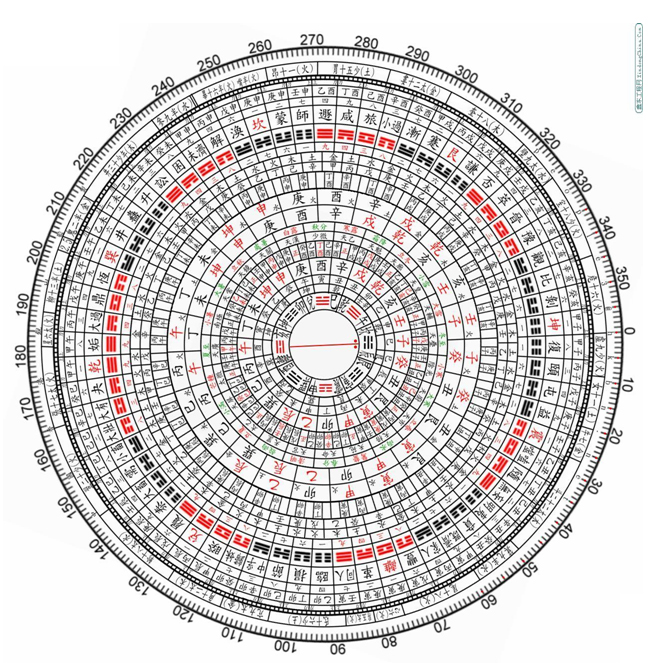
There are 10 Heavenly Stems: Jia, Yi, Bing, Ding, Wu, Ji, Geng, Xin, Ren, and Gui. There are 12 Earthly Branches: Zi, Chou, Yin, Mao, Chen, Si, Wu, Wei, Shen, You, Xu, and Hai. Stems and branches pair up in order, one stem with one branch, and a full cycle runs through 60 combinations. This is the famous “Sixty Jia-Zi” cycle, a system that has marked years, months, days, and hours in China for over two thousand years.
Because the cycle repeats every 60 years, a year combination eventually comes back around. The year 1984 was a Jia-Zi year, and 60 years later, 2044 will be a Jia-Zi year again. The Month Pillar follows the solar terms rather than the lunar calendar: each month pillar covers one solar-term month beginning with the Start of Spring, not the first day of the lunar month. This is the detail beginners get wrong most often.
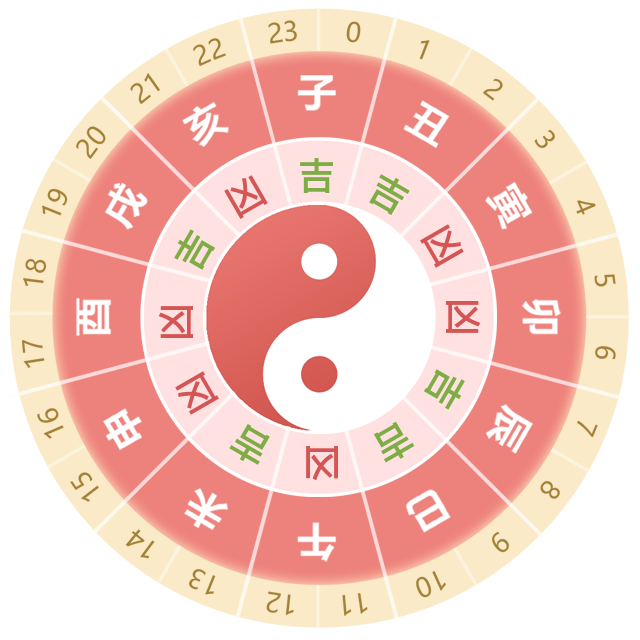
The Hour Pillar divides the day into 12 two-hour periods. Zi hour runs from 11 p.m. to 1 a.m., Chou hour from 1 a.m. to 3 a.m., and so on. If a birth time falls right on the boundary between two periods, a difference of a few minutes can change the Hour Pillar, so the more precise the birth time, the more reliable the chart.
Each Earthly Branch also contains hidden stems, called “hidden stems” in chart terminology. For example, Yin contains Jia, Bing, and Wu, while Chen contains Wu, Yi, and Gui. Charts often list one to three hidden stems beneath each branch. They matter when analyzing the distribution of the Five Elements, but beginners can safely skip them on a first read and come back to them later.
Reading the Five Elements and the Ten Gods
Every stem and branch corresponds to one of the Five Elements, known in Chinese as Wu Xing: Wood, Fire, Earth, Metal, and Water. The stems divide neatly: Jia and Yi are Wood, Bing and Ding are Fire, Wu and Ji are Earth, Geng and Xin are Metal, Ren and Gui are Water. The branches follow the same system: Zi is Water, Wu is Fire, Yin and Mao are Wood, Shen and You are Metal, and Chen, Xu, Chou, and Wei are Earth. Convert all eight characters into elements and you can count how many of each element a chart holds.
Using our example chart, Jia-Zi, Bing-Yin, Wu-Chen, Ren-Xu: Wood appears in Jia and Yin, Fire in Bing, Earth in Wu, Chen, and Xu, Water in Zi and Ren, and Metal does not appear at all. Counting the elements gives you an immediate picture of which elements are abundant and which are missing, the most basic step in traditional chart analysis.
The “ten gods” are relationship labels assigned to the other seven characters, with the Day Master as the center. Characters of the same element and same polarity as the Day Master are called “Friend,” those of the same element but opposite polarity are called “Rob Wealth,” those that support the Day Master are “Resource,” those the Day Master generates are “Output,” those that control the Day Master are “Power,” and those the Day Master controls are “Wealth.” Each label is a traditional metaphor describing how the elements interact, a bit like roles in a family or a workplace.
You do not need to memorize the ten gods by heart. First identify the Day Master, then ask how each other character relates to it: same as me, supporting me, generated by me, controlling me, or controlled by me. The label follows naturally from the answer. Most apps print the labels directly on the chart, so reading a few sample charts side by side with this guide is enough to get comfortable.
Luck Cycles: A Ten-Year Clock That Keeps Moving
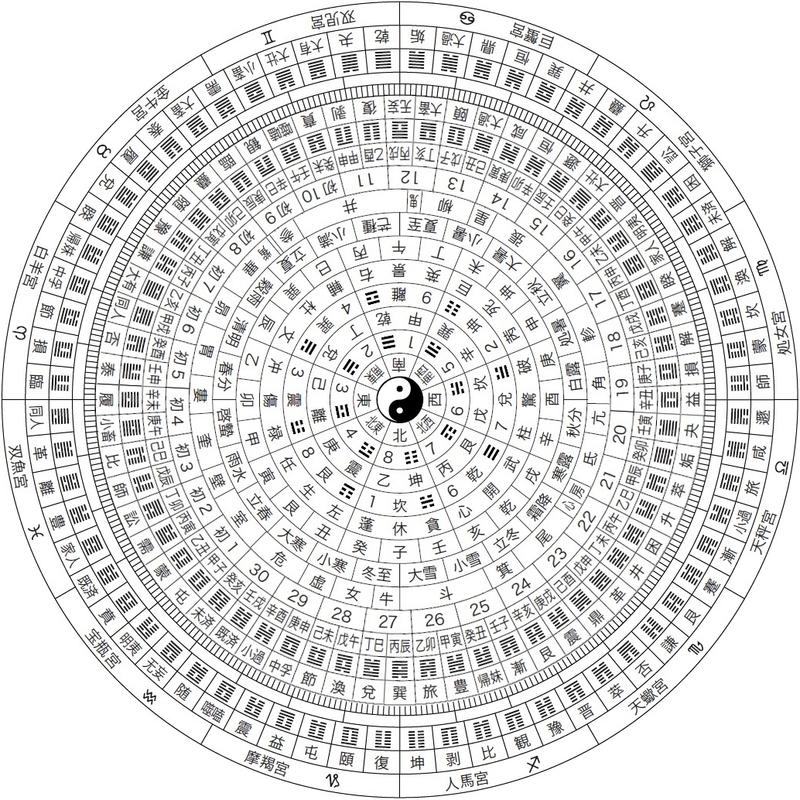
The Four Pillars freeze a single moment, the moment of birth. Luck cycles, called Da Yun in Chinese, are the moving scale laid over that moment. In traditional practice, a luck cycle changes every 10 years, and each ten-year step is also written as a stem-branch pair, counted forward or backward from the Month Pillar. Chart apps calculate this automatically and list the steps by age.
For example, a chart might read: luck begins at age 8; ages 8 to 17 run Yi-Mao, ages 18 to 27 run Jia-Yin, ages 28 to 37 run Gui-Chou. To read it, place the luck cycle characters next to the original Four Pillars. The luck characters combine with the birth chart in patterns of clash, combination, and penalty, and traditional analysis studies how these combinations shift the balance of the Five Elements.
Below the luck cycles sit the annual pillars, one stem-branch pair for each calendar year. The year 2025 is Yi-Si, and 2026 is Bing-Wu. The year pillar, the current luck cycle, and the birth chart stack together as the finest layer of traditional analysis. For a first read, work in three layers: the birth chart first, then the current luck cycle, then the current year. Layer by layer, nothing gets tangled.
One caution: the starting age of the luck cycles and the forward or backward counting depend on gender and on the yin-yang nature of the birth year, and different schools use slightly different rules. The same chart can show a starting age that differs by one year between apps. Trust the app you are using and do not get stuck on a one-year difference.
How to Read a Chart, Step by Step
Put the pieces together and the reading order becomes clear. First, identify the Four Pillars and match the eight characters to year, month, day, and hour. Next, identify the stems and branches and locate each pair within the sixty-year cycle. Then count the Five Elements and identify the ten gods to see how the elements relate. Finally, overlay the luck cycles and the current year, placing the static birth moment onto a moving timeline.
Three practical tips will make your first reading much easier. First, take your own chart and work through it column by column against this guide, marking anything you cannot yet identify instead of trying to master everything at once. Second, pay special attention to the Day Master and the Month Pillar: the Day Master is the reference point, and the Month Pillar sets the season and the strength of the elements, which is why traditional analysis gives it heavy weight. Third, treat BaZi as cultural knowledge to learn and discuss. It is an ancient system for recording time and describing the generating and controlling relationships among the Five Elements. Understanding its structure is a reward in itself, and it is not a verdict on anyone’s future.
The next time someone hands you a BaZi chart, you will not stare blankly at eight characters. From pillars to stems and branches, from elements to luck cycles, read it one column at a time, and the chart slowly turns into a readable map of time.
Quick Answers
What exactly is a BaZi chart?
A BaZi chart, also called the Four Pillars of Destiny, is a traditional Chinese way of writing down a birth time. Year, month, day, and hour each become a pair of characters, eight in total, and the chart analyzes those characters through the Five Elements and their relationships.
Which character should I look at first?
Start with the stem of the Day Pillar, the Day Master. It is the reference point for everything else on the chart, and most apps highlight it for you.
What is a luck cycle?
A luck cycle, or Da Yun, is a ten-year period represented by its own stem-branch pair. It shows how the birth chart interacts with the passage of time, one decade at a time.
Do I need to memorize all sixty combinations?
No. Chart apps calculate the pillars automatically. What you need is the structure: four pillars, stems on top and branches below, elements counted across the chart, and luck cycles layered on top.
Is a BaZi chart a prediction about my future?
No. This guide treats BaZi as cultural knowledge, a historical system for recording time and describing elemental relationships. Read it to understand the tradition, not as a fortune-telling verdict.