Xiao Lin had already paid the venue deposit when the argument started. One side of the family had checked the almanac and declared a certain Saturday “suitable for marriage.” The other side checked the zodiac signs and pointed out that the same day clashed with the bride’s mother, who was born in the Year of the Horse. The wedding date was still undecided, and the planning had already ground to a halt.
If that scene sounds familiar, you are not alone. For many couples in China, picking a wedding date is not a test of superstition. It is a practical exercise in lining up three things that rarely agree on their own: traditional customs, what both families feel comfortable with, and the hard reality of venue availability. This guide walks through the process step by step, so you can reach a date everyone can accept without spending three weeks flipping through an almanac.
One thing to be clear about from the start: date selection, known in Chinese as “ze ri” (literally “choosing a day”), is a folk cultural custom. It is about smooth proceedings and family peace of mind. It does not determine how happy a marriage will be, and it cannot bring or block good fortune. Treat it as a planning tool, not a verdict.
Step 1: Start With Availability, Not the Almanac
The first step in choosing a wedding date is not opening the almanac. It is drawing a circle around the time window that actually works. Sit down as a couple and settle three questions first: which season do you want the wedding in, are there periods when either set of parents absolutely cannot attend, and what dates do your venue and wedding vendors still have open?
Take a concrete example. Suppose you are aiming for sometime between November 2026 and January 2027. Weekends in that window number only about twelve. Subtract two weeks when one parent will be traveling for work, and the genuinely available Saturdays and Sundays may shrink to eight or ten days. That is your real shortlist.
Write that window down before you consult any almanac, and your search becomes far more efficient. Do it the other way around, and you will keep finding “perfectly auspicious” days only to discover the hotel was booked months ago or your best man cannot get the day off. Availability is a hard constraint; traditional considerations are choices you make within it, not the other way around.
A practical approach is to list three candidate weekends in order of preference, then check each one against the almanac and the clash rules. If your first choice gets vetoed, you do not have to start from scratch. You simply move to the next name on the list.
Step 2: How to Read the Almanac
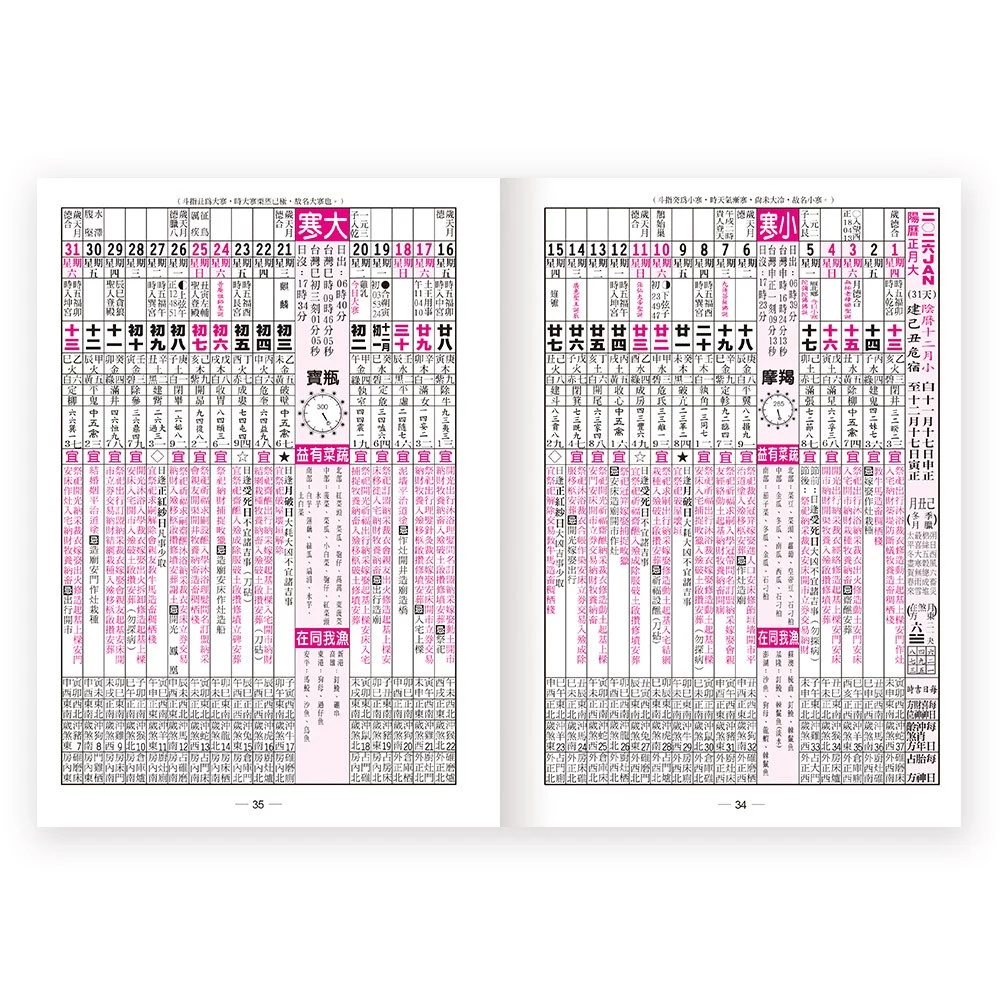
The traditional Chinese almanac, called “huang li” or “tong shu,” is a daily calendar that marks each day as favorable or unfavorable for various activities, from weddings to moving house. When you open it to look for a wedding date, four pieces of information matter most.
The Four Columns That Matter
First, the “suitable” list. If the characters for “jia qu” (marriage) appear in the day’s “suitable” column, tradition considers that day appropriate for holding a wedding.
Second, the “avoid” list. If “marriage” appears in the day’s “avoid” column, cross that day off your list first, no matter how convenient it looks.
Third, the clash and direction note. A typical entry reads something like “clashes with Horse, sha in the South.” This means the day conflicts with people born in the Year of the Horse, and the inauspicious direction for the day is the south. We will unpack both parts below.
Fourth, the day’s guardian spirit. Each day is assigned a presiding spirit, and six of them, Qinglong, Mingtang, Tiande, Yutang, Jin Kui, and Siming, are known as the “Yellow Path” spirits. A day governed by one of these six is traditionally called a “huang dao ji ri,” an auspicious day on the Yellow Path. Couples often treat this as a bonus point rather than a requirement.
Two Details People Usually Miss
The first detail is who exactly is clashed with. A day that clashes with the bride or groom themselves is a much bigger deal, in most families’ eyes, than a day that clashes with a groomsman or a distant cousin. The usual working rule is to avoid days that clash with the bride and groom first, then check whether the day clashes with either set of parents.
The second detail is the “sha” direction. “Sha” here refers to an inauspicious direction for the day, not a physical danger. On a day marked “sha in the South,” tradition advises against ground-breaking work or long journeys heading south. For a wedding, this becomes relevant if the groom’s procession route runs straight south all the way. Some families in this situation simply adjust the departure direction or the timing slightly, and consider the matter handled.
Days Folk Tradition Often Suggests Avoiding
Beyond the daily entries, folk tradition flags a few recurring dates. The 3rd, 7th, 13th, 18th, 22nd, and 27th days of each lunar month are collectively called “San Niang Sha,” the “Three Ladies’ curse days,” and are traditionally considered unsuitable for weddings. There is also “Yang Gong Ji,” thirteen days scattered through the year that tradition likewise marks as days to avoid for major events.
Neither of these has any scientific basis, and whether you observe them depends entirely on family habit. But knowing about them in advance matters, because a date that looks fine to you may bother an elder later. A quick check now can save an awkward conversation after the invitations have been printed.
Step 3: Avoiding Clashes: Zodiac Pairs, Months, and Family Negotiation
The core of clash avoidance is the system of “di zhi,” the twelve Earthly Branches, each paired with a zodiac animal. The branches form six opposing pairs, and a day governed by one branch is said to clash with the animal of the opposite branch.
The Six Clash Pairs
- Rat clashes with Horse.
- Ox clashes with Goat.
- Tiger clashes with Monkey.
- Rabbit clashes with Rooster.
- Dragon clashes with Dog.
- Snake clashes with Pig.
Once you know this table, reading a date becomes straightforward. If the bride was born in the Year of the Rabbit, a day marked “clashes with Rooster” is no problem, but a day marked “clashes with Rabbit” should be avoided. If the groom was born in the Year of the Dragon, days marked “clashes with Dragon” go off the list.
This is also why Xiao Lin’s family got stuck: the disputed Saturday clashed with the Horse, and the bride’s mother was born in the Year of the Horse. Under the priority rule above, a clash with a parent is worth taking seriously, but it is not necessarily a deal-breaker in the way a clash with the bride or groom would be.
The Bride’s Favorable Months
Traditional date selection also has a saying about “the bride’s favorable months for marriage,” known as “nu ming xing jia da li yue.” The rule assigns two favorable lunar months to each zodiac sign for the bride:
- Rat and Horse: the 6th and 12th lunar months.
- Ox and Goat: the 5th and 11th lunar months.
- Tiger and Monkey: the 2nd and 8th lunar months.
- Rabbit and Rooster: the 1st and 7th lunar months.
- Dragon and Dog: the 4th and 10th lunar months.
- Snake and Pig: the 3rd and 9th lunar months.
Following this rule, a bride born in the Year of the Rabbit would ideally marry in the 1st or 7th lunar month. Picking a date inside one of those months and then checking it against the daily almanac amounts to clearing a first hurdle that most families will recognize and respect.
When Everything Conflicts: A Priority Order
In real life, the bride’s and groom’s signs, the parents’ signs, and the favorable months often pull in different directions. Trying to satisfy every single rule at once is nearly impossible, and chasing a zero-conflict date can stall the planning for months. A sensible priority order is:
- The couple themselves must not be clashed with. This is the non-negotiable layer.
- The favorable month should match if possible. This is the layer most elders will ask about first.
- Parental clashes can be handled through ceremony details. For example, an elder whose sign is clashed with on the day can skip the groom’s procession segment, or the tea ceremony can be scheduled after the auspicious hour has passed.
The goal of date selection is for both families to feel at ease, not to produce a mathematically perfect chart. A date that both sides accept with good grace is worth far more than a theoretically flawless one that leaves everyone exhausted.
Step 4: From a Date to a Final Plan
Once the date is chosen, there is still the question of the auspicious hour. The almanac divides each day into twelve two-hour periods, called “shi chen,” and marks each as favorable or unfavorable. You do not need to schedule every minute of the wedding around these periods. Pin down only the key moments: the departure time of the groom’s procession and the start of the ceremony itself.
Here is a concrete example. Suppose the auspicious window on your day runs from 9:00 to 11:00 in the morning, the “Si” hour. If the groom’s motorcade leaves at 8:30 and arrives at the bride’s home around 9:00, the timing lines up naturally, and nobody has to get up at 4:00 in the morning to chase a lucky minute.
Build slack into the run-of-show. The parts of a wedding day most likely to overrun are traffic and hair and makeup, so mark the two or three moments that genuinely cannot move and let the rest float by half an hour either way. Share a single timeline with your wedding planner, photographer, and drivers, with the fixed points clearly marked and the flexible ones labeled as such. The day will run far more smoothly.
Backup plans matter just as much. Run your second and third choice dates through the same checks and write them into a simple table: date, suitable and avoid entries, clash notes, auspicious hours, venue availability, and whether key family members and friends can attend. If the first choice falls through because of weather, a venue problem, or a sudden family emergency, the backup can step in immediately, without another three nights of almanac research.
Your Actionable Checklist
Pulling all of the above together, here is the checklist that turns this guide into a finished decision:
- Circle a feasible window of two to three months and list three candidate weekends in order of preference.
- Check the almanac: confirm “marriage” appears in the suitable column and not in the avoid column.
- Check the clashes: rule out days that clash with the bride or groom first, then review clashes with parents.
- Check the favorable month: give preference to a month that matches the bride’s zodiac sign.
- Set the auspicious hours: lock in only the procession departure and the ceremony start.
- Prepare the backups: run the second and third choice dates through the same checks and write them into your table.
The most useful thing you can do this weekend is also the simplest. Each partner, and each set of parents, writes down three weekends that work for them, and you take the overlap. Then check those overlapping dates against the almanac, mark the clashes and auspicious hours, and bring the table to a family meeting next week. Half an hour with the table in front of everyone is usually enough to settle the date.

Quick Answers
What if no date satisfies everyone? Prioritize in this order: the couple not clashed with, the favorable month if possible, and parental clashes handled through ceremony adjustments. A date everyone accepts beats a perfect date nobody can agree on.
Do we need a professional date selector? Not necessarily. For most couples, the almanac plus the clash table in this guide is enough. A professional can help if the two families hold sharply different traditions and you want a neutral third opinion.
What if the venue is only free on a “bad” day? Weigh the trade-off honestly. A venue that fits your budget and guest list on a less-than-ideal almanac day is often the better choice, especially if the clash does not involve the bride or groom. Many families adjust ceremony details rather than give up a good venue.
Does the auspicious hour really need to be exact to the minute? No. Fix the two key moments, the procession departure and the ceremony start, and let the rest of the day breathe. A wedding runs on people, not on minutes.
Can the date affect the marriage itself? There is no evidence that it can. What genuinely shapes a wedding day is the division of labor, the budget, and communication between the two families. A schedule both sides endorse is worth more than any “perfect” date that was fought over.
Once the date is settled, put your energy where it counts: who does what on the day, what the budget covers, and how the two families stay in sync. A date chosen with everyone’s comfort in mind is a good start. The marriage itself is built on everything that comes after it.
This article introduces a folk cultural custom for general information only. It does not promise any outcome, and it is not a substitute for professional advice on legal, financial, or personal matters.