It is 6:30 in the morning in a quiet corner of the park. A few older people are standing perfectly still, feet apart, arms curved in front of their chests as if they were holding an invisible balloon. Fifteen minutes pass. Their foreheads glisten slightly with sweat, yet their faces look completely relaxed. Passersby assume they are daydreaming. Anyone who has trained knows better: this is Zhan Zhuang.
Zhan Zhuang (pronounced “jan jwong”) literally means “standing like a post.” It is one of the oldest foundation practices in Chinese martial arts, a form of standing meditation in which you hold a fixed posture and let your body learn to stand, breathe, and balance as one unit. No equipment, no gym, no special clothing — just a patch of ground big enough for two feet. For a beginner, the payoff is refreshingly practical: better posture, stronger legs, and a sharper sense of where your weight actually sits. This guide starts with the simplest stance, Wuji, then moves on to San Ti Shi, and gives you a 10-minute daily routine you can start tomorrow.
What Are You Actually Training?
Zhan Zhuang does not train brute strength. It trains whole-body coordination. Think about how you normally stand or sit: shoulders creeping up toward your ears, lower back sagging, knees locked straight. After months and years of those habits, a stiff neck, an aching back, and tingling feet start to feel normal. Standing practice brings those habits into the open. How do your feet meet the ground? Which way do your knees point? Is your back upright or collapsed? Are your shoulders dropped or tense? You fix one thing at a time, and your body gradually learns a cheaper, easier way to hold itself up.
A useful way to picture it: Zhan Zhuang is a slow-motion health check for your posture. Stand for three minutes and the problems you normally ignore will introduce themselves. Some people discover they always load their heels. Others notice one shoulder sits half an inch higher than the other. Others find their calves start trembling before two minutes are up. None of that is bad news — it is your body adapting to a new way of carrying weight, and noticing it is the first step to changing it.
One thing to be clear about from the start: Zhan Zhuang is a traditional martial arts foundation exercise, not a medical treatment. It can help you improve posture, build lower-body endurance, and sharpen focus, but it is not a cure for anything. Anyone promising otherwise is selling something.
Step One: Wuji Stance — Stand Right Before You Stand Long
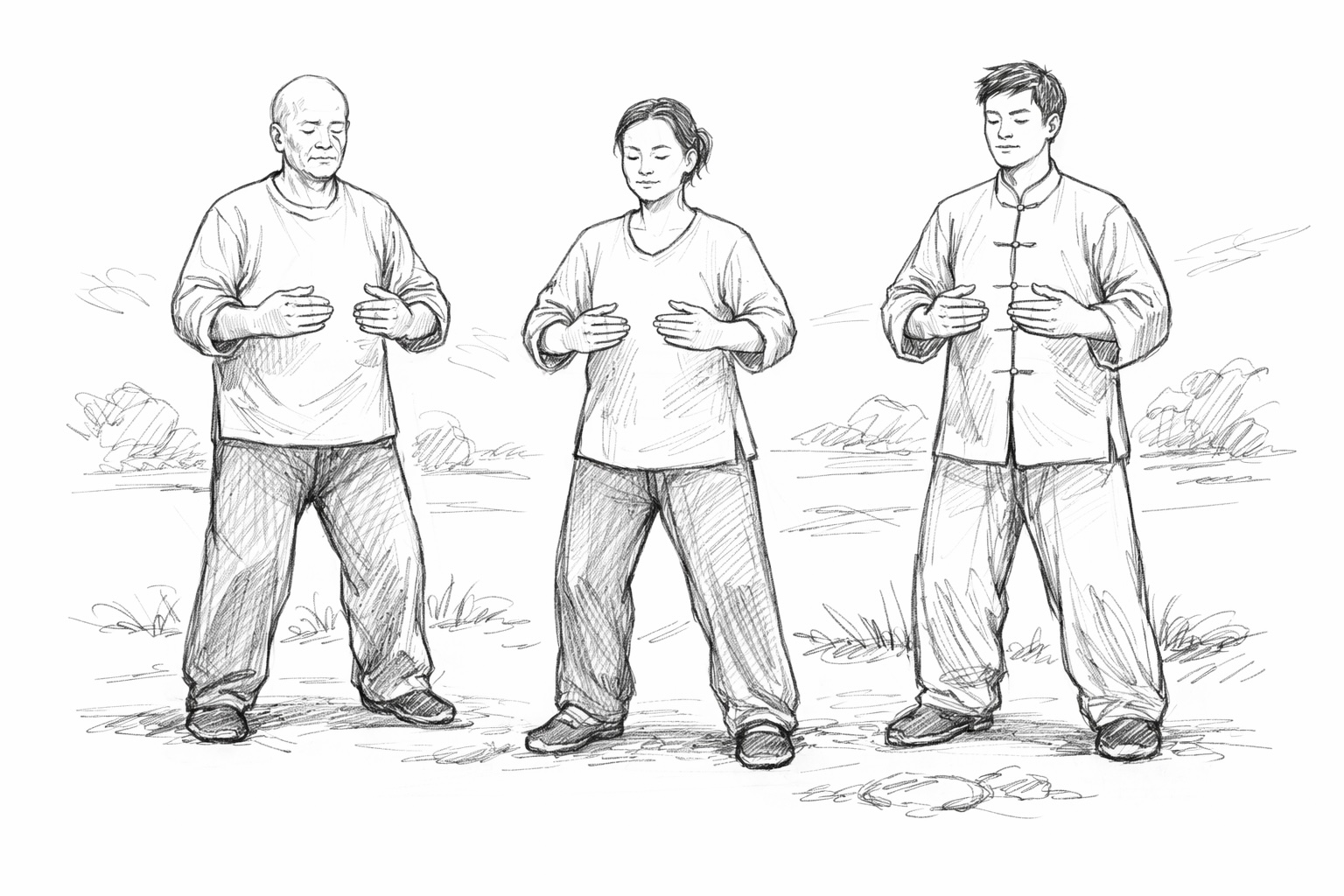
Wuji stance is where every beginner starts. The name means “the stance of no extremes” — a neutral, balanced, natural posture. Its key points fit in five sentences: feet shoulder-width apart, toes turned slightly inward; knees softly bent, tracking in the same direction as your toes; back upright but not rigid, as if a thread were gently lifting the crown of your head; arms curved in front of your chest, as if you were hugging a basketball; shoulders dropped, fingers relaxed, breathing natural.
Beginners tend to make the same three mistakes. The first is knees collapsing inward. After a minute or two the knees drift together, and over time that strains the joints. The fix is simple: keep your knees pointing toward your second and third toes at all times. The second is shrugging while lifting the arms. The moment the arms come up, the shoulders follow, and you finish the session with a neck more tired than your legs. Check every 30 seconds and consciously drop your shoulders. The third is holding your breath. Concentration makes people forget to breathe until their faces turn red. Let the breath take care of itself — in through the nose, out through the mouth, slow and unforced.
The standard for Wuji stance is not how long you can stand, but how steady you can stand. In week one, three minutes once a day is enough. In week two, build to five minutes. By week three, if you can hold a full eight minutes without your posture falling apart, you are ready for the next stage.
Step Two: San Ti Shi — Adding Difficulty One Piece at a Time
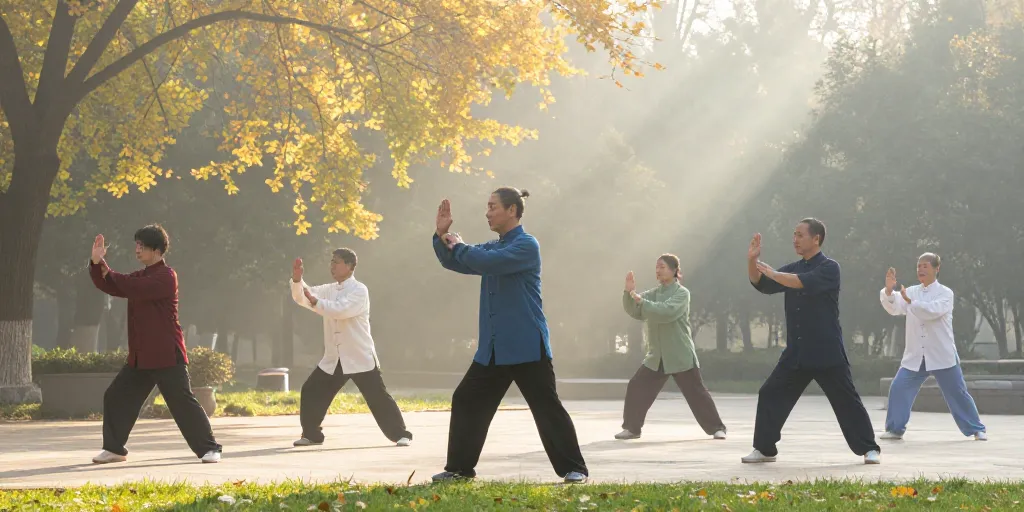
San Ti Shi, or “Three Body Posture,” is the signature stance of Xingyi Quan, one of China’s major internal martial arts. Compared with Wuji, it adds a split stance — one foot forward, one back — and an asymmetric arm position, one hand extended, one held near the abdomen. The basic shape: step the front foot forward about one and a half foot-lengths, angle the back foot out at 45 degrees; extend the front hand forward at chest height, draw the back hand in front of the abdomen; distribute your weight roughly 30 percent front and 70 percent back, with hips level — neither leaning forward nor tipping back.
Do not jump straight from Wuji into the full San Ti Shi. Break it into three stages. First, practice only the footwork: stand in the split stance, switching legs, two minutes per side, until your feet feel stable. Second, add the hand positions, keeping the front elbow slightly bent — never lock the arm fully straight. Third, combine breath and whole-body relaxation, alternating sides, three minutes each.
The back leg causes the most trouble. A back leg that will not straighten, a heel that lifts off the ground, or hips that twist to one side are all common. Here is a quick self-check: ask someone to look at you from the side. From heel to hip, the back leg should form one straight diagonal line, with the heel firmly on the ground. If your back heel keeps lifting, your stance is too wide — pull the front foot back about 10 centimeters and try again.
Your 10-Minute Daily Routine
Put Wuji and San Ti Shi together and the routine practically writes itself:
- Warm-up, 1 minute: circle your ankles, knees, and shoulders ten times each.
- Wuji stance, 4 minutes: focus on four checkpoints — feet, knees, back, shoulders.
- San Ti Shi, 2 minutes per side: alternate left and right legs.
- Cool-down, 1 minute: lower your arms slowly, walk gently in place, and wait for your breathing and heart rate to settle before stopping.
Follow this plan for four weeks. In week one, you can lengthen the Wuji portion and shorten San Ti Shi. From week two, split the time evenly. By week four, if you finish ten minutes feeling only mildly warm, with legs a little tired but not shaking, you can extend the total to fifteen minutes or push each San Ti Shi side to three minutes. The rule for progressing never changes: advance when your posture stays clean, not when the clock looks impressive.
Fix a regular time — right after waking up, or an hour after dinner. A fixed slot makes the habit stick, and it makes progress easier to see. After each session, jot down two lines: how many minutes you stood, where you felt it most, and which part felt awkward. Look back after a week and the improvement will be obvious.
Making Standing Practice Part of Everyday Life
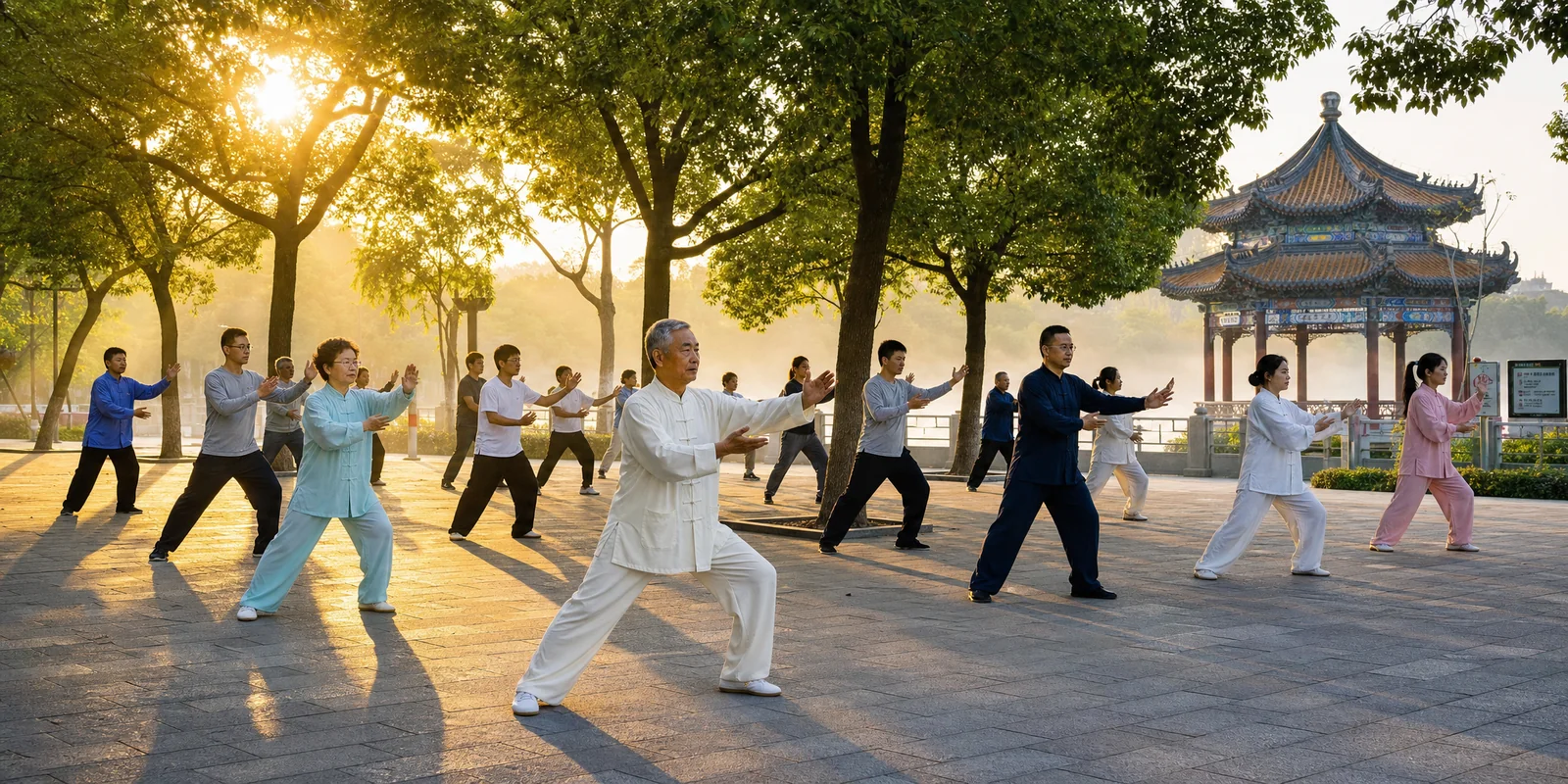
The barrier to entry is low; the hard part is showing up every day. Wuji stance teaches your body to stand correctly. San Ti Shi builds strength down into your feet. The 10-minute routine turns the whole thing into a habit. Do not chase a single 30-minute session, and do not compete with anyone over who can stand longer. The only measures that matter are whether your posture stays steady and whether you feel good afterward.
Start with a small commitment: seven days in a row, ten minutes a day. After that week, check in with yourself. You may notice your back straightening on its own when you stand, or your feet pressing more solidly into the ground when you walk. That is the first change Zhan Zhuang leaves behind — quiet, but real.
Quick Answers
How long should a beginner stand? Three minutes of Wuji stance is a solid start. Build gradually to ten minutes over three to four weeks. Steadiness matters more than duration.
Morning or evening? Either works. Morning practice shakes off overnight stiffness; evening practice, done at least an hour after dinner, helps you unwind. Pick the time you can repeat daily.
What if my legs shake? Completely normal, especially in the first two weeks. Trembling means the muscles are working in a new way. If the shaking is violent or painful, stop, rest, and shorten the next session.
Do I need special shoes or clothes? Anything loose that lets you move freely. Flat, soft-soled shoes are ideal. Bare feet on a mat or firm floor work well too.
Can I practice with knee problems? Keep the knee bend shallow and stop if you feel sharp pain. If you have a knee condition, check with your doctor before starting.
How is this different from just standing still? Ordinary standing is passive and usually sloppy. Zhan Zhuang is active: every joint is aligned on purpose, the whole body is engaged, and your attention stays on posture and breath throughout.
Safety note: Practice within your limits and progress gradually. Stop immediately and rest if you feel sharp pain, dizziness, or heart palpitations. If you have knee problems, cardiovascular issues, or any chronic condition, consult a doctor before beginning. Zhan Zhuang is a traditional fitness practice; it makes no therapeutic promises and is not a substitute for professional medical care.