5 a.m. The morning bell at Shaolin Temple hasn’t finished ringing, and the warrior monks are already lined up on the stone slabs in front of the Pagoda Forest. Cold air seeps into their collars. Someone breathes into his hands, rubs them warm, then drops into a horse stance. In the distance, the chanting of scriptures; up close, the rustle of robes in motion — two sounds that have coexisted here for fifteen hundred years.
How Kung Fu Grew Out of a Monastery
The Shaolin Temple was founded in 495 CE, when Emperor Xiaowen of the Northern Wei dynasty granted the Indian monk Batuo a plot of land at the foot of Mount Shaoshi in the Song Mountains. At that point it was an ordinary Buddhist temple — kung fu had nothing to do with it.
The turning point came a generation later. The monk Bodhidharma — known in China as Damo, the founder of Chan Buddhism (Chan, better known in the West by its Japanese name Zen, is a school of Buddhism that emphasizes direct insight through meditation) — arrived at Shaolin and is said to have meditated facing a cave wall for nine years. Legend has it that he noticed the monks’ bodies were failing them: years of sitting meditation had left them frail, and some dozed off during practice. He left behind two training methods, the Yijin Jing (Muscle-Tendon Changing Classic) and the Xisui Jing (Marrow-Washing Classic) — one a dynamic routine for the muscles and bones, one a quiet practice for breath and energy. Movement and stillness, combined: this is where the famous saying “Chan and martial arts spring from one source” begins.
Shaolin kung fu entered the official history books under the Tang dynasty, in a story the Chinese still tell today. In 621 CE, the future emperor Li Shimin was campaigning against the warlord Wang Shichong, and thirteen Shaolin warrior monks joined the fight, helping capture Wang’s general Wang Renze. Li Shimin later granted the temple forty qing of farmland — roughly 680 hectares — and formally allowed it to keep warrior monks. Overnight, the Shaolin fighters went from “monks who knew a few moves” to an armed force with imperial blessing.
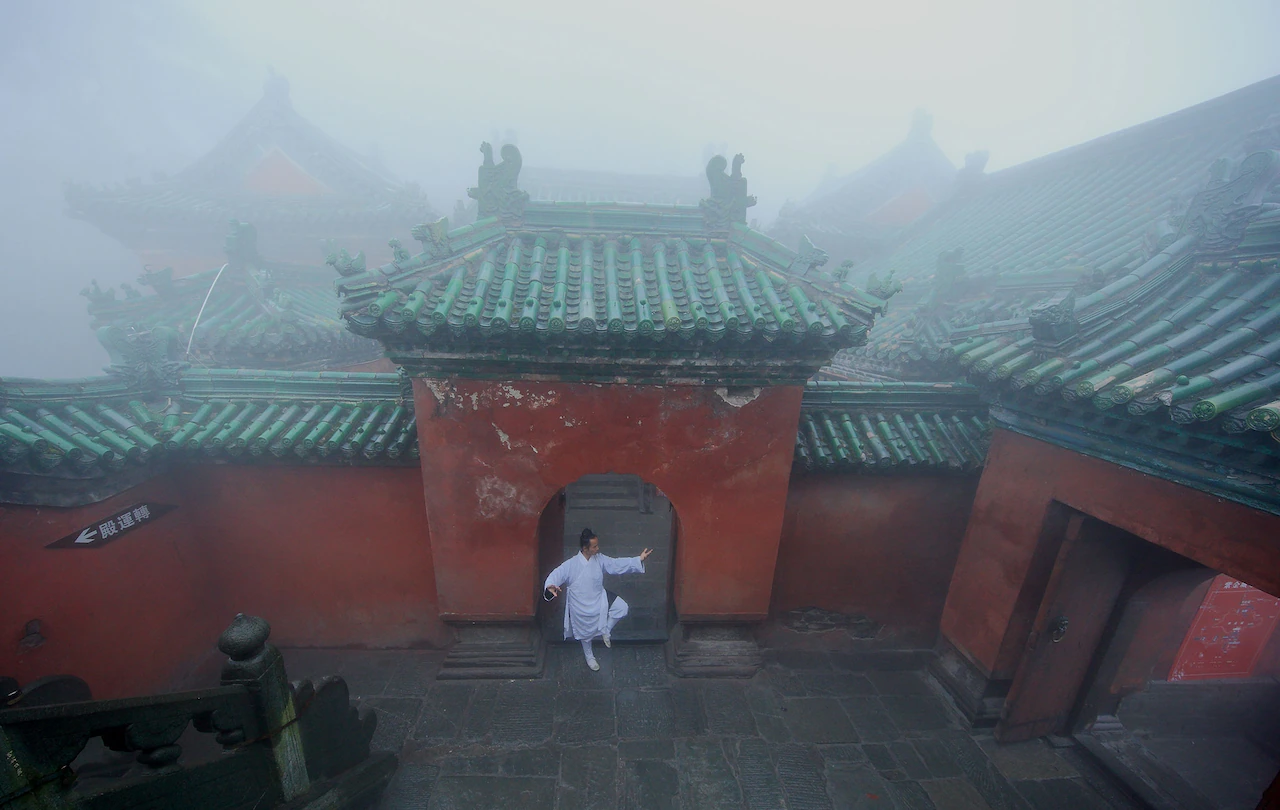
What Zen Buddhism Gave to Martial Arts
Ancient Chinese fighting arts had two roads: killing techniques developed in the military, and stage tricks performed at temple fairs. What made Shaolin different was that it grafted the mind-training of Chan Buddhism onto the muscle and bone of combat.
Chan teaches “pointing directly at the human mind, seeing one’s nature and becoming Buddha.” Shaolin monks apply the same principle to practice. There is a standing rule in their training: before the stance, settle the mind. Hold a stance for a full half-hour and you are not allowed to let your thoughts wander; the moment your attention drifts, you gather it back. This is nearly identical to seated meditation — watch the breath, collect the scattered mind. Here, martial arts stops being mere body training and becomes a path of cultivation.
The other meeting point is between “no-mind” and adaptability. Chan Buddhism speaks of “arising mind without abiding anywhere” — applied to a fight, it means: don’t pre-script your opponent’s moves; when the strike comes, let the body answer on its own. The Ming-dynasty military strategist Qi Jiguang, who studied Shaolin’s staff method for his own New Book on Effective Discipline, called it “the finest there is” — and what impressed him was precisely this fluidity, the refusal to get stuck in fixed forms. The Shaolin staff survived from the Song dynasty to the Ming, more than five hundred years, on the strength of this mind method.
“The Martial Art Reveals the Character”: Shaolin’s Code of Wude
The Shaolin Temple has ten monastic rules for its fighters. They state plainly: never use skill to bully the weak, never nurse grudges or pick fights, never show off your technique in front of others. Violators faced punishments from kneeling penance to expulsion. These rules were enforced: even in the Qing dynasty, visiting martial artists who wanted to spar with the monks had to present a formal letter of introduction first, and winners were forbidden from boasting about it afterward.
The governing idea is summed up in four characters: wu yi guan de — “judge the martial art by the virtue.” The phrase comes from the Zuo Zhuan, a history from the 4th century BCE, and Shaolin adopted it as its martial creed: the level of a person’s skill can be read from their character. The deeper the kung fu, the more restrained the temper should be. The old masters liked to say, “In the end, kung fu trains the heart.”
This code of wude — martial virtue, the ethical discipline governing every traditional Chinese martial artist — shaped Chinese martial culture far beyond the temple walls. In the Republican era, the Jingwu Athletic Association built moral education into its curriculum; after 1949, when wushu was standardized as a sport, the maxim “learn manners before learning arts, learn virtue before learning combat” became the nationwide rule. Its roots all trace back to Shaolin’s system of precepts.
The Lineage: A Family Tree of Kung Fu
Shaolin’s transmission runs along two lines: master-to-disciple inside the temple, and the diffusion of styles among the people.
Inside the temple, seniority is everything. The warrior monks are ranked by generation names, a practice dating to the Yuan dynasty: beginning with the character fu, the sequence runs through dazhi, zhenliao, xiangwei… down to today’s heng and yan generations. Fifteen hundred years, and the generational record has never broken. Each generation has its specialty — some masters devote themselves to Xiaohong Quan, others to Tongbei Quan — passed down face to face, one generation teaching the next.
The folk line traveled further. During the Ming and Qing dynasties, monks who left the order or wandered as itinerant teachers carried Shaolin boxing to Henan, Hebei, and Shandong, spawning dozens of styles — Shaolin Changquan, Chaquan, Paoquan, and more. Today, more than three hundred boxing styles across China claim Shaolin roots. In 2006, “Shaolin Kung Fu” was inscribed on China’s first list of national intangible cultural heritage; in 2010, the Historic Monuments of Dengfeng — the temple complex, the Pagoda Forest, the Chuzu Nunnery — joined the UNESCO World Heritage List. A single temple’s martial tradition holding both a national and a world-level recognition is without precedent in Chinese martial history.
What “Chan and Wu United” Still Offers Us
Seen as cultural history, Shaolin kung fu was never just about winning fights. It is a complete system of self-cultivation: Chan’s mind method to rein in distraction, martial training to temper the will, and the precepts of wude to discipline behavior. Take any one of the three away, and it is no longer Shaolin kung fu.
For modern readers, the value of this system isn’t in the ring. Someone who sits at a desk ten hours a day might take from Shaolin’s standing practice the simple lesson of “stand straight, settle down.” A hot-tempered person might read in “judge the martial art by the virtue” the idea of having strength without abusing it. The true meaning of a cultural code is turning outward skill into inward character.
If this has sparked your interest, consider taking an introductory class at a reputable local martial arts school to feel what basic traditional training is actually like; or find a cultural study of the Yijin Jing and see how the ancients understood the union of movement and stillness. Shaolin Temple also holds an annual martial arts culture festival — if you can visit, watching hundreds of monks perform the same form in perfect unison is more powerful than any written description.

Quick Answers
What does “Chan and Wu united” actually mean? It means that in the Shaolin tradition, meditation practice and martial training are treated as one path: the same mental discipline that steadies you in seated meditation — watching the breath, collecting wandering thoughts — is applied directly to combat movement. The body is trained through martial forms; the mind is trained through Chan.
Was Shaolin kung fu originally meant for fighting? Yes and no. The techniques certainly work, but the temple’s stated purpose was cultivation: strengthening monks’ frail bodies for meditation, then building a full ethical system around the skill. Fighting effectiveness was the vehicle, not the destination.
What is wude? Wude (martial virtue) is the ethical code binding traditional Chinese martial artists — no bullying the weak, no grudges, no showing off, respect for teachers and peers. Shaolin’s written precepts are the earliest systematic form of it, and they became the model for martial morality across China.
Can I learn Shaolin kung fu without being a Buddhist? Absolutely. Today most people practice it as a martial art, a sport, or a fitness discipline. The cultural ideas in this article — mental focus, ethical restraint — travel just fine outside a religious setting.
The Takeaway
Fifteen hundred years of Chan and Wu tell one story: the strongest martial art the Shaolin Temple ever produced wasn’t a punch or a staff technique — it was the idea that skill and character are the same training. The bell still rings at 5 a.m., the monks still line up on the stone slabs, and the oldest lesson still holds: kung fu, done right, is the practice of becoming a better person. The fists are only the beginning.
Safety note: Martial arts should always be learned under a qualified instructor at a reputable school. Train gradually, know your limits, and never attempt advanced movements or weapons practice on your own — you could get seriously hurt. This article is cultural history, not technique instruction; it promises no fitness or combat results. If you have any health concerns, consult a doctor before starting practice.
中文版:禅武合一:少林功夫背后的文化密码