It’s the most boring exercise in all of Chinese martial arts: you strike a pose, you don’t move a muscle, and you stand there for fifteen minutes. Most beginners quit within three days. The veterans? They’ve been standing for decades. Today we’re unpacking the three essentials of Zhan Zhuang — literally “standing like a post” — so you can see exactly where that gap comes from, and how to cross it.
Don’t be fooled by the simplicity. Zhan Zhuang looks like doing nothing, but it’s one of the most efficient whole-body training methods ever devised: it builds leg strength, postural alignment, breath control, and mental focus all at once, with zero equipment and almost no injury risk. The catch is that nearly everyone does it wrong at first — and wrong standing practice just teaches your body bad habits. The three essentials below are what correct practice looks like.
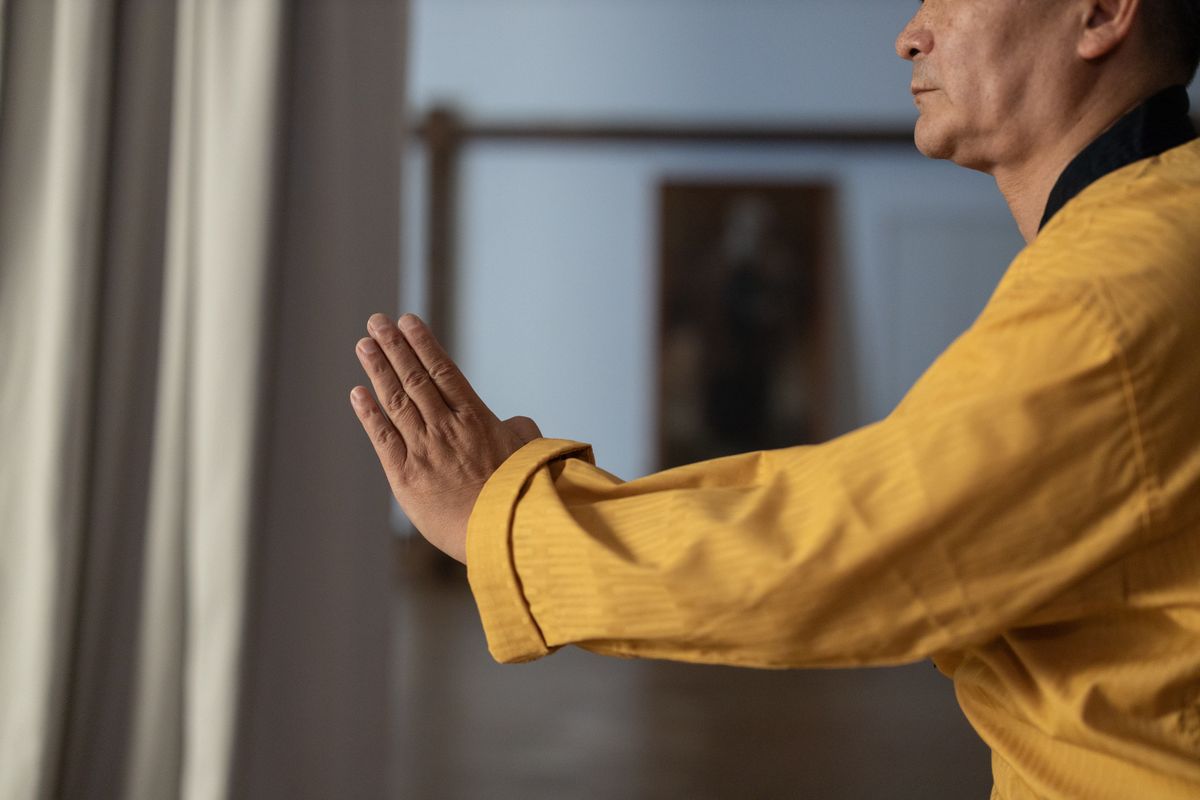
Essential 1: Correct Structure — Get the Skeleton Right So the Muscles Can Rest
Take Hunyuan Zhuang — “embracing the universe stance” — the most widely practiced posture. Stand with your feet shoulder-width apart, toes turned slightly inward. Bend the knees softly so they track directly over the toes. Sit the hips back a touch, as if perching on a tall bar stool. Round your arms in front of your chest like you’re hugging a big beach ball, and let the elbows hang heavy. Lift the crown of the head (the bai hui point) gently upward, as if a thread were suspending you from above, and tuck the chin just slightly.
The checkpoint: ask a friend to look at you from the side. Your ear, shoulder, hip, knee, and ankle should fall on roughly one vertical line. The moment anything drifts off that line, your muscles have to work overtime to compensate — and you’ll be aching within five minutes. Good structure is what lets you stand for thirty minutes without wrecking yourself; bad structure is why most beginners conclude “this isn’t for me” after a week of knee pain.
The beginner trap: squatting too low. A deep stance looks more “legit,” but that’s pure illusion. Beginners should keep the knee bend around 130 degrees — close to standing upright. Get the shape right first; depth comes later, and it comes naturally once the structure is honest.
One more detail people miss: the feet. Let your weight distribute across the whole sole, with a slight emphasis on the outer edges. If your arches collapse inward, your knees will follow them inward too — and that’s where knee trouble starts. Think of your feet as the foundation of a building: everything above depends on them being stable.
Essential 2: Relax and Sink — The Harder You Try, the Softer You Must Become
Here is the central paradox of Zhan Zhuang: the frame has to hold its shape while the muscles let go of effort. Most beginners do the opposite — they lock the frame into a rigid statue and call that “strong.” The test is simple: after three minutes of standing, are your shoulders dropped or shrugged? If they’ve crept up toward your ears, you haven’t relaxed yet, no matter how correct the posture looks from outside.
Three relaxation cues to repeat silently: sink the shoulders — let them melt downward as if sliding off your frame; drop the elbows — imagine each elbow tip weighed down by a thousand pounds; loosen the lower back — relax the waist area and tuck the tailbone ever so slightly inward. Run through these three every minute or so during your stand. You’ll be amazed how quickly tension sneaks back in.
Breathe naturally — never force deep breathing. A huge number of beginners start holding their breath the moment they take the stance, faces turning red within a minute. That’s a serious mistake: held breath means held tension everywhere else. If your breathing turns ragged, stop, walk a few slow steps until it settles, and stand again. There’s no prize for suffering through a bad session.
The Chinese word for what you’re after is song — often translated as “relax,” but it really means something closer to “alert looseness.” A cat about to pounce is song: utterly loose, yet completely ready. A sleeping cat is just limp. You’re training the first kind, not the second.
Essential 3: A Quiet Mind — Give Your Attention a Parking Spot
Posture set, body relaxed — now the third problem arrives: what is your mind supposed to do for fifteen minutes? The traditional method is called “guarding the dantian“: rest your attention lightly on your lower abdomen — about three finger-widths below the navel, the body’s traditional center of gravity and energy — and think of nothing in particular, without straining at it.
The beginner substitute: if guarding the dantian keeps slipping away from you, count your breaths instead. Silently count “one” on the inhale, “two” on the exhale, up to ten, then start over. It’s almost embarrassingly simple — and it works, because it gives the thinking mind a small, boring job instead of leaving it unemployed.
The quality of attention you’re aiming for is described as “as if guarding, yet not guarding” — like holding a baby bird in your hand. Grip too tight and you crush it; hold too loose and it flies away. You can’t force this balance; you can only notice when you’ve lost it and gently come back. Stand for a hundred days and the feeling becomes unmistakable.
Expect the mind to rebel. Planning dinner, replaying conversations, suddenly remembering emails — all completely normal. The practice isn’t “having no thoughts.” It’s noticing you’ve wandered and returning, hundreds of times per session. Every return is one rep for your attention muscle.
The 5 Mistakes Beginners Make Most
- Holding the breath: red face, bulging neck veins. Fix: part your lips slightly and breathe naturally through the nose. If you catch yourself holding, exhale fully and reset.
- Collapsed lower back: the waist arches forward and starts aching within minutes. Fix: tuck the tailbone and imagine the small of your back pressed flat against a wall behind you.
- White-knuckling through it: legs shaking violently but you refuse to stop out of pride. Fix: when the shaking becomes uncontrollable, close out the session properly. Add one minute next time. Progress, not punishment.
- Checking the phone for the time: glancing every minute keeps the mind from ever settling. Fix: use voice time announcements, or don’t time yourself at all — stand until you naturally feel like stopping.
- Ending too abruptly: finishing the stand and walking straight off, then feeling dizzy or lightheaded. Fix: rise slowly, march gently in place for a minute, rub your hands warm and press them over your face before moving on.
3 Starter Drills You Can Do at Home Today
If holding the full posture feels impossible right now, start with these three stepping stones for a week or two first:
- Wall standing (3 minutes a day): press the back of your head, your shoulder blades, your buttocks, and your heels against a wall, chin slightly tucked. This is the fastest way to calibrate correct structure — stand against the wall first, and your free-standing posture will naturally fall into place.
- The ball-hug feeling (2 minutes a day): actually hug a yoga ball or a firm pillow to your chest and notice how your arms hang from the ball rather than holding it up with effort. Memorize that sensation of “supported roundness,” then hug an invisible ball with empty hands.
- Single-leg standing (1 minute per leg): builds balance and ankle strength. If your weight feels wobbly and unstable during Zhan Zhuang, add a week of this drill — the improvement is usually immediate and dramatic.
The Body Sensation Map: What “Right” Feels Like, Head to Toe
When the posture is right, your body sends unmistakable signals. Use this map to check yourself after each session:
- Feet: the yongquan point — the “bubbling spring” on the front third of the sole — feels faintly warm and swollen, like standing in warm water. That’s your weight genuinely sinking down.
- Legs: the front of the thighs aches, the calves feel tight — that’s the normal sensation of muscles doing their job. But knee pain is never normal: if your knees hurt, stand up. Nine times out of ten, your knees have drifted past your toes.
- Lower back: the waist feels sore and warm — the lower back has released and opened. If it hurts sharply instead, your back has collapsed; tuck the tailbone a touch more.
- Hands: the fingertips tingle and swell, as if a tiny electric current were running through them. That’s circulation speeding up in the extremities. Don’t shake it off — wait a minute and it passes on its own.
- Head: the scalp feels slightly tight and light, like wearing a snug cap. That’s the crown lifting and the mind gathering into one place.
Remember the rule: soreness, swelling, tingling, and warmth are good signals; sharp pain, dizziness, and breath-holding are bad signals — stop immediately if they appear. Three months from now, this map will shift from “happens sometimes” to “happens every time you stand.” That’s when you know the practice has taken root.
From 5 Minutes to 30: The Progression Chart
- Weeks 1–2: 5 minutes a day. One goal only: memorize the posture so you don’t have to think about it.
- Weeks 3–4: 10 minutes a day. Start noticing what genuine relaxation actually feels like — most people have never felt it before.
- Month 2: 15–20 minutes a day. The leg shaking eases off; you can hold your mental anchor for stretches at a time.
- Month 3 onward: 30 minutes a day. By this point, standing has quietly become something you look forward to rather than endure.
FAQ
Morning or evening? Either works, but keep it consistent — same time, same spot. Many practitioners prefer morning, when the mind is naturally quieter. Avoid standing right after a heavy meal; wait at least an hour.
My legs shake uncontrollably after two minutes. Am I doing it wrong? No — that’s the standard beginner experience. Shaking means the muscles are waking up. It fades over weeks as your structure improves. Just don’t try to be heroic about it.
Can Zhan Zhuang replace my workout? It’s a superb complement to any training, but it’s not cardio and it’s not a full strength program. Think of it as the foundation everything else stands on — literally.
Zhan Zhuang isn’t a talent contest — it’s a showing-up contest. Remember the three essentials: correct structure, relax and sink, a quiet mind. Try five minutes tonight, and tell yourself tomorrow morning: five more minutes. A year from now, you’ll thank the person who started today.
Practice within your limits; consult a qualified professional if you feel unwell.
中文版:站桩三要