Auntie Chen lives on the 12th floor. She mounted her drying rack at 1.8 metres high, and the moment the laundry went up, her living room lost half its midday light. It is a small, everyday frustration — and it is exactly the kind of thing balcony feng shui is about.
In Chinese tradition, the balcony is treated as the home’s “mouth for light and air” — the opening through which sunlight and fresh air enter. In feng shui terms, this flow of air and light is called qi (气), a word that roughly means vital energy or atmosphere. Whether or not you believe in qi as a force, the practical advice that grew up around it is strikingly down to earth: keep the balcony bright, open, and easy to walk through. You pass through it a dozen times a day — hanging clothes in the morning, airing the quilt at noon, watering two pots of plants in the evening. The five tips below are all things you can do this weekend. They are cultural interpretation, for reference only, not a prediction about your fortune.
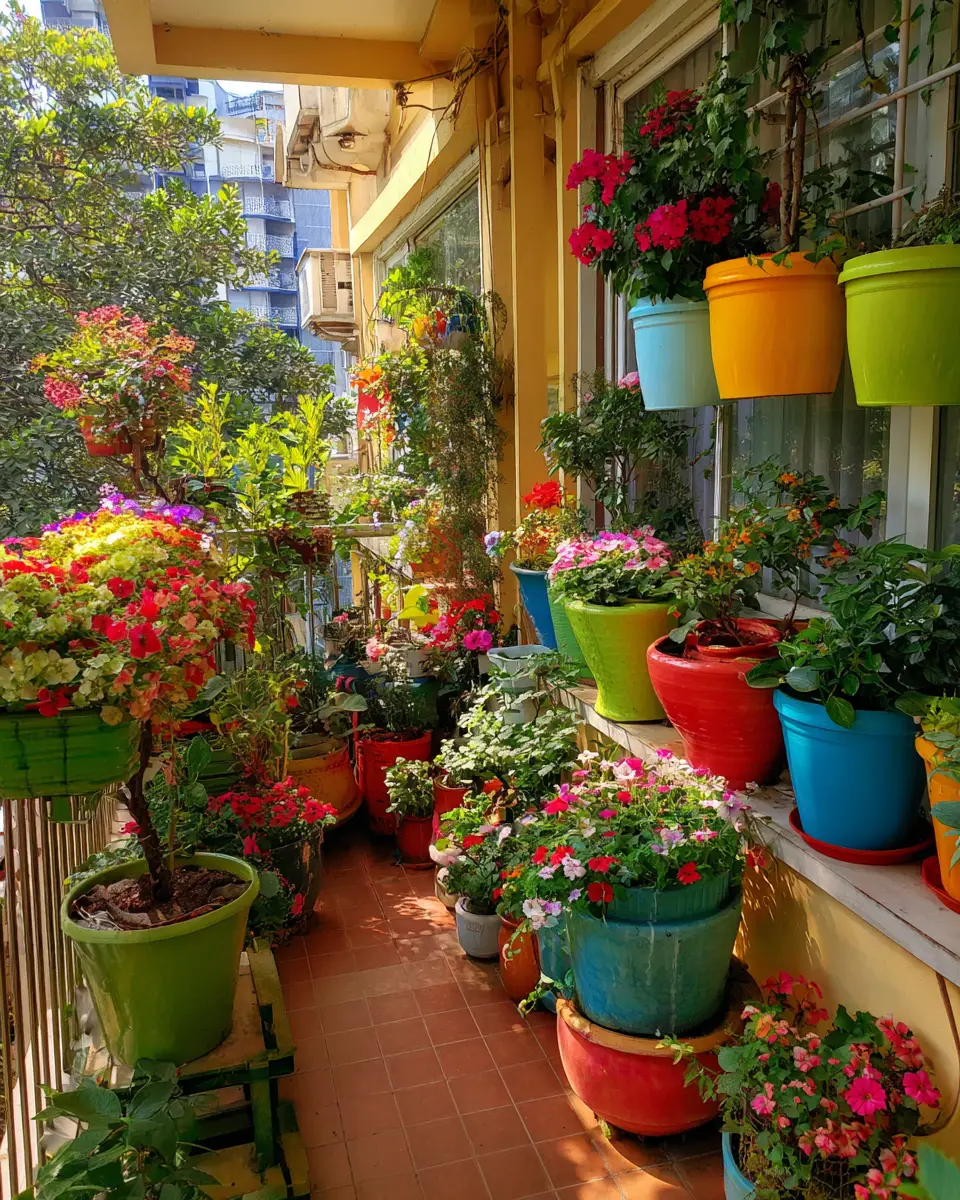
Tip 1: Start With Sunlight, Not the Compass
Many people reach for a compass the moment balcony feng shui comes up, measure the orientation, and then forget the most practical question of all: how many hours of sun does this balcony actually get? On a clear morning at 10 a.m., stand in the middle of your balcony and look. That one glance tells you more than any compass reading.
A south-facing balcony is the winner in winter — around the winter solstice it gets direct sun roughly from 9 a.m. to 3 p.m. An east-facing balcony only gets morning light, which makes it a good spot for a breakfast table and for drying light clothes. A west-facing balcony takes the harsh afternoon sun; in summer the floor can be hot to the touch between 4 and 6 p.m., so it needs a sheer curtain plus a blackout curtain. A north-facing balcony gets the least direct sun all year, and laundry there needs an extra day to dry.
The old saying “sit facing north, live facing south” (坐北朝南) is really just a way of saying a south-facing home is bright. When you are choosing a flat, do not just take the agent’s word for the orientation. Ask one question: on a winter morning at 10 a.m., does the sunlight reach at least one metre into the living room? If it does, the bones of the place are good. If your balcony faces north, paint the walls a pale colour and lay light-coloured tiles — that alone can brighten the space by 20 to 30 percent. If it faces west, add sheer and blackout curtains, pull them shut in the afternoon, and open them again in the evening for ventilation. You cannot change the orientation, but you can always improve the light. For reference only.
Tip 2: Choose Short, Sturdy Plants — Don’t Let Leaves Block the Light
Plants on a balcony are there to add a touch of life, so the first thing you see when you walk in is green. The common mistake is letting them multiply: seven pots crammed onto a 3-square-metre balcony, a big-leafed plant grown to 1.5 metres tall, and suddenly every ray of sun at the railing is blocked and the living room is darker than before.
The practical rule is to fix the number first, then pick the varieties. A small balcony of about 3 square metres needs only 2 to 3 pots; even one over 5 square metres should not have more than 5. Keep the height below the railing, or keep just one plant of about 1 metre as a centrepiece and choose the rest at 30 to 50 centimetres tall.
For varieties, match the plant to the light. South- and west-facing balconies with strong sun suit jasmine, roses, and cactus, which all tolerate heat. North- and east-facing balconies with weaker light suit shade-tolerant pothos, spider plants, and monstera — watering once or twice a week is enough, and watering every day will rot the roots. Put spiky plants like cactus and roses in a corner, away from the drying route, and be extra careful if you have a child under 3 at home. Rotate each pot every two or three months so the leaves get even light, and snip off dead leaves as you go. A half-dead plant sitting there looks messier than an empty spot. For reference only.
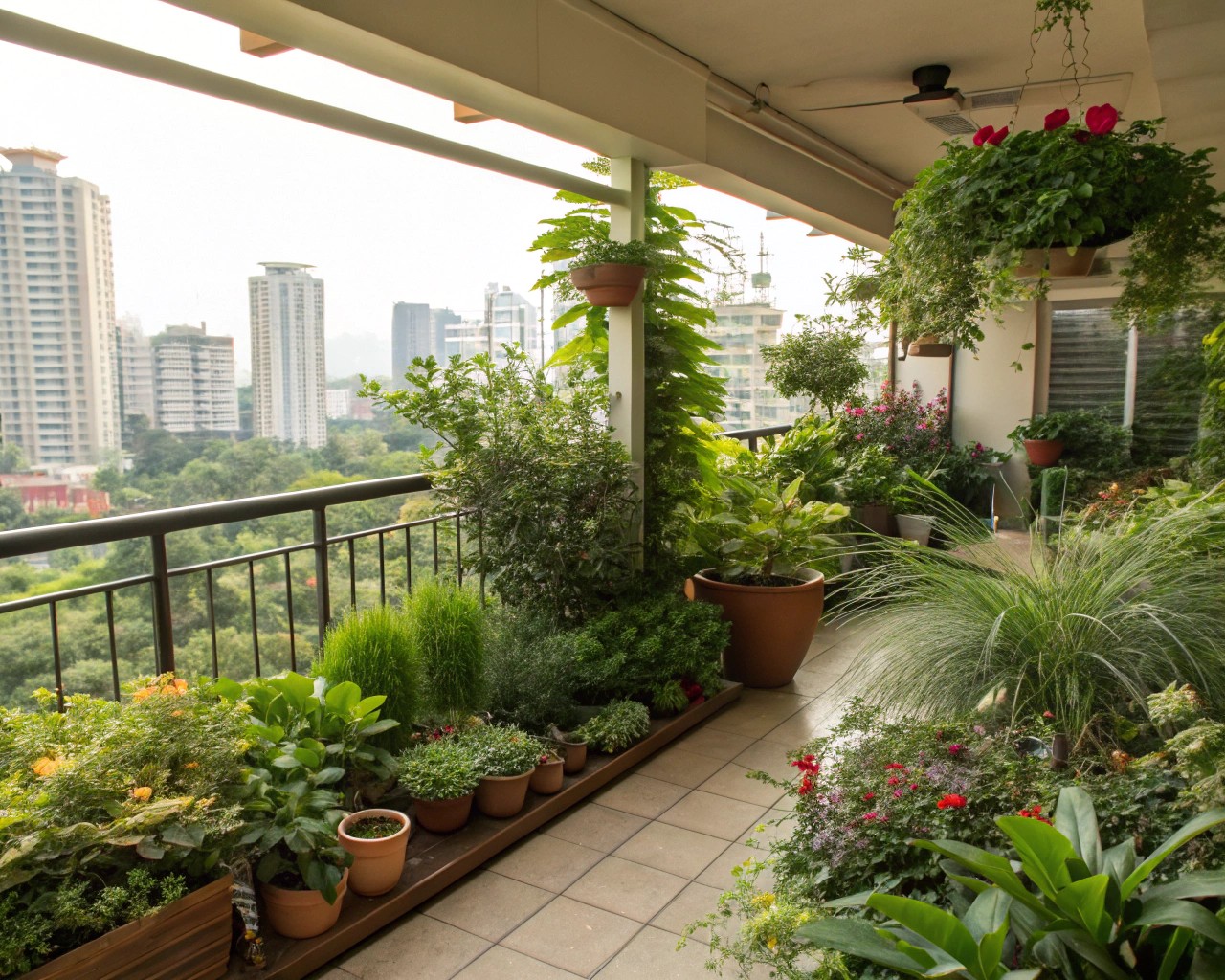
Tip 3: Zone Your Drying Area — and Keep a Path You Can Actually Walk
The most common kind of balcony mess is a drying area that swallows the whole space. Quilts, sheets, and heavy coats hang in a single row from the railing to the sliding door, leaving a 30-centimetre gap that you have to squeeze through sideways just to water the plants. The fix is simple: split the balcony in two. Let the drying zone take only the outer third, and keep the remaining two-thirds for walking and plants.
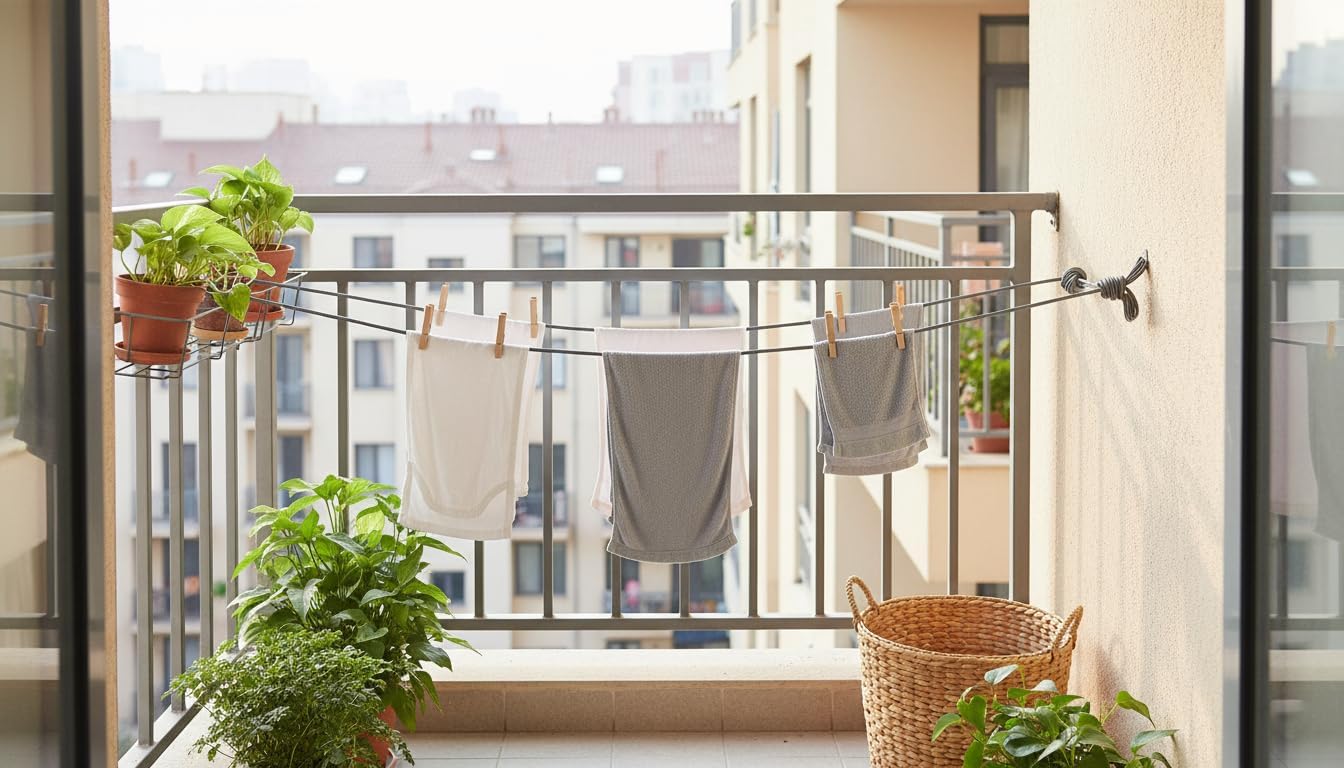
Mount the drying rack against a side wall at 1.7 to 1.8 metres high — within easy reach, but not so low that you bump your head on wet clothes. A height-adjustable rack works even better: lower it to 1.5 metres while you hang things, then raise it above 2.2 metres when you are done, and the space overhead is free again.
Drying has an order, too. Before 9 a.m., hang light shirts and underwear; between 11 a.m. and 2 p.m., when the sun is strongest, put out the quilts and heavy coats; bring everything in before 5 p.m. so the night damp does not settle back in. If it rains for three days straight and clothes still are not dry after two days, move them indoors to a ventilated spot and point a small fan at them — leaving them stewing on the balcony only breeds a musty smell. Leave 5 to 10 centimetres between garments so the wind can pass through; they dry faster and stay fresh. And when you finish with the pegs, put them back in their hanging basket instead of leaving them scattered on the floor. For reference only.
Tip 4: Clear Half the Clutter and the Balcony Lights Up at Once
Almost every home ends up using the balcony as a storeroom: four old cardboard boxes stacked up, a broken fan that has sat there for two years, a child’s old bicycle leaning against the railing, and a bag of renovation offcuts bought at some forgotten point. Once the stuff piles up, the balcony has only one function left — holding things. Traditional feng shui warns against clutter piling up on the balcony and against sharp corners pointing at the walkway. Translated into everyday language, that is two sentences: too much stuff blocks light and blocks the way, and sharp objects on the walking route are easy to bump into.
Try the 15-minute method. First, carry out the obviously useless things — torn boxes, appliances untouched for two years, dried-out old flowerpots. Then sort what is left into three groups: things you use often go into lidded storage boxes stacked on one side of the balcony, no higher than 1 metre; things you use occasionally go into a living-room cupboard; anything you have not used in a year, let it go. Two light-coloured lidded boxes of about 60 litres each are enough for an ordinary balcony. Hang sharp tools and mops on hooks in a corner, never across the middle of the walkway. When you finish, you should have at least 1 square metre of floor clear, sunlight falling straight onto the ground, and the living room looking a shade brighter — all from a single 15-minute session on a weekend afternoon. For reference only.
Tip 5: Spend 10 Minutes a Day on a Small Balcony Check
A good balcony stays good because of ten minutes a day. Before you leave in the morning, take a look: if last night’s laundry is dry, take it down instead of letting dry clothes occupy the rack all day. Check the plant soil — push a finger 2 centimetres in; water only if it feels dry, not otherwise. In the evening, glance at the sliding-door track for fallen leaves and dust; a monthly clean with an old toothbrush takes care of it, and wiping a smudged railing window takes five minutes.
Each week, do two small jobs: check whether the drying rack’s screws and ropes have loosened — replacing the rope on a height-adjustable rack every six months is far cheaper than having the rod come down — and rotate each plant pot so the shaded side faces the sun. Once a month, mop the floor properly and check that the drain is not blocked; look especially before the rainy season, because a blocked drain can leave 2 to 3 centimetres of standing water after one heavy downpour. The traditional saying is that a clean, bright, well-ventilated balcony has good qi. In everyday language, that is simply this: a place someone looks at and tends every day never gets messy. For reference only.
Quick Answers
Which direction is best for a balcony? South-facing gets the most winter sun — direct light roughly from 9 a.m. to 3 p.m. around the winter solstice. East-facing suits mornings, west-facing needs curtains against the afternoon heat, and north-facing needs pale colours and an extra drying day. Orientation cannot be changed; light can be improved.
How many plants should I put on a balcony? Two to three pots for a balcony of about 3 square metres, and no more than five even above 5 square metres. Keep them below railing height, match the variety to the light, and water shade-tolerant plants only once or twice a week.
How should I arrange the drying area? Give it only the outer third of the balcony and keep the rest as a walkway. Mount the rack at 1.7 to 1.8 metres, or use a height-adjustable one. Hang light clothes before 9 a.m., quilts between 11 a.m. and 2 p.m., and bring everything in before 5 p.m., leaving 5 to 10 centimetres between garments.
What is the fastest way to make a balcony brighter? Clear half the clutter in 15 minutes: throw out what you have not used in a year, put the rest in two lidded 60-litre boxes no higher than 1 metre, and free at least 1 square metre of floor. Sunlight on bare floor brightens the living room too.
Does balcony feng shui predict my fortune? No. The ideas in this article are cultural interpretation, for reference only. What actually works is a bright, open balcony that is easy to walk through — and that comes from ten minutes of attention a day.
Start tonight with three five-minute jobs: move the tallest light-blocking plant to a corner and bring it below railing height; take the dry clothes off the rack and space the rest 5 to 10 centimetres apart; and carry away the single most obstructive item on the floor so there is a path you can walk normally. Tomorrow at 10 a.m., stand on the balcony again and see whether the sunlight reaches half a metre further into the living room. If it does, keep adjusting, tip by tip — a balcony changes the way it does, a week and a month at a time.