Picture an old fortune-telling shop on Liulichang, the antique street in Beijing, sometime in the 1930s. A customer sits down, and before he says a word, the master glances at his face — not at his eyes, as you might expect, but at his eyebrows. Do they cluster at the inner corners? Do the tails scatter or taper? Do the hairs lie flat or bristle? Within seconds, the master is nodding and offering a few observations that make the customer murmur, “Yes, that’s right.” This is mianxiang — Chinese face reading, literally “face physiognomy” — and eyebrows have been one of its favorite subjects for over a thousand years. Is it accumulated folk wisdom, or elegant guesswork? This guide lays out what the tradition actually says, purely as cultural knowledge. Everything here is for reference and entertainment only — not a guide to anyone’s fate.
Where Eyebrows Sit in Chinese Physiognomy
In traditional Chinese face reading, the face is divided into twelve “palaces,” each linked to a different area of life. The eyebrows sit in the Palace of Siblings (xiongdi gong), and they carry a second title: the Officials of Protection and Longevity (baoshou guan). The name sounds mystical, but the logic is practical. Eyebrows arch above the eyes like the eaves of a roof, sheltering them — so the old texts connected them with affection, health, and longevity. The Mayi Xiangfa (Physiognomy of the Hemp-Robed Master), one of the classic manuals, calls the brows “the canopy over the two eyes,” meaning their shape was thought to mirror a person’s spirit and state of mind.
Today, most of us look at eyebrows as a matter of style. In the old system, they were read as a matter of qi — the vital energy or “breath” that Chinese thought believed animated the body. Thick brows were said to signal abundant blood and energy; faint brows, a fine, careful mind. None of this has scientific backing, and it is important to say so plainly. What it does show is how people observed each other before modern psychology existed: reading character from small outward details. In an age without personality tests, face reading was one of the tools people used to make sense of strangers. Treat the claims below as a record of that tradition — for reference and entertainment only.
Five Classic Eyebrow Shapes and What They Were Said to Mean
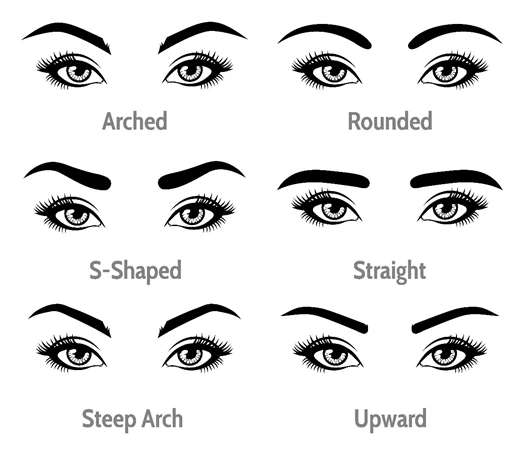
Traditional physiognomy classified eyebrow shapes in fine detail. Five shapes appear again and again in the old manuals, in opera, and in everyday conversation.
Willow-Leaf Brows: Fine and Gently Curved
Willow-leaf brows (liuye mei) are slender, with a soft curve and a tail that dips slightly downward — like the leaf of a willow tree. The old saying was that people with this shape were “gentle in nature”: mild-mannered, easy to get along with, and unlikely to pick a fight. On the Chinese opera stage, female lead roles (dan characters) almost always wear willow-leaf brows; the moment the audience sees them, they know the character is tender and refined. In real life, the shape is also the most common in women’s makeup, for a simple reason: soft lines make a face look approachable.
Straight Brows: Flat as a Horizontal Line
Straight brows (yizi mei, literally “one-character brows”) run almost flat from inner corner to tail, with barely any arc — like the Chinese character for “one” drawn across the face. Tradition held that such people were “upright and direct”: principled, plain-spoken, and unwilling to bend. The flat-brow makeup popularized by Korean dramas is a modern variation of this shape, and it gives the wearer a crisp, efficient look. The old texts added a caution, though: brows that are too flat and rigid were also read as a sign of stubbornness — a reminder to listen to other people’s opinions before digging in.
Sword Brows: Rising Like a Drawn Blade
Sword brows (jian mei) start low at the inner corner and sweep upward toward the tail, angled like a sword leaving its sheath. The old reading was that people with sword brows were “bold and discerning”: decisive, quick to act, and suited to command or to making hard calls. On the opera stage, warrior roles (wusheng) wear sword brows with their helmets, and the effect is instant — the character radiates sharpness before speaking a line. In a modern office, a naturally upturned brow often reads as “presence”; in interviews, it can leave an impression of decisiveness. That is the visual suggestion of the shape at work — the brow frames the eyes, and the eyes do the talking.
Eight-Character Brows: Drooping Like the Character “Eight”
Eight-character brows (bazi mei) are high at the inner corner and low at the tail, forming the shape of the Chinese character for “eight” (八). Tradition described such people as “delicate in thought” — but also prone to worrying too much. There is a folk saying, “eight-character brows, a face full of sorrow,” and it is really about optics: with the tails drooping, the whole face looks as if it is frowning. Many people born with this shape are perfectly cheerful, yet they keep being asked, “Why do you look so unhappy?” The brow is doing the talking, not the mood.
Silkworm Brows: Rounded and Full Like a Resting Silkworm
Silkworm brows (wocan mei) are rounded and full, with the middle of the brow rising gently like a silkworm at rest. The old texts called this a fortunate shape: easygoing, good-natured, and popular with others. One point of confusion is worth clearing up — silkworm brows are not the same thing as the puffy “lying silkworm” (wocan) under the eyes, a feature of the lower eyelid. Same word, different place; don’t mix them up.
What Thickness, Length, and Texture Were Supposed to Mean
Beyond shape, the old manuals also read the density and length of the brows:
- Thick, dense brows: Said to signal strong blood and energy — plenty of drive in youth, and a tendency to throw oneself into things. But brows so thick they meet in the middle, the so-called “joined brows” (lianxin mei), were read the other way: a person weighed down by worries, liable to brood over a single problem.
- Thin, sparse brows: Traditionally read as a fine, careful mind — someone who thinks three times before acting. From a modern point of view, sparse brows have far more to do with genetics, age, and nutrition; it is completely normal for brows to thin as we get older.
- Long brows: The old saying goes, “brows longer than the eyes mean a long life” (mei chang guo mu ze shou). There is no scientific basis for it, but long brows really are a symbol of blessing and longevity in Chinese culture — the God of Longevity (Shouxing) is always pictured with long white brows flowing down his face.
- Short brows: Tradition held that brows shorter than the eyes belonged to impatient people who rushed through everything. Today we know brow length is mostly inherited, and it has no direct link to temperament.
- Messy, unruly brows: Hairs growing in different directions, or growing against the grain, were said to mean “a mind full of thoughts” — someone carrying many things at once. A modern brow stylist meeting this shape does the same thing the old texts would have recommended in practice: trim along the natural direction of growth, and the face looks tidy in minutes.
One reminder belongs here, and it is worth repeating: all of the above is a record of traditional belief, not a scientific conclusion. The thickness and length of eyebrows are decided mainly by genetics, age, and health. They cannot be used to judge anyone’s destiny. Read them as cultural history — for reference and entertainment only.
Can Trimming Your Eyebrows Change Your Luck?
Folk wisdom says that reshaping your brows can “change your luck,” and fortune-telling shops are often asked the question: if I trim my eight-character brows into sword brows, will my fortunes improve? The traditional answer was that trimming could “regulate one’s appearance and energy.” The realistic answer is that trimming changes how you look — and how you feel about how you look.
Take a concrete example. A person born with eight-character brows keeps being asked, “Why do you look so sad?” After months of it, even looking in the mirror starts to feel deflating. Trim the tails slightly upward, and the visual center of the whole face lifts. People stop asking; the person in the mirror looks more alert. Nothing about fate has changed — but image management and psychology have done their work. Psychologists call this “embodied cognition”: the state of your appearance shapes how you feel, and how you feel shapes how you deal with people.
A few practical tips if you want to try: for your first trim, go to a professional brow stylist rather than attacking your brows with scissors at home. Decide on the shape you want first, and bring a reference photo to talk through. Brows grow back in roughly 4 to 6 weeks, so a bad trim is not a disaster — wait a month and it is back. If your brows are sparse and you want them fuller, a brow pencil or brow powder looks more natural than tattooing, and it is far easier to adjust.
How to Read Eyebrows the Sensible Way
Pull the tradition together, and a few down-to-earth conclusions emerge:
- Brow shape shapes first impressions, not destiny. The shape of your brows genuinely affects how strangers read you at first glance — sword brows look decisive, willow-leaf brows look gentle. That belongs to visual psychology, not to fate.
- The state of your brows can reflect health and mood. Brows that suddenly fall out, turn white, or thin out noticeably are worth a visit to the doctor — that is far more reliable than any face reading. Thyroid problems and nutritional deficiencies can show up in the brows first.
- The old sayings are cultural heritage, not an instruction manual. Knowing them helps you read old paintings, opera, and novels — for instance, why a warrior wears sword brows and a heroine wears willow-leaf brows. That is cultural literacy, and it is genuinely useful.
- Never use brow reading to judge a person. Deciding someone’s character from the shape of their eyebrows, and sticking a label on them, is neither accurate nor fair. To really know someone, look at what they do and what they say — not at their brows.
Eyebrow reading has survived for a thousand years, but its truly valuable part is not the fortune-telling. It is the habit of careful observation that the old masters practiced. The best attitude today is to keep these sayings as cultural knowledge: fine for conversation over tea, but when a big life decision is on the table, trust your own judgment. For reference and entertainment only — no superstition, please.
Quick Answers
What is mianxiang? Mianxiang is Chinese face reading — the traditional practice of judging character and fortune from facial features. It divided the face into twelve “palaces,” with the brows in the Palace of Siblings. It is a cultural tradition, not a science, and its claims should be read for reference and entertainment only.
Which eyebrow shape is “best”? The old texts praised different shapes for different qualities — sword brows for decisiveness, willow-leaf brows for gentleness, silkworm brows for good fortune — but no shape is objectively better. What matters in real life is whether the shape suits your face and makes you feel comfortable.
Do thick brows really mean good health? No. Brow thickness is mostly decided by genetics, age, and health. Sudden changes in your brows — falling out, thinning, or turning white — can be a health signal worth checking with a doctor, but thickness alone says nothing about your destiny.
Can trimming my brows change my luck? Trimming changes your appearance and your confidence, and that can change how people respond to you. That is image management and psychology at work — not a change of fate. For reference and entertainment only.
How should I use eyebrow reading today? Treat it as cultural knowledge: a way to enjoy opera, old paintings, and classic novels more deeply, and a reminder to look at people carefully. Never use it to label someone or to make important decisions.
Your eyebrows are the frame of your face — and a small window into a thousand years of Chinese culture. Spend ten minutes in front of a mirror, see which of the five classic shapes yours resembles, and enjoy the story behind it. If the shape makes you look tired, a small trim or a touch of brow pencil can lift the whole face. And if anyone tries to read your fortune from your brows, smile, thank them for the story — and decide your own future yourself. For reference and entertainment only.
中文版:眉毛看相:眉形与性格的传统解读