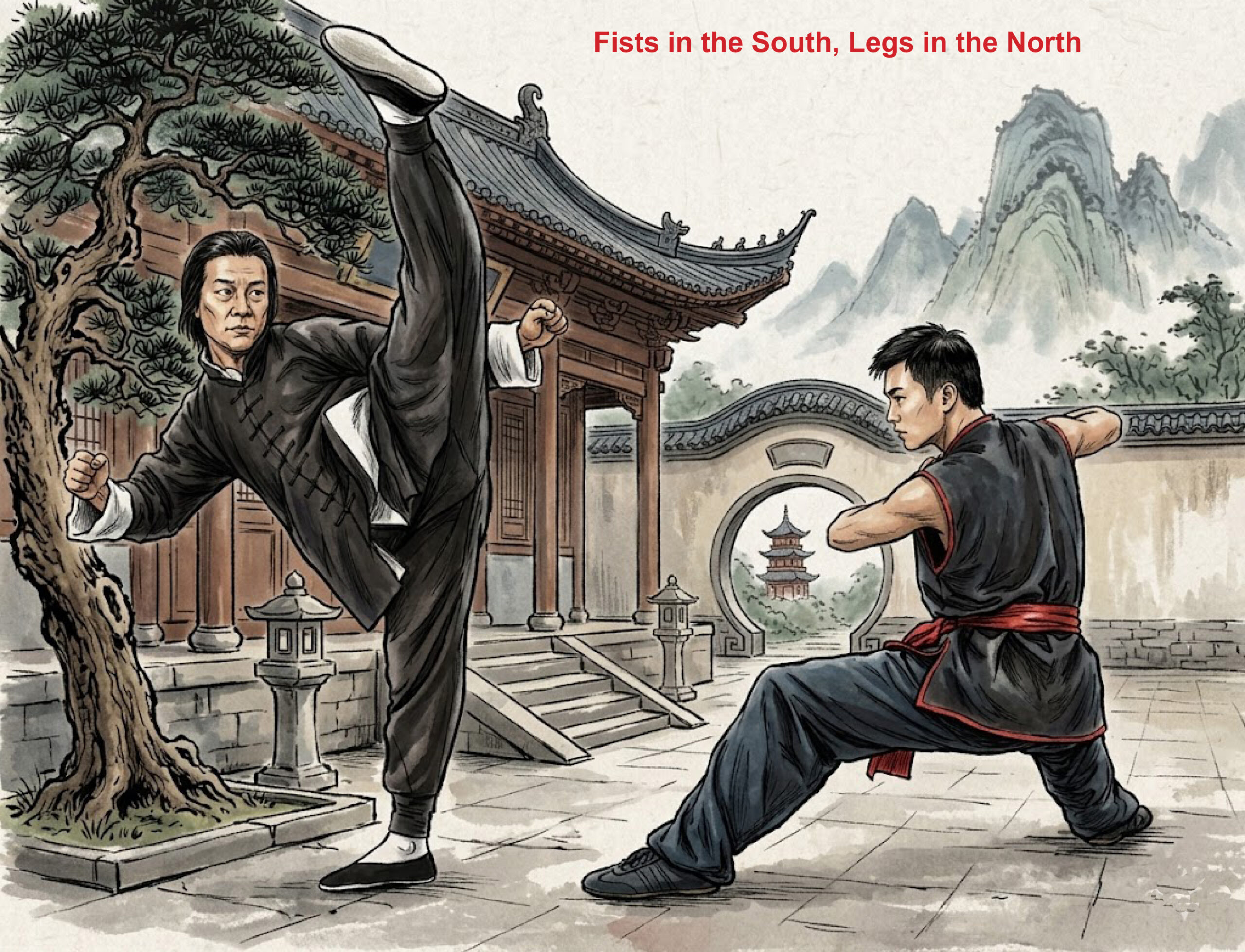
An old boxing teacher in Guangdong has a saying he repeats to every new student: “Northern legs can kick over a man’s head, but southern fists only fight within three feet.” It sounds like a joke. Anyone who has actually trained knows it points to one of the most interesting dividing lines in Chinese martial arts.
Where the Saying Comes From
“Southern fists, northern legs” was never the advertising slogan of any single school. It is a folk summary that took shape during the Qing dynasty (1644-1912), when martial arts moved out of military camps and escort agencies and into ordinary neighborhoods. As more people practiced, each region’s fighting style began to carry traces of local life. By the Republican era (1912-1949), when organizations like the Jingwu Athletic Association and the Central Guoshu Institute staged matches and published textbooks, northern and southern teachers shared the same stage, and the saying spread even further.
One thing needs to be clear from the start: the saying describes a tendency in style, not a ranking of skill. The south has leg techniques, and the north has short-range punching. To say “southern fists” does not mean southern fighters never train their legs, and to say “northern legs” does not mean northern fighters cannot use their hands. The phrase simply picks out the most distinctive, most memorable part of each region’s boxing.
Here is a concrete comparison. The first form of Wing Chun, called Siu Nim Tao (literally “little idea form”), is practiced almost entirely within the space of a single square table. The feet barely move; all the power is generated within a few inches. A northern style like Chaquan (Cha-style boxing), by contrast, includes a famous set called the Ten Roads of Tan Tui (springing legs), in which a single road may cover a dozen steps of advancing, retreating, and turning. Same word, “practice,” but a completely different feeling in the body.
Why Southern Fists Are Dense and Rooted
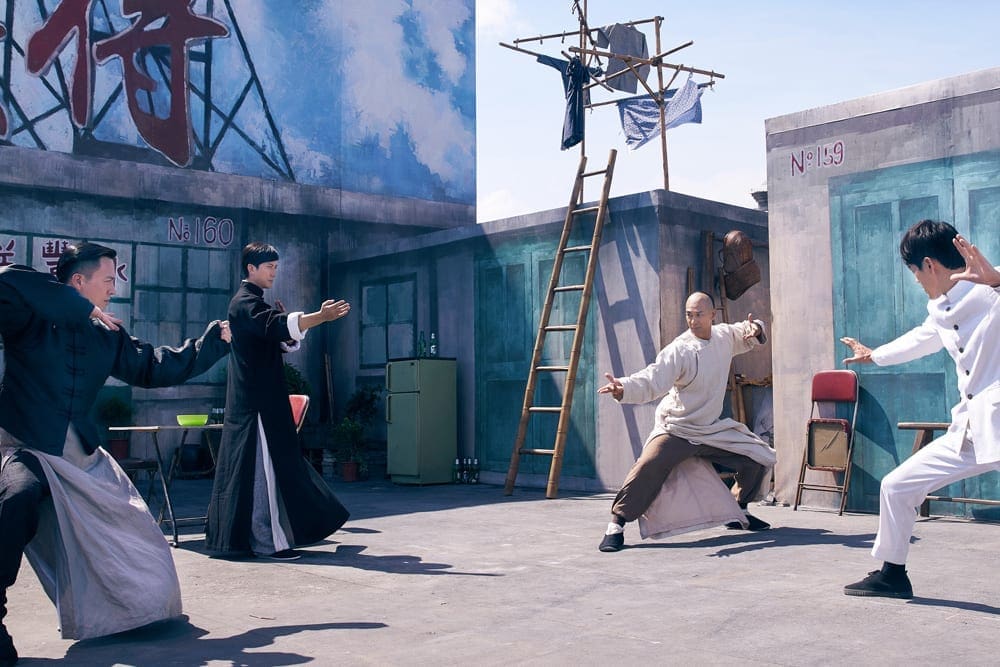
The south is a land of rivers, canals, hills, and crowded villages. Alleys are narrow. People practiced on boats, on field ridges, and in the courtyards of ancestral halls. When space is tight, techniques cannot be wide and sweeping. Southern styles therefore developed dense handwork, fast-changing hand techniques, and solid, low stances.
Hong Quan (Hung Gar), one of the best-known southern styles, is a good example. Its foundational form, Gong Zi Fu Hu Quan (the “T-shaped tiger-subduing fist”), uses rigid forearm techniques known as “bridge hands” and a deep, stable horse stance. The guiding principle is summed up in the phrase “take root when you land”: first stand firm, then worry about hitting anyone. Baihe Quan (White Crane style) imitates the pecking and wing movements of a crane, short, quick, and precise. Cai Li Fo (Choy Li Fut) blends punches, palm strikes, claw grabs, and bridge techniques into continuous close-range combinations.
Daily life shaped these choices as well. In the Lingnan region of Guangdong and Guangxi, clan villages lived close together, and village defense was a real, practical need. A fighter wanted a problem solved in three to five moves. Wing Chun’s famous principle of “simultaneous attack and defense” comes straight from that logic: the block and the strike are the same motion, giving the opponent no time to breathe. When the legendary teacher Huang Feihong opened his school in Foshan, he taught the same emphasis: hard bridge hands, a steady horse stance, and only then, striking.
Southern styles also share one technical obsession: the “bridge.” In Chinese martial arts, the bridge means the forearm as both weapon and shield. Techniques with names like “sealing hand,” “sinking bridge,” and “circling bridge” turn a close-range exchange into something like a fast game of chess played at arm’s length. Building a good bridge takes years of stance training and partner drills, because the forearm must be both hard like an iron ruler and springy enough to redirect force.
Why Northern Legs Are Long and Expansive
The north is different. Wide plains, open training grounds, and a daily life that included horseback riding, marching, and long-distance escort work all favored the legs. A leg is simply longer than an arm, and in open space, that extra reach is a real advantage. Shaolin Quan, Baji Quan, Chuo Jiao (poking-foot boxing), and Tan Tui are all northern representatives famous for their kicking.
Tan Tui, literally “springing legs,” is traditionally taught as twelve roads, each with its own combination of kicks and footwork. Practiced well, the leg snaps out like a whip and returns just as fast. Chuo Jiao goes even further. Folk sayings about it claim that “the hands are just two doors; it is the legs that do the fighting,” and its mandarin-duck kicks and chain kicks arrive in waves. Baji Quan is best known for close-range shoulder and elbow strikes, but its chopping kicks and stamping kicks are equally fierce, following the old rule of “seven parts leg, three parts hand.”
Military tradition also runs deep in northern boxing. The long-fist systems that grew out of Song-dynasty military training, and the military forms compiled by the Ming general Qi Jiguang, all favored large, open, fully extended movements. A practitioner in a long robe, running through a full form in a village courtyard, moved with big arcs and a brisk rhythm. The result was not only practical but visually striking. Northern teachers still say “train the legs before the fists,” because solid legwork is what keeps the whole stance stable.
The Geography and Daily Life Behind the Styles
Put the two traditions on a map and the differences make sense. In the south, waterways were the roads. People traveled by boat, and on a rocking boat the first skill you need is balance and a low center of gravity. Indoor fighting and alley encounters made short strikes, bridge hands, and “inch power” (explosive force delivered over a very short distance) the natural answer.
In the north, the open terrain gave fighters room to move. Habits formed on horseback and on long marches carried over into training: long stances, big frames, and kicking techniques had room to grow. Diet and build are sometimes mentioned by old teachers as well. Northerners, on average taller with longer limbs, could make good use of reach; southerners, often smaller and quicker, found close-range entanglement and rapid combinations more natural. That is a broad statistical tendency, not a rule about any individual, and it should never be used to label a person.
There is one more thread that is often overlooked: exchange. The Grand Canal, trade routes, and escort agencies constantly connected northern and southern teachers, and styles borrowed from each other all along. Northern Chaquan contains traces of southern short striking, and southern Cai Li Fo absorbed footwork from northern long-fist boxing. The north-south divide is less like a wall and more like two rivers: different sources, but long since flowing into each other.
How to Read the Old Saying Today
The most valuable lesson of “southern fists, northern legs” is that martial arts do not grow out of nowhere. They grow out of life. When you meet a new style, ask three questions: where was it practiced, for whom, and what problem was it solving? Once you know the answers, the style’s quirks suddenly have a history. Without that background, talking about styles easily slides into empty arguments about which school is better, and that is exactly the trap the old saying warns against, because it was never a ranking in the first place.
For anyone starting to practice today, the practical advice is simple.
- Try both before choosing sides. Experience the basic training of one southern and one northern style, for example Wing Chun’s Siu Nim Tao and the first three roads of Tan Tui. Your body will tell you the difference faster than any book.
- Cross-train the missing piece. If you practice a southern style, borrow some northern leg flexibility and sense of distance. If you practice a northern style, borrow southern bridge hands to sharpen your close-range reactions.
- Watch the feet when you watch a performance. In a documentary or a live demonstration, the fastest way to read a style is to watch the stance and the striking distance: tight and rooted, or long and expansive?
Southern fists and northern legs were never two sides of a contest. They are two halves of one puzzle. The density, stability, and cleverness of the south, together with the length, openness, and vitality of the north, make up the complete picture of traditional Chinese martial arts. The next time you hear the saying, treat it as a map. Follow it, and you will see rivers and mountains, daily life, and hundreds of years of people who practiced.
Quick Answers
Does “southern fists, northern legs” mean the south is better at punching and the north at kicking? No. It describes each region’s most distinctive tendency, not a scoreboard. Both regions train hands and legs; the saying highlights what each is most famous for.
Which southern styles should a beginner look at first? Wing Chun is a good entry point for close-range structure, and Hong Quan (Hung Gar) is a good choice if you want strong stances and bridge-hand training.
Which northern styles are known for legwork? Tan Tui (springing legs) and Chuo Jiao (poking-foot boxing) are the classic examples, and both are still widely taught as foundational leg training.
Can one person practice both traditions? Yes, and many modern teachers recommend it. Southern close-range sensitivity and northern distance control complement each other well.
What should I watch for in a performance? Watch the feet and the striking distance. Small steps, rooted stances, and short strikes point south; long strides, big frames, and extended kicks point north.
Practice within your limits, and seek guidance from a qualified instructor before attempting any new physical training routine.