A long spear leans against the wall, its red tassel bright in the light. Most people pick it up for the first time full of excitement — and lose it within three minutes. The tip wobbles, the shaft feels heavy, and the thrust comes out soft and limp. Here is the truth about learning the spear: it is not about strength. It is about three things working together — grip, technique, and footwork. Get those three in sync, and within three months you will be thrusting like you mean it.
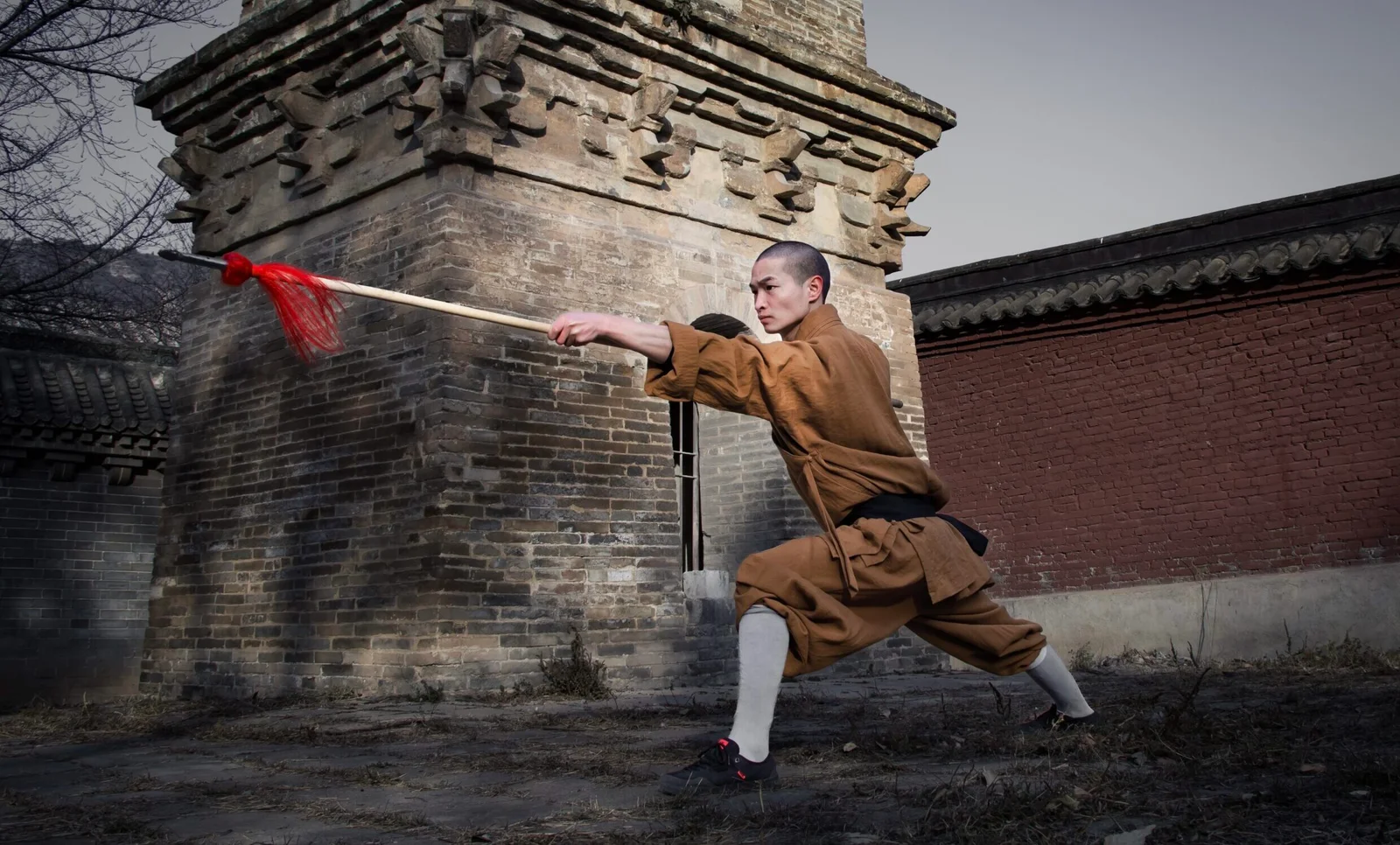
In Chinese martial arts, the spear is called the “king of weapons” — not because it is the flashiest, but because it is the longest and the most honest. It hides nothing. If your hands are wrong, the tip tells on you. If your feet are wrong, your whole body tells on you. That honesty is exactly why it is such a good teacher for beginners.
Know Your Spear: Three Types, One Starting Point
Traditional Chinese spears fall into three main types. The great spear (da qiang) has a thick shaft and a heavy head. It was the battlefield weapon, built around the old saying “one inch longer, one inch stronger,” and it usually runs 2.6 to 3 meters long. The flower spear (hua qiang) is light with a small head, made for performance and forms. The white waxwood spear (bai la gan qiang) has a flexible shaft that trembles when you thrust — it is the best tool for learning to feel force and to release power cleanly.
For a beginner, start with a white waxwood spear. Remember three numbers when choosing one. Length: roughly your height plus 30 centimeters — if you are 170 centimeters tall, a spear around 2 meters is right. Weight: between 1.5 and 2 kilograms; anything heavier and your wrists will give out first. Grip: the shaft should feel smooth but not slippery, and never over-waxed.
Before buying, borrow one from a martial arts school and try it. Stand straight, hold the middle of the shaft with one hand, and extend your arm level. If you can hold it steady for 10 seconds without shaking, the weight suits you. If you cannot, go lighter. Do not tough it out — a strained wrist can cost you a month of rest.
Grip: Two Hands, Two Jobs
The grip is the foundation of spear work. Your rear hand — usually the right — sits on the back third of the shaft. It is the power hand: it drives the spear out and pulls it back. Your front hand — usually the left — sits about 40 centimeters from the spearhead. It is the guiding hand: it steadies the direction and controls the tip. Keep the two hands 60 to 80 centimeters apart. Too close and you cannot generate force; too far apart and the tip wanders.
There are two basic grips. In the yin grip, the rear palm faces down; in the yang grip, it faces up. Thrusts mostly use the yin grip, because it drives the spear out cleanly. Blocking and pressing often require switching between the two, which you do by rolling the wrist. As a beginner, master the yin grip first — switching grips is an advanced skill.
Three common mistakes to avoid. First, gripping too tight: white knuckles and a stiff wrist turn the spear into a dead stick. The right feeling is “hold it, do not strangle it” — leave your fingers a little room to move. Second, putting the front hand too close to the head: with only 20 centimeters of tip left, your thrust becomes a short-stick poke. Third, holding the very end of the shaft: the tail drags down, and one thrust leaves your arm aching.
Here is a simple daily drill for grip strength. Hold the spear level in front of your chest with both hands, and aim the tip at a fixed point about 3 meters away — a nail on the wall, for example. Hold for one minute. If the tip drifts more than 5 centimeters up or down, your wrists are not steady yet. Keep practicing.
The Three Core Techniques: Block, Press, Thrust
Traditional spear work is built on three moves: lan (block), na (press), and zha (thrust). Learn these three well and you can handle most basic skills tests. The thrust is the core. The rear hand drives the spear forward while the front hand slides along the shaft, sending the tip straight at a point level with your chest. Thrust out fast, pull back fast — one out-and-back counts as one rep. Count as you go, and do at least 50 reps per session.
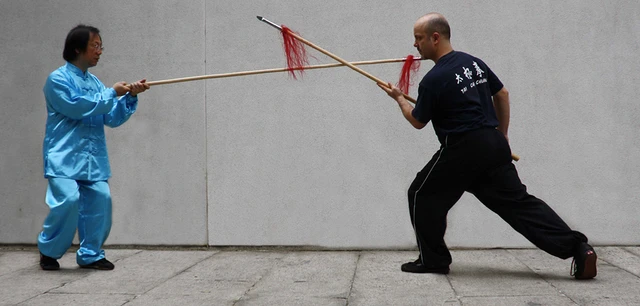
The block is a defensive move. When an opponent’s tip comes at you, your front hand lifts the shaft upward, tracing a small arc that deflects the incoming spear. Watch the angle: keep about 30 degrees between your shaft and theirs. Too small an angle and you cannot deflect it; too large and you leave your own guard wide open.
The press is a controlling move. You drive the tip downward onto the middle of your opponent’s shaft, pinning it so they cannot thrust. The power comes from sinking your waist and hips, not from your arms. Drop your waist and the tip presses down by itself — that force is far greater than arm strength alone.
Now link the three together. Thrust; your partner blocks; you deflect their spear with a block of your own, press down to pin it, and thrust again. Practice this combination 20 sets a day, three moves per set, without pausing between them. After two weeks, you will notice the tip pointing noticeably steadier.
Footwork: The Spear Arrives When the Feet Arrive
There is an old saying in spear practice: “the spear arrives when the feet arrive.” Wherever the tip goes, the feet must follow. Train the hands without the feet and your thrust is a spear with its roots cut — one push and it falls over.
The most basic footwork is the bow-stance thrust. Left foot forward, right foot back, front leg bent, rear leg driving. As you thrust, step forward half a step with the front foot, so the tip and the toes arrive almost together. Never let the rear heel leave the ground — the moment it lifts, you lose your base and the thrust loses its power.
Retreating has its own move: the step-back block. When your opponent attacks, step back with the right foot first, shift your weight backward, and lift the spear to block in the same motion. Keep the retreat to about 30 centimeters. Step back too far and you lose your range; too short and you do not escape the attack.
Another essential step is the follow step (gen bu). After the front foot steps out, the rear foot follows up half a step at once, keeping your center of gravity between your legs the whole time. With a good follow step, you will not lean forward or backward during a run of consecutive thrusts.
A simple way to train footwork: draw a straight line 3 meters long on the ground, and practice bow-stance thrusts along it, going back and forth 10 times. The tip should travel along the line and your feet should never step off it. If you drift off, stop and start again. What you are training is the synchronization of spear and step.
Your First Four Weeks: A Beginner Plan
- Week 1: Grip and holding only. 20 minutes a day: hold the spear level for 3 sets of 1 minute, then 100 thrusts in place, split into 2 sets. Goal: hold the spear without aching, and keep the tip from shaking.
- Week 2: Add the block and the press. 30 minutes a day: 100 thrusts, 50 blocks, 50 presses. Practice each move separately until the shapes are clean, then link them. Goal: no distorted movements.
- Week 3: Add footwork. 30 minutes a day: bow-stance thrusts along the line, 10 round trips; 50 step-back blocks; 50 follow-step thrusts. Goal: the spear arrives when the feet arrive.
- Week 4: Combine everything. 40 minutes a day: 20 sets of the thrust-block-press combination, then the first three moves of a simple spear form, such as the opening of the “Five Flowers Spear.” Goal: smooth, continuous movement with steady breathing.
After a month, if you can do 100 thrusts without your arms aching and land the tip within 10 centimeters of your target, you have entered the door. Do not rush into learning full forms — without solid basics, a form is just an empty show.
Quick Answers
Which spear should a beginner buy? A white waxwood spear, about your height plus 30 centimeters, weighing 1.5 to 2 kilograms. Borrow one first and test it with the one-hand level hold.
How far apart should my hands be? 60 to 80 centimeters. The rear hand drives, the front hand guides — too close kills your power, too far makes the tip wobble.
What is the single most important technique? The straight thrust. It is the core of the other two moves, and 50 reps a day will do more for you than any fancy form in your first month.
Do I need a partner to practice? Not at first. Grip drills, thrusts, and footwork along a line can all be done solo. Add a partner only when your three basic moves are clean.
How long until I see progress? Most beginners feel the tip steadying within two weeks of daily practice. After a month, 100 thrusts without arm fatigue is a realistic benchmark — and a real one.
The Spear Trains Patience
There is no shortcut into spear work. Grip, thrust, footwork — practice a little every day, advance a little every week, and in a month the change is visible. Pick a spear that fits you, find an open space, and follow the four-week plan. When 100 thrusts leave no shake in your hands and your feet keep up with the tip, you are in. Train the spear and you train the mind first: steady the wrist, steady the step, and the tip steadies itself.
Safety note: Practice in an open, flat area, and keep a clear radius of at least 3 meters with no one passing through. Beginners are advised to wear wrist guards and to warm up the wrists, shoulders, and lower back thoroughly before training. Cover the spearhead with a cloth sleeve to avoid accidental injury. Increase your training load gradually, and stop immediately if your wrists or shoulders hurt; if pain lasts more than two days, consult a qualified professional. This article is cultural education about traditional Chinese martial arts only and is not medical or rehabilitation advice.