Picture a dinner table. The bill arrives, and before anyone can reach for it, one friend has already grabbed it. In a business meeting, when the plan hits a wall, the same person is the first to say, “I’ll cover it.” A friend texts asking to borrow money, and the reply comes back in under three seconds: yes. Do you know someone like this? In the BaZi system — the Chinese “Four Pillars of Destiny,” a traditional method of reading a person’s birth chart — this energy of rushing to give, rushing to take responsibility, has a name of its own: Jiecai, often translated as “Rob Wealth.”
Before we go further, one thing matters: BaZi is a cultural framework for understanding personality patterns, not a verdict on anyone’s fate. Jiecai describes a tendency, not a destiny. This guide reads it the way the tradition itself suggests — as a lens for self-knowledge, not a prediction.
What Is Jiecai? A “Same Element” Among the Ten Gods
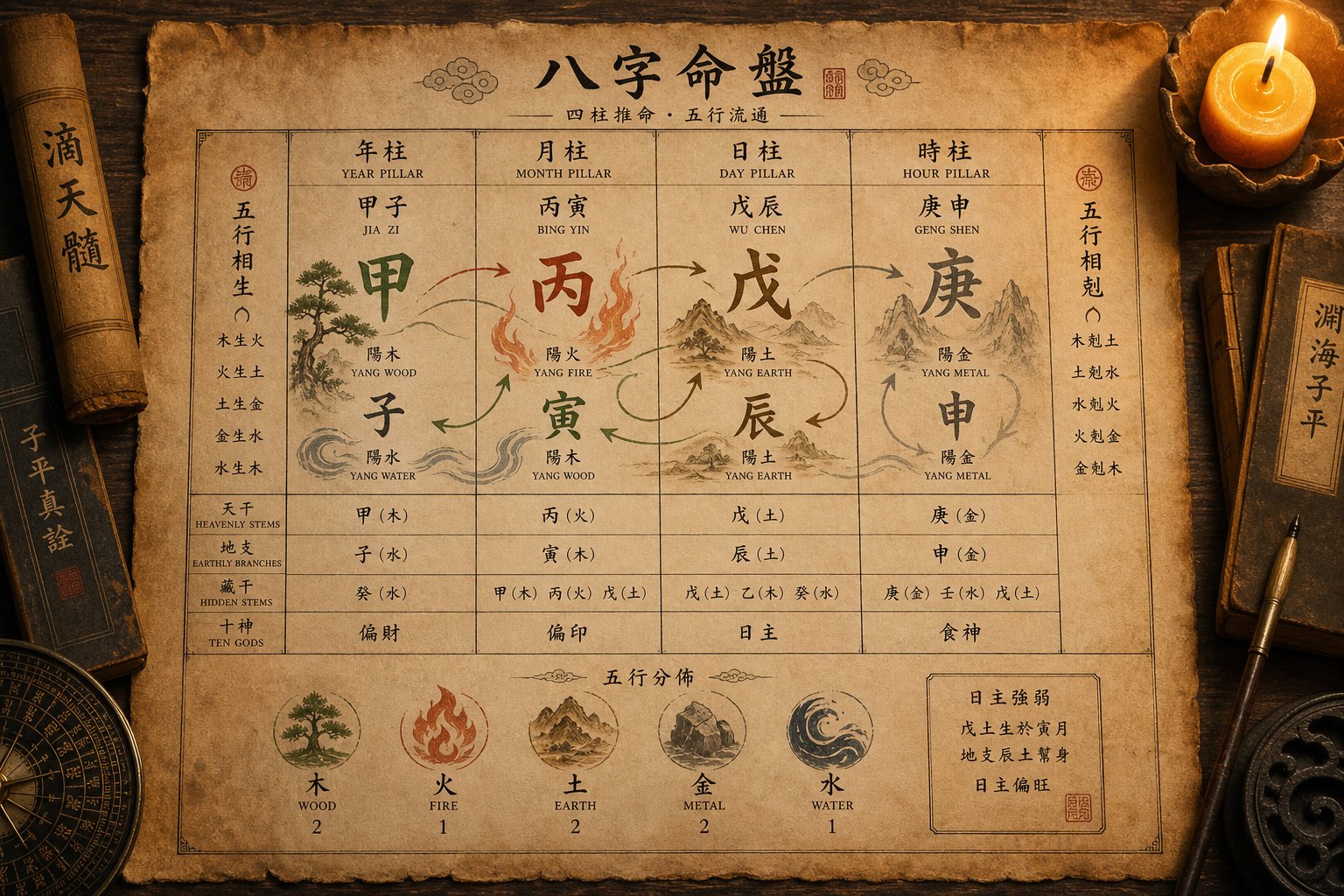
The Ten Gods (Shishen) are ten symbols BaZi uses to describe how the Day Master — the element representing you, derived from the day you were born — relates to every other element in your chart. Jiecai has a very plain definition: it is the element that shares your Day Master’s element but carries the opposite yin-yang polarity. If your Day Master is Yang Wood (Jia), then Yin Wood (Yi) is your Jiecai. If your Day Master is Yang Fire (Bing), then Yin Fire (Ding) is your Jiecai. Same element, so the two resonate with each other; opposite polarity, so there is a competitive edge between them.
The old name is vivid. The character “jie” does not mean robbery in the criminal sense. It means this energy divides what belongs to the Day Master — money, opportunities, attention — and takes a share of it. When Jiecai shows up in the month branch, the “commander” position of the chart, it colors the whole personality. When it appears in the year, month, and day pillars at once, that dividing, sharing, competing current runs through a person’s entire life.
The first thing to get straight: Jiecai is not a lucky or unlucky label. It is more like a coordinate on a personality map — it tells you which direction someone instinctively leans when handling resources, relationships, and competition.
Three Faces of a Strong Jiecai
People with strong Jiecai energy tend to show three faces, often at the same time. Understanding all three — not just the flattering one — is the key to reading this pattern honestly.
Face One: Loyalty
The first face is generosity in action. For someone with strong Jiecai, friendship is defined by showing up. Take Old Chen, a neighbor from my hometown: whenever a family in the village needed hands to build a house, he was the first on site — hauling bricks, mixing mortar, cooking for the crew — three days of work without a word of complaint. People like this choose friends by chemistry, not by usefulness. Once they decide someone is worth it, they give wholeheartedly.
Face Two: Competitiveness
The second face is a drive to compete. Same element, same energy — meet a peer and the instinct is to measure yourself against them. Picture two salespeople joining a company on the same day. When the colleague closes a big deal, the Jiecai-strong one does not feel envy; the first thought is, “Next month, I’ll close an even bigger one.” This competitiveness usually points upward. The stronger the rival, the more energized they become.
Face Three: Impulsiveness
The third face is impulsiveness. Jiecai energy arrives fast and leaves fast. They buy something the moment they like it; they hear a business idea at night and want to recruit a partner by morning. Many opportunities are won exactly this way — by saying yes first and figuring it out later. The risk is that the costs only become clear afterward: money lent out and never returned, a project accepted before realizing there are not enough hands to finish it.
These three faces usually appear together: the same person who would take a bullet for a friend can also talk themselves into a corner through a split-second decision. To understand Jiecai, you have to accept this contradiction — it is both the source of loyalty and the crack through which money leaks.

Jiecai in Business: The Best Partner — and the Hardest Test of Boundaries
There is a saying in startup circles: look for a co-founder who has strong Jiecai but with something to keep it in check. The experience behind it is that Jiecai-strong people bring momentum and do not count every penny of effort. When the team is short-handed, they fill the gap; when cash is short, they cover it. In the hardest first three months of a venture, they are often the ones holding everything together. I know a restaurant founder whose partner pulled out right before opening day — he mortgaged his car and maxed out two credit cards to get the doors open. And the first thing he did after opening was to make the accounts visible to the whole staff.
But Jiecai in partnership has another side: boundaries blur easily. The company account and the personal wallet get mixed; the partner’s money and one’s own money get counted together. When profits come in, everyone is happy. The moment losses appear, every old entry in the books becomes ammunition for an argument. There is also the habit of taking on everything — refusing to delegate, leaving teammates with nothing to do, burning out while the team never grows.
So the rule for working with a Jiecai-strong person is to settle the rules first. Put equity splits in a written agreement. Require two signatures on financial approvals. Spell out who decides what, in black and white. Jiecai values loyalty, but loyalty cannot replace a system; once the system stands, loyalty has somewhere solid to land. And if you are the Jiecai-strong one, proposing a contract and open books before the partnership starts is not a sign of distrust — it is insurance against your own impulsiveness.
Jiecai in Relationships: Generous — and Prone to Overstepping
In a circle of friends, Jiecai-strong people are usually well liked, because they are the ones who actually show up: moving house, airport runs, sitting with someone in a hospital at 2 a.m. One call and they are there. Their contact list may hold two or three thousand names, but the truly close friends number five or six.
The trouble starts with overstepping. A friend goes through a breakup, and they march off to confront the ex. A colleague gets criticized by the boss, and they defend them on the spot. Relatives argue, and they drive over at midnight to mediate. The intention is good, but the person involved often does not appreciate it — the deeper an outsider wades into someone else’s family business, the more likely they end up pleasing nobody. The lesson Jiecai-strong people need to learn is simple: before helping, ask, “What do you need me to do?” instead of deciding for the other person.
The same pattern shows up in romantic relationships. A Jiecai-strong partner often expresses love by spending money and carrying burdens — that, to them, is what love looks like. But the partner may actually want companionship, listening, or simply respect for their own choices. A reader once wrote to me about her husband, whose Jiecai is very strong: he decided everything in the household, big and small. She said, “He is so good to me that I have lost myself.” That is the blind spot of Jiecai in intimacy: a great deal of giving, very few boundaries.
The fix is not complicated: swap “I know what’s best for you” for “Tell me what you think,” and ask one more question before jumping in to help.
Once You Understand Jiecai, How Do You Use This Energy Well?
In BaZi, no Ten God is absolutely good or bad, and Jiecai is no exception. Used well, it is drive, initiative, and loyalty. Used poorly, it is impulsiveness, lost money, and blurred boundaries. The point is not to suppress it, but to give it the right outlet.
The first outlet is competitive work. Sales, entrepreneurship, competitive sports, any role that calls for charging ahead — the “competing” edge of Jiecai is an advantage here. Put that drive into measurable goals like revenue or finished work, which pays far better than competing with the people around you.
The second outlet is discipline inside cooperation. Sign the agreement before the partnership. Think through the worst case before lending money. Before any non-essential purchase over a few hundred dollars, give yourself a 24-hour cooling-off period. The rule looks simple, but after three months of following it, most people find their pile of “favor debts” has shrunk by more than half.
The third outlet is putting loyalty to constructive use. Jiecai-strong people make natural organizers: communities, sports teams, hobby groups, volunteer projects — any setting that needs someone to rally people and cover the gaps is exactly where this energy shines. Once giving has a clear direction and a boundary, it stops being a bottomless pit.
And one more caution: never judge a chart by a single Jiecai alone. The Ten Gods must be read as a whole — is there an Officer (Guan) nearby to restrain it, an Output (Shishang) to channel it, is the Wealth star strong or weak? Those combinations decide how the same Jiecai looks in different people.
Quick Answers
Is Jiecai good or bad? Neither. It is a personality pattern: strong loyalty and drive on one side, impulsiveness and blurred boundaries on the other. The outcome depends on how it is channeled, and on the rest of the chart.
How do I know if I have strong Jiecai? In a BaZi chart, look for the element that matches your Day Master’s element with opposite yin-yang polarity, especially in the month branch. A full reading should be done by a qualified practitioner — a single star never tells the whole story.
Can Jiecai people be good business partners? Yes — often the best, because they bring energy and do not count small costs. The condition is clear written rules: equity, financial approvals, and decision-making agreed in advance.
What is the single most useful habit for a Jiecai-strong person? A 24-hour cooling-off period before any large non-essential expense. It is small, it is concrete, and it directly counters the impulsive side of this energy.
Jiecai is a mirror. In the end, what it reflects is a way of moving through the world: willing to give, daring to compete, unafraid to lose out — and also prone to impulse, to overstepping, to letting money slip away. The energy itself is neither right nor wrong. The difference lies in whether it has been given a proper place. When it is, it becomes the most moving part of a person.
If you have a Jiecai-strong friend, offer them a little more understanding. If that person is you, try three small things: wait 24 hours before any large expense, put the rules of a partnership in writing before you start, and ask what the other person truly needs before you help. Do those three things for a month, and the Jiecai energy will still be there — but the impulsiveness will be much quieter.
This article is a cultural introduction to the BaZi tradition for general interest. It is not financial, medical, or life advice, and it makes no predictions about any individual’s future.