It’s 10 p.m. You’ve been at your desk since nine in the morning, and your chest feels like someone left a stone sitting on it. You sigh, and even that feels like hard work. Without thinking, your hand drifts to the center of your chest and starts rubbing in small circles. That spot your fingers found on their own — there’s a name for it in traditional Chinese medicine: Danzhong, the “Chest Center” point.
In Chinese medicine, the body is mapped with acupoints — specific spots along energy pathways called meridians, through which qi (vital energy) is understood to flow. Danzhong, also known as CV17 (the 17th point of the Conception Vessel, the meridian running up the centerline of the front of the body), sits right in the middle of the chest. Traditional texts describe it as a gathering place for qi in the upper body, and for centuries people have pressed it to ease that heavy, stuck feeling. This guide shows you how to find it, how to press it safely, and when to leave it alone.
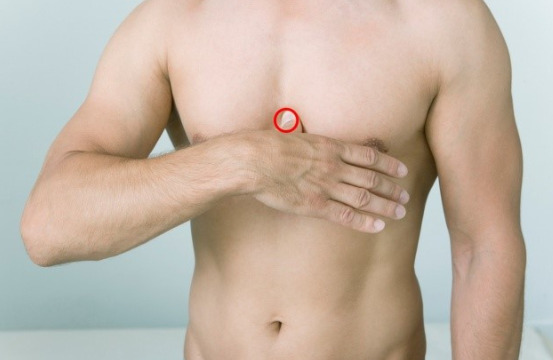
Where Is Danzhong? Find It in Three Steps
Danzhong sits on the midline of the chest, at the midpoint of the line connecting your two nipples. Sit or stand up straight, drop your shoulders, and run your fingers down the center of your breastbone. When you reach the level of the nipples, press gently — a faint, dull ache is the signal you’ve found it.
Step 1: Find the horizontal line
Raise one arm and locate the nipple on that side. This gives you the height of the line you need. In most adults, this point sits roughly 10 to 12 centimeters (about four to five inches) below the top of the breastbone, though body shape can shift it a centimeter or two.
Step 2: Find the vertical line
Place your index and middle fingers together on the center of your breastbone and slide them slowly up and down. You’re tracing the midline of the chest — the Conception Vessel runs right along it. The point where this vertical line crosses the horizontal nipple line is Danzhong.
Step 3: Confirm by feel, not by ruler
Press the spot lightly. You should feel a soft, slightly tender hollow — not hard bone. That dull, achy sensation is the most reliable confirmation. For women, pressing through a thin layer of clothing works fine; the landmark is the same. For larger body types, the crossing point may sit about half a centimeter lower than the exact midpoint, so trust the ache over the measurement.
Common mistake: aiming too high. Beginners often land on the upper breastbone, near the manubrium (the broad, flat top of the sternum). That area feels hard and bony, with almost no ache when pressed. Slide your fingers two to three centimeters lower until you feel a small, soft dip — press it, feel the faint soreness, and you’ve got it.
How to Press It: Pressure, Rhythm, and Timing
The single most important rule for this point is: gentle. Directly underneath it are the breastbone and ribs, and the skin here is thin. Pressing hard doesn’t help more — it just hurts. Use the pad of your middle finger, keep it in contact with the skin, and work in small circles around the point, 60 to 80 circles per minute. The pressure should be just enough to produce that dull ache, never a sharp sting.
Circular rubbing: the best starting technique
Place the pad of your middle finger on the point and rub 30 circles clockwise, then 30 circles counterclockwise. That’s one set. Do two or three sets a day — three to five minutes total is plenty. Breathe with the movement: press a little deeper as you inhale, ease off as you exhale, letting your chest rise and fall with the rhythm. Around the second minute you may yawn or let out a long sigh — that’s your body relaxing.
Steady pressing: when the tightness is stronger
If your chest feels seriously constricted and rubbing seems too mild, switch to steady pressing. Place the pad of your middle finger straight down on the point, slowly increase pressure until you feel the dull ache, hold for five seconds, then slowly release. Repeat eight to ten times. Never use your fingernail, never jab suddenly, and never dig in with a knuckle. You can combine the two techniques: one minute of steady pressing, then three minutes of circular rubbing to finish.
Timing matters too. Three minutes after waking helps your chest open up after a night curled in bed. A short session half an hour after lunch eases the heavy feeling from sitting all morning. The best slot is one hour before bed — but not right at bedtime, because the lingering ache can make it harder to fall asleep. Once or twice a day is enough. Ten minutes won’t work twice as well as three; if the skin turns red or sore, stop the next day.
When to Use It: Four Everyday Moments
After three hours of back-to-back meetings. You’ve barely spoken, but your chest feels tighter with every hour. Step to a window when the meeting ends, rub the point for two minutes with three slow, deep breaths, and your shoulders will loosen along with it. The point of the massage is to break the stiffness of sitting still — not to treat an illness.
Finishing a project at midnight. Your mind is racing, but your chest feels stuffed with cotton. Before you close the laptop, rub for three minutes, take two sips of warm water, and go wash up for bed. Staying up late is hard on your body — this is just a small wind-down ritual, not compensation for the late night.
After a run or a long climb upstairs. Your heart is still pounding and your chest feels tight. Walk slowly for three to five minutes first, and only press once your breathing has settled — with one-third less pressure than usual. Pressing hard right after exercise, while your heart is still racing, only makes the discomfort worse.
After an argument. A fight with family, or a single cutting remark from a client, leaves the anger stuck in your chest. Find a quiet corner, sit down, and rub for three minutes while you slow your breathing — count to four on the inhale, six on the exhale. Once the tension eases, deal with whatever made you angry.
Five Mistakes to Avoid
- Pressing too hard: If the skin turns red or bruises, you’ve gone too far. The correct feeling is a dull ache, not sharp pain. If it hurts, lighten up immediately.
- Going too long: Fifteen or twenty minutes of rubbing leaves the skin hot and tender the next day. Three to five minutes is the ceiling — more is not better.
- Pressing through a thick sweater: In winter, a heavy jumper absorbs all the pressure and your fingers never really reach the point. One thin layer is fine; take the thick coat off first.
- Pressing right after a meal: Pressing your chest on a full stomach can trigger nausea or acid reflux. Wait at least half an hour after eating.
- Using your fingernails: Nails dig in, hurt, and can break the skin. Acupressure always uses the finger pad, never the nail.
One small detail: your hands should be clean and warm. Coming in from the cold with icy fingers makes your body flinch and your muscles tense — rub your palms together to warm them first.
Who Should Skip Self-Massage
Not everyone should press this point on their own. Pregnant people should not press acupoints on the chest or abdomen themselves — the pressure and location are hard to judge, so ask your prenatal doctor first. Anyone with broken skin, eczema, redness, or swelling on the chest, or who has recently had chest surgery, should wait until the skin has fully healed, since pressing can irritate the wound.
- People with a history of heart disease: If you feel chest tightness, chest pain, or palpitations, don’t try rubbing it away yourself — get checked first. Massage is no substitute for a medical examination.
- People with rib or breastbone injuries: A fracture or crack that hasn’t fully healed can be made worse by pressing. Wait until your doctor confirms recovery.
- People on medication or other treatment: If you’re unsure whether massage could interfere with your treatment, ask your doctor first.
- People with very sensitive skin: If pressing brings up a rash or itching, stop and try another way to relax, like a walk or slow breathing.
There is a simple test for whether you should be pressing at all: if you feel anything beyond the dull ache — a sharp sting, a pricking sensation, or the tightness getting worse — stop right away. Pain is your body telling you not to continue.
Quick Answers
How do I know I’ve found the right spot? The midpoint of the line between your nipples, on the centerline of the chest. Press it: a soft hollow and a dull ache mean you’re there. Hard bone with no ache means you’re too high — slide down two to three centimeters.
How hard should I press? Just hard enough to feel a dull ache, never sharp pain. If the skin reddens or you wince, ease off. The finger pad does the work; fingernails and knuckles never do.
How long, and how often? Three to five minutes per session, once or twice a day. Two or three sets of 30 clockwise and 30 counterclockwise circles is a full session. Longer sessions don’t add benefits.
When is the best time? After waking, half an hour after lunch, or one hour before bed. Avoid pressing right after meals or immediately after exercise — wait until your breathing has settled.
Can I press it when I’m stressed or upset? Yes — that’s one of the most common uses. Sit down, rub for three minutes, and breathe slowly (four counts in, six counts out) until the tension eases, then deal with the problem.
What if the tightness doesn’t go away? If your chest often feels tight or painful, or pressing causes unusual pain, don’t keep pushing through it. See a doctor to find the real cause — that matters far more than a few extra minutes of rubbing.
Try It Tonight: The Three-Minute Routine
Danzhong is easy to find and the technique is simple — the hard part is turning it into a habit. One hour before bed tonight, sit comfortably, place the pad of your middle finger on the center of your chest, rub 30 circles clockwise and 30 counterclockwise, and repeat for three sets while breathing slowly. Three minutes, start to finish. When you’re done, take a sip of warm water and notice whether your chest feels a little looser.
Keep it up for a week, once or twice a day, three to five minutes each time, and check whether the heavy feeling after long hours at a desk has changed. Tie it to something you already do every day — right after brushing your teeth in the morning and an hour before bed — and you won’t forget it. If after a week your chest still feels tight or painful often, or pressing it causes unusual pain, don’t tough it out. Get a medical check-up and find the real cause.
Disclaimer: This article is a cultural introduction to a traditional wellness practice and does not constitute medical advice. Use gentle pressure only — aim for a mild, dull ache, never sharp pain. Pregnant people, children, people with heart conditions, recent chest injuries or surgery, and anyone with broken or irritated skin on the chest should use caution or avoid pressing this point, and should consult a doctor first. If you experience persistent chest tightness, chest pain, difficulty breathing, or palpitations, stop immediately and seek medical care. This article makes no promise of any therapeutic effect.