Last Saturday at the wet market, white radishes were going for next to nothing. The vendor snapped one open with his hands — the flesh was snow-white, juice practically beading on the cut surface. The woman beside me bought five in one go. Her father-in-law, she said, gets a winter cough every year, and a bowl of radish soup soothes his throat. It is a plain, unglamorous vegetable. It is also one of the most useful things you can put on a winter table.
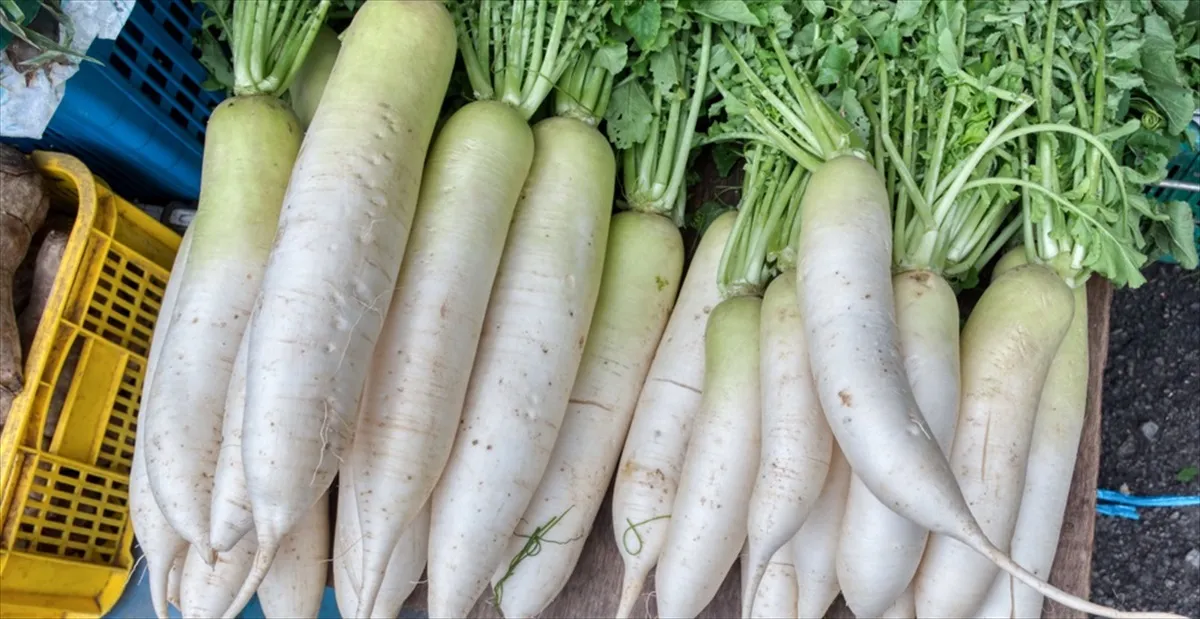
What’s Actually Inside a White Radish
Per 100 grams (about 3.5 oz), white radish — known in English as daikon — contains roughly 21 mg of vitamin C, close to half of what you would get from a medium orange. It has about 1 gram of fiber and only 21 calories, so a whole 300-gram radish (around 10.5 oz) has fewer calories than half a small bowl of rice. It also contains glucosinolates, compounds that release pungent mustard oil when the flesh is chewed. That sharp, nose-tingling bite of raw radish is the mustard oil at work — and it is also part of what makes radish a digestive aid.
Beyond that, white radish is more than 93% water, with about 173 mg of potassium and 36 mg of calcium per 100 grams. Winter air is dry, and people tend to feel parched, constipated, or overstuffed after heavy meals. A vegetable that is mostly water, with decent fiber and almost no calories, lines up neatly with all three problems. One caveat: the vitamin C in radish is heat-sensitive. Simmer it in soup for more than 40 minutes and you lose over half of it. If vitamin C is what you are after, raw or quickly stir-fried radish is the better bet.
“Eat Radish in Winter, Ginger in Summer” — Where the Saying Comes From
This old Chinese saying comes from the traditional idea of eating with the seasons. In summer, people drink iced drinks and sit in air conditioning, chilling the stomach from the inside — ginger, which is warming in nature, is meant to warm it back up. In winter, the cold outside drives people toward hotpot, braised meat, and rich food; the stomach ends up stuffed and overheated, and radish, which is cooling in nature and helps move food downward, is meant to settle that heat.
Modern nutrition can explain about half of it. After the first frost, the starch in winter radish converts to sugar, so it tastes sweeter and holds more water — it is genuinely the best radish of the year. The saying is about following the season, not an iron rule for everyone. People whose digestion already runs cold can end up with loose stools if they eat raw radish every day in winter. More on that below.
Four Ways to Eat It — and Why They Feel So Different
The same radish, prepared four ways, is practically four different foods.
Raw: the most vitamin C, and the strongest kick
Shredded raw and tossed with a splash of vinegar and sesame oil, radish keeps the most vitamin C, and the mustard-oil pungency is at its fullest — an excellent appetite opener. The downside is that it is cold and raw. If your stomach is sensitive, about 100 grams (3.5 oz) at a time is enough, and do not eat it on an empty stomach.
In soup: the gentlest, and the best for the whole family
Cut into chunks and simmered for about 30 minutes with pork ribs or lamb, radish soaks up the richness of the broth while cutting the meat’s greasiness. Much of the vitamin C is lost, but the fiber and minerals mostly survive, and a good amount of potassium leaches into the soup. For older people, children, and anyone with a weak stomach, soup is the safest way to eat radish.
Pickled: a rice-table star, but watch the salt
Radish strips salted to draw out water, then tossed with chili flakes, white vinegar, and sugar, are ready after one night in the fridge — crisp, tangy, and dangerously easy to eat with rice. The catch is salt: 100 grams of pickled radish often contains more than 3 grams of salt, so one small dish can be a third of your whole day’s salt intake. People with high blood pressure should keep it to a treat — around 50 grams (under 2 oz) is plenty.
As a filling: the most underrated way to eat it
Shred radish, blanch it, squeeze it dry, and mix it with ground pork, dried shrimp, or egg for dumpling or bun filling. Blanching removes most of the pungency, children like it, and one meal can easily deliver 150 grams (over 5 oz) of radish — far more than most people would eat from a plate of stir-fried radish alone.
In short: eat it raw for vitamin C, in soup when you want everyone at the table to enjoy it, pickled as a condiment in small amounts, and as a filling when you want children to eat more of it without noticing.
Three Winter Radish Recipes, Measured Out
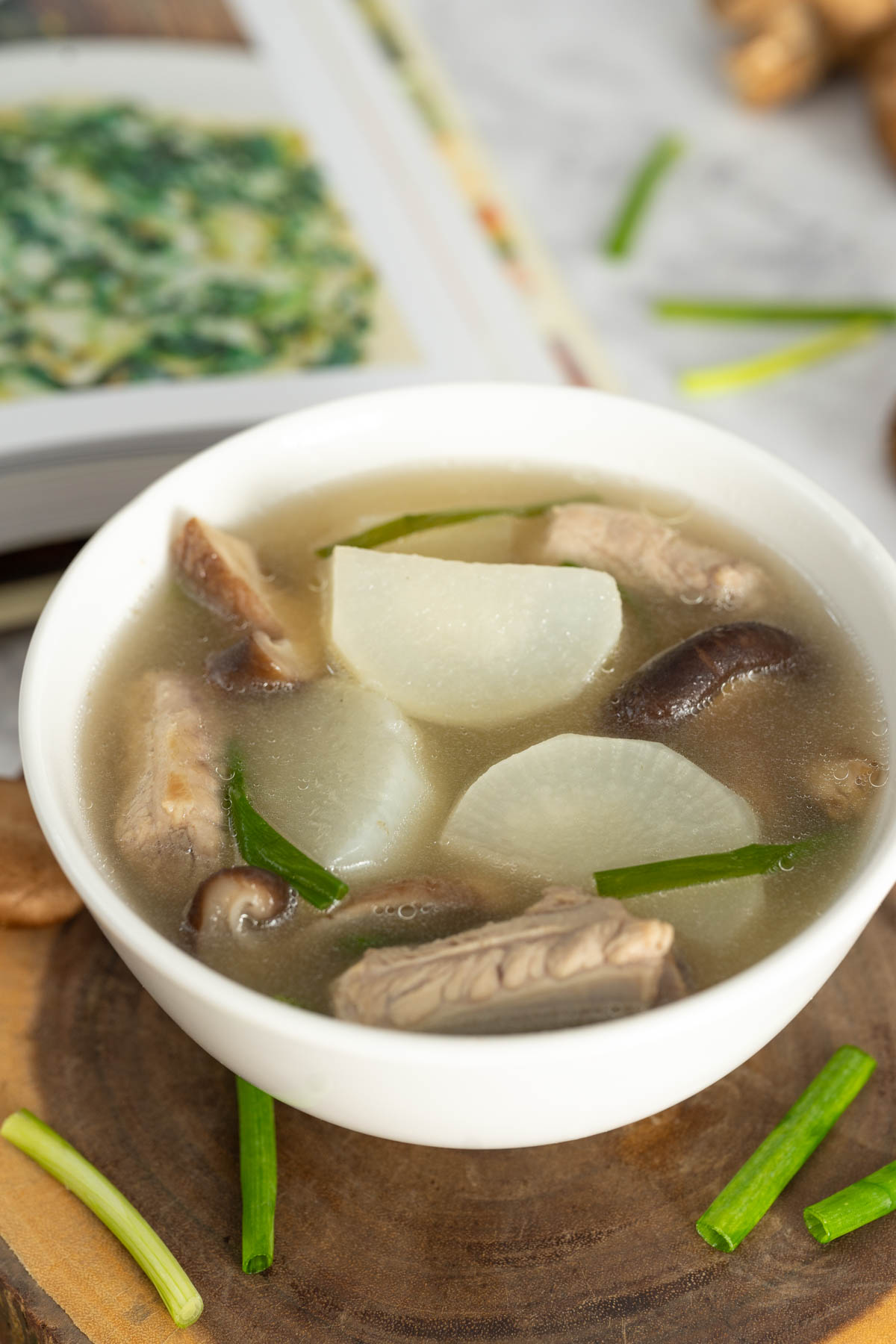
White Radish and Pork Rib Soup
Ingredients: white radish 500 g (1 lb 2 oz, about 4 cups in chunks), pork ribs 400 g (14 oz), ginger 3 slices, 1 scallion, salt 5 g (1 tsp), Shaoxing wine 10 ml (2 tsp).
- Put the ribs in a pot with cold water, add the wine, and blanch for 3 minutes. Drain and rinse off the foam.
- Put the ribs, ginger, and scallion in a clay pot or Dutch oven with 1.5 liters (about 6 1/4 cups) of water. Bring to a boil, then simmer on low for 40 minutes.
- Peel the radish, cut it into chunks, and add it to the pot. Simmer for another 25 minutes — it is done when a chopstick slides through easily.
- Add the salt 5 minutes before serving and sprinkle with chopped scallion. The order matters: salt too early and the rib meat turns tough and dry.
The cooked radish comes in under 40 calories per 100 grams, so this works well as a main dish even when you are watching your weight.
Shredded Radish Cakes
Ingredients: white radish 300 g (10.5 oz, about 2 1/2 cups shredded), flour 150 g (1 1/4 cups), 1 egg, chopped scallion 20 g (about 2 tbsp), salt 3 g (1/2 tsp), five-spice powder 2 g (1/2 tsp), cooking oil as needed.
- Shred the radish finely, toss with 3 g (1/2 tsp) of salt, and let it sit for 10 minutes. Squeeze out the excess water.
- Mix the radish shreds with the flour, egg, scallion, and five-spice powder. The batter should hold together in a ball without falling apart; if it is too dry, add a spoonful of water.
- Brush a skillet lightly with oil, press a small scoop of batter into a round cake about 8 cm (3 inches) across, and fry over medium-low heat for about 3 minutes per side, until golden.
This makes about 8 cakes — a good breakfast with a bowl of millet porridge. Keep the heat moderate: too hot and the outside burns while the inside stays raw. Golden outside, tender inside is what you want.
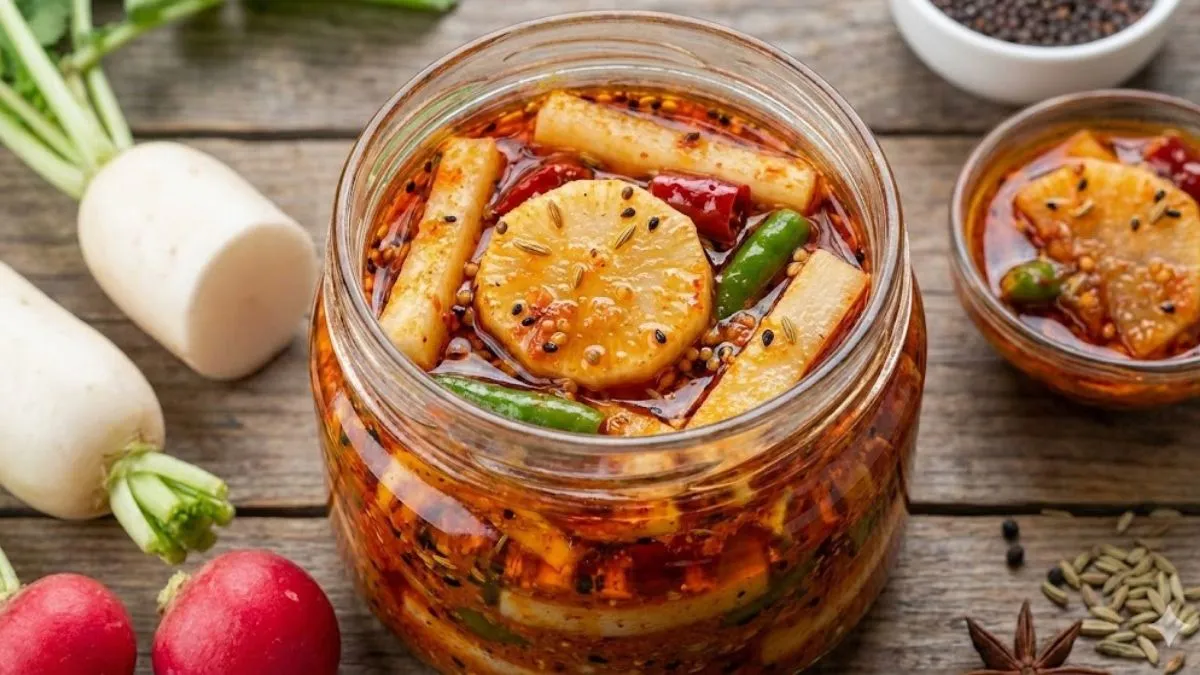
Sweet-and-Sour Pickled Radish Sticks
Ingredients: white radish 400 g (14 oz), white vinegar 30 ml (2 tbsp), sugar 15 g (1 tbsp), salt 8 g (1 1/2 tsp), 2 dried chilies, 10 Sichuan peppercorns.
- Cut the radish into sticks about 0.5 cm (1/4 inch) thick. Toss with 8 g (1 1/2 tsp) of salt and leave for 2 hours to draw out the water, then pour the liquid away.
- Mix the vinegar, sugar, chopped dried chilies, and peppercorns into a dressing and toss with the radish sticks.
- Pack into a clean glass jar and refrigerate overnight. Ready the next day, and best eaten within 3 days.
Do not make too much at once: 400 grams of raw radish shrinks to about 300 grams once pickled, and around 50 grams (under 2 oz) per serving with porridge is the right amount.
Pairings to Watch Out For
The warning that radish should not be eaten with ginseng comes from traditional Chinese medicine theory: ginseng is a powerful tonic that replenishes vital energy, while radish disperses energy and aids digestion — the two work in opposite directions, so eating them together may weaken the ginseng’s tonic effect. If you are taking ginseng or codonopsis (dang shen) as a prescribed tonic, keep radish at least 2 hours apart, or ask the doctor who prescribed it. In everyday cooking with ordinary ingredients, there is no such problem — no need to worry.
People with a cold, weak stomach should keep three things in mind: eat less raw radish in winter and more of it cooked in soup; keep a single serving under 200 grams (7 oz); and avoid large amounts of raw radish after 8 p.m., when it can cause bloating and disturb sleep. If radish always leaves your stomach feeling cold or gives you loose stools, switch to cooked radish, or to gentler vegetables like Chinese yam or pumpkin.
One more thing: eating radish together with citrus fruit or persimmons can interfere with the thyroid’s uptake of iodine, because of the thiocyanate in radish. People who already have thyroid problems should space them about half an hour apart. For everyone else, an occasional shared meal is nothing to worry about.
And a detail that is easy to miss: do not simmer white radish and carrots together for a long time. Carrots contain an enzyme that breaks down vitamin C, so the white radish loses more of it than it has to. The loss is not dramatic, but now that you know, cooking them separately is the better deal.
Quick Answers
How much radish should I eat each week? Two to three times a week, about 150 to 200 grams (5 to 7 oz) per serving. Soup and fillings are the workhorses; raw and pickled are the garnish.
Which way of cooking keeps the most nutrients? Raw keeps the most vitamin C; soup keeps the fiber and minerals and is the gentlest on digestion. Pickling keeps the crunch but adds a lot of salt.
Can I eat radish if I have a sensitive stomach? Yes — cooked, not raw. Soup is the safest option, and keep portions modest. Skip raw radish late in the evening.
Is it true radish clashes with ginseng? In traditional Chinese medicine theory, yes — they work in opposite directions. If you take ginseng or a similar tonic, separate them by at least 2 hours, or ask your doctor. Ordinary meals are unaffected.
What is shiliao? Shiliao, literally “food therapy,” is the traditional Chinese idea of using everyday foods, chosen for their warming or cooling nature, to support health — more like a dietary habit than a medical treatment.
This winter, three rules are enough: eat radish two or three times a week, about 150 to 200 grams at a time; make soup and fillings your main methods, and treat raw and pickled as accents; if your digestion runs cold, stick to cooked radish, and if you take tonic herbs, keep them apart in time. Tonight is a good night to try the radish and pork rib soup — forty minutes, one pot, and the whole family can eat it.
Disclaimer: This article is food and nutrition education, not medical advice. Food therapy cannot replace medication or medical treatment. If you have a chronic condition such as chronic gastritis, thyroid disease, or diabetes, please follow your doctor’s dietary advice. No health benefit is promised here. If you experience persistent discomfort, seek medical care promptly.
中文版:白萝卜怎么吃最养人?秋冬食疗指南