Seven in the morning, in the corner of a neighborhood park. A woman in her sixties steps forward, her arms opening slowly to either side, as if she were parting a curtain of tall grass. A jogger passes behind her without noticing. A child on a scooter slows down to watch. She is not fighting anyone. She is not stretching, exactly. She is practicing Wild Horse Parting Its Mane, one of the most recognizable moves in Tai Chi — Tai Chi being the slow, flowing Chinese martial art that doubles as a form of moving meditation, practiced as much for balance and calm as for self-defense. And if you have ever tried it, you will know the strange frustration it produces: the move looks simple, just two arms opening and one foot stepping forward, yet after six months of practice many people still feel as if they are pushing at empty air.
The problem is almost never in the hands. It is in the step underneath them. Get the footwork right, and the arms almost take care of themselves. This guide breaks the move down the way a good teacher would: foot first, hand second, waist in charge of the turn, breath following the whole thing.
What This Move Actually Does
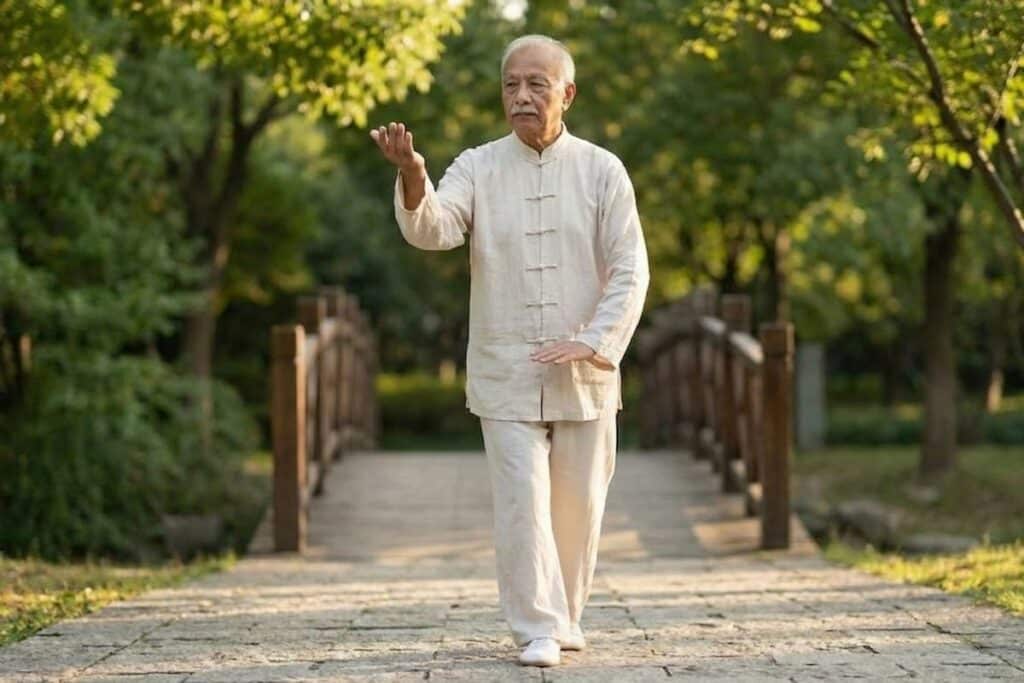
Wild Horse Parting Its Mane comes in a left form and a right form, mirror images of each other. One left and one right together make a single complete repetition. The name gives you the picture: imagine a wild horse, and your hands parting the thick mane along its neck, one hand sweeping up and out, the other pressing down and away. The two hands pull apart along a diagonal line, and your whole body opens from gathered to spread.
Start standing in place, hands held together in front of your chest, left hand above and right hand below, as if you were cradling a ball about 30 centimeters across — roughly the size of a basketball. Step your left foot forward and to the left. As your weight shifts onto it, your left hand sweeps up and to the left, your right hand presses down and to the right, and the two hands finish on a diagonal line. At the end of the move you face about 45 degrees to your front-left, standing in a left bow stance, your left hand level with your eyebrows, your right hand pressed down beside your right hip. Pause, then do the right form. The whole thing takes about 6 to 8 seconds. Faster than that, and you lose the feeling of parting; slower, and you start holding your breath.
The quality of the move is not in how wide you open. It is in whether the opening has substance. Picture yourself standing between two sliding doors, a hand on each one, walking forward and pushing them apart as you go. Your arms are carried outward by your body, not stretched out by themselves. Done right, your shoulders stay loose, and there is enough space under each armpit to fit a fist. Done wrong, your shoulders creep up toward your ears, your arms go stiff, and parting the mane turns into arm-wrestling.
The Left Form, Step by Step: Feet First, Hands Second
Begin from the gathered position, hands holding the imaginary ball in front of your chest. Your left foot moves first. Lift the heel, let the toes skim the ground as they reach forward and to the left, and set the foot down about 40 centimeters ahead of your body, toes pointing toward eleven o’clock — roughly 45 degrees outward. Heel touches down first, then the rest of the foot rolls down onto the sole. That heel-then-sole order matters, and it cannot be reversed: if the whole sole slaps down at once, your weight drops suddenly and your knee wobbles with it.
Only once the foot is planted does your weight start to move. Think of your weight as a bowl of water, poured slowly from the right foot into the left. The pour takes about half the total time of the move. Your left leg bends gradually, the knee tracking in the same direction as the toes, until the knee is bent at about 120 degrees — a comfortable bow stance, not a deep squat. Your right leg stretches naturally behind you, its heel allowed to lift slightly off the ground, but the toes must stay down. If your back toes lift, your balance has already gone.
The hands move last. Your left hand arcs from your chest up and to the left, fingertips pointing up, palm angled outward, as if you were offering a leaf up into the air on a slant. At the same time your right hand presses down and to the right, palm facing down, fingers pointing forward. The two hands should finish about 70 percent as far apart as your arms would be at full stretch — open too wide and your chest collapses inward; open too narrow and nothing has really parted at all.
Here is a quick self-check you can do without a mirror: at the finished position, your left hand, the tip of your nose, and your left knee should sit roughly on one vertical line. Your right hand should rest about 10 centimeters outside your right thigh. Your body should not lean forward or backward, and the crown of your head should feel as if a thread were gently pulling it upward. If you can tick all of that off, the shape is right.
The Right Form: A Mirror Image, Not a Photocopy
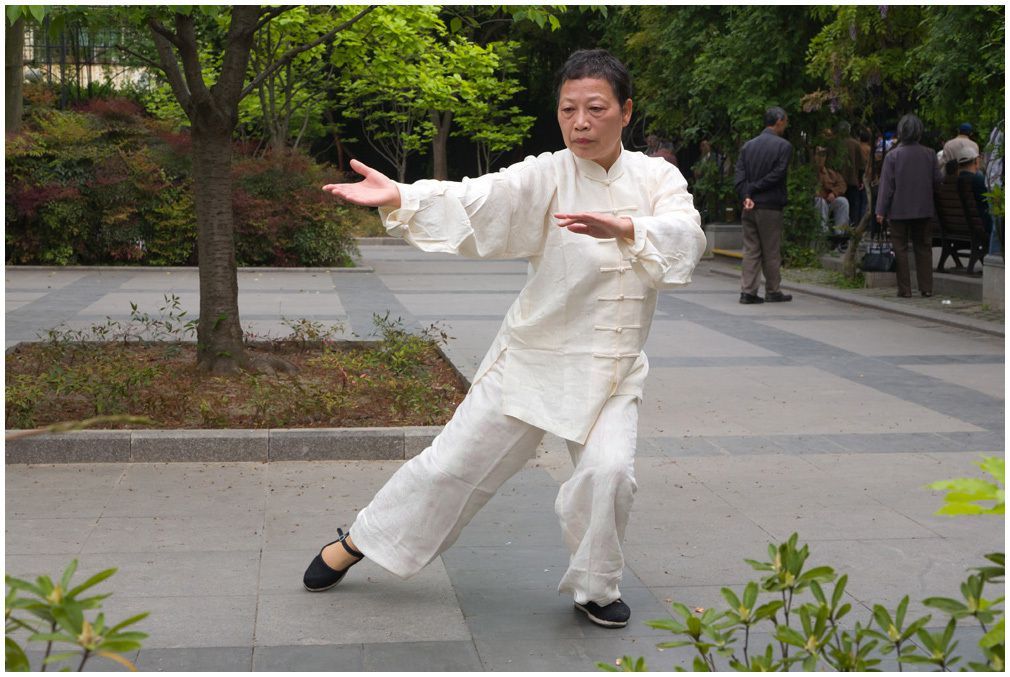
The right form starts from the left bow stance. First, gather. Shift your weight back onto your right foot, turn your left toes inward by about 30 degrees, lift the left heel, and draw the left foot back toward the right foot while your hands come together again in front of your chest. This gathering takes about 2 seconds, and it deserves the same patience as the opening: let your body return to center before you set off again. Rushing the gather is how the next form starts crooked.
Now step your right foot forward and to the right, the same 40-centimeter stride as the left, toes pointing toward one o’clock. Shift your weight onto the right foot, sweep your right hand up and to the right, and press your left hand down and to the left. One detail to watch: your right hand should finish level with your eyebrows, no higher. Push it higher and the move turns into a surrender pose, arms up, chest exposed, structure gone.
The hand shape is a detail beginners often miss. When you part the mane, your hands are open and relaxed, fingers spread naturally, fingertips lifting very slightly, like lotus leaves floating on water. Do not make a fist, and do not stiffen your fingers into a blade. Keep the wrist straight, so the palm and the forearm form one continuous line. The moment the wrist collapses, the energy of the move — the smooth, connected force that Tai Chi practitioners call jin, the directed power that travels through a relaxed body rather than from muscle alone — breaks off at the wrist and never reaches the fingertips.
There is also a footwork rule for the turn. The two forms together turn your toes through about 90 degrees, but your body itself only turns about 45 degrees. Some people turn a full 90 degrees on the right form and end up standing sideways, all their weight stacked on one leg, with nowhere to go for the next move. The limit is simple: your shoulders should stay directly above your hips throughout. The shoulders turn, the waist carries the turn, the hips stay put. If your hips swing around with your shoulders, you have turned too far.
Breathing: Inhale as You Part, Exhale as You Gather
The breathing pattern for this move is simple, and that is the point. Gather, exhale. Part, inhale. When your hands come together in front of your chest, your chest folds slightly inward and the breath flows out slowly. When your hands open, your chest opens and the breath comes in on its own. Do not force a deep breath — breathe lightly through your nose and feel the air settle low in your belly, like filling a balloon to about 70 percent. Stop there; a full balloon is a tense balloon.
The most common breathing problem is holding the breath. People get halfway through the parting, their face flushes, their shoulders lock, and the whole movement freezes. The fix is to slow the move down by half and let the breath set the pace: 2 seconds to step, 3 seconds to part the hands, 1 second holding the finished position, air moving the whole time. In Tai Chi, the breath is tied to an idea called qi — the vital energy that, in traditional Chinese thought, flows through the body and is guided by slow movement and calm breathing. You do not need to believe anything mystical about it to benefit: slow breathing with slow movement is, on its own, one of the most reliable ways to settle the nervous system.
Ten minutes a morning, on a balcony or in an empty corner of the park, about six repetitions, is enough. After a week or two, breath and movement usually start to fall into step, and the move stops feeling like two separate jobs — a step, then an arm wave — and starts feeling like one continuous action.
Five Common Mistakes and How to Fix Them
Mistake 1: Hands first, feet second. The hands shoot out before the foot has landed, and the body feels dragged along by its own arms, weight floating in mid-air. Fix it by stepping first and waiting half a second after the foot lands before the hands move. Practice by saying two words to yourself as you move: “foot” on the step, “hand” on the parting.
Mistake 2: A bow stance so wide the knee passes the toes. A stride of 60 centimeters or more puts the front knee well past the toes, loads the knee joint, and leaves the thigh shaking. Fix it by shortening the step back to 40 centimeters, with the knee tracking straight over the toes. When you are settled, the knee should still be able to bounce gently up and down — if it feels locked in place, the stance is too deep or too wide.
Mistake 3: Shrugging and lifting the elbows as the hands part. The shoulders ride up, the elbows rise higher than the shoulders, and the neck disappears. Fix it by sinking the shoulders first — drop them down, deliberately, before the hands move — and keeping the elbows below shoulder height, with that fist-sized space preserved under each armpit. Practice in front of a mirror twice: if the shoulders do not move and only the hands do, you have it.
Mistake 4: Leaning forward or sitting back. As the hands part, the torso lunges forward, or the weight sinks back and the hips stick out. Fix it by lifting the crown of the head upward and tucking the tailbone very slightly inward. Ask someone to look at you from the side: your earlobe, shoulder, hip, and ankle should sit roughly on one vertical line.
Mistake 5: The left and right forms are different sizes. The left opens generously, the right stays cramped, or the other way around — almost everyone has a stronger side. Fix it by doing three repetitions on each side and filming yourself from the front on your phone. Compare the height of the hands and the length of the steps, and close whatever gap you see, rep by rep, until the two sides look the same to an outside eye.
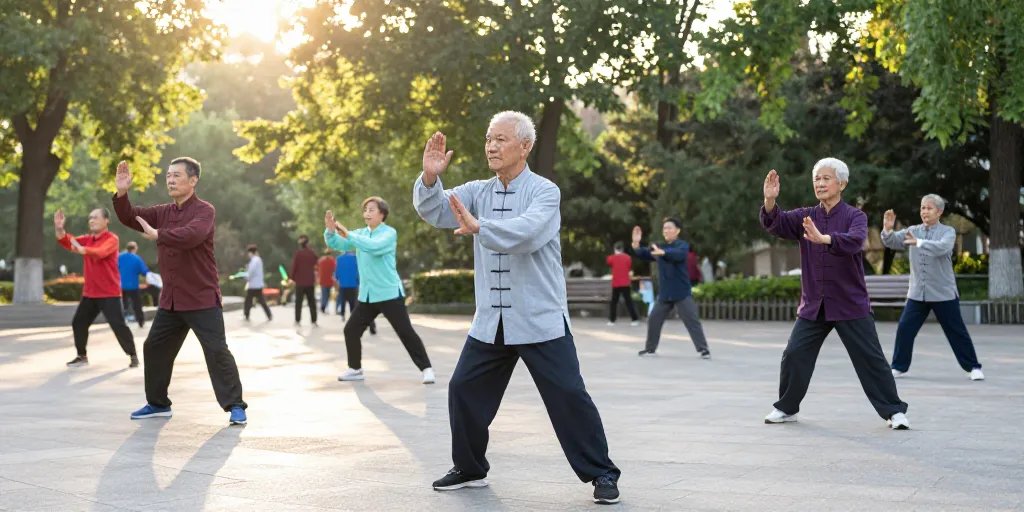
Putting it together: three weeks to a steady form. What Wild Horse Parting Its Mane really trains is a paradox that runs through all of Tai Chi: parting with gathering inside it, gathering with parting inside it. The hands open, but the waist and hips stay connected. The feet step apart, but the center of gravity stays steady. Once that feeling is in your body, it carries straight into the next moves — Cloud Hands, Brush Knee and Push, all of them run on the same rule: feet first, hands second, waist leading the turn.
Here is a practical plan. Give it ten minutes a day, six repetitions on each side, and nothing else. In the first week, watch only your stride length and the direction of your toes. In the second week, watch only your breathing. In the third week, stand in front of a mirror and correct the shrugging and the leaning. Three weeks in, the move changes from something that looks right to something that feels steady — and from there, learning the full Tai Chi form gets a great deal easier.
Quick Answers
How long does one repetition take? About 6 to 8 seconds: roughly 2 seconds to step, 3 seconds to part the hands, 1 second holding the finished position, and about 2 seconds to gather back before the other side.
How big should the step be? About 40 centimeters, with the toes turned out about 45 degrees. If your front knee passes your toes or your thigh starts shaking, the step is too long — shorten it, don’t force it.
Why do my shoulders keep rising? Because the arms are doing the work the body should be doing. Sink the shoulders before the hands move, keep the elbows below shoulder height, and let the weight shift carry the arms outward.
How long until it feels natural? Most people find the footwork settles in the first week, the breathing in the second, and the whole move feels connected after about three weeks of ten minutes a day.
Can I practice if my knees are sensitive? Yes, with a shorter step — around 30 centimeters — a shallower bow stance, and a slower weight shift. Stop immediately if you feel pain in the knee, and rest rather than pushing through it.
What should I practice after this? Cloud Hands and Brush Knee and Push. They use the same pattern — feet first, hands second, waist leading — so the feeling you built here transfers directly.
Safety note: If you have knee discomfort, shorten your stride to about 30 centimeters, halve the depth of your bow stance, and shift your weight more slowly. Stop right away if you feel knee pain, and rest. Build up gradually — do not chase a big, dramatic stance on your first day. This article is traditional cultural and fitness education, not medical advice, and it makes no promise of any therapeutic effect. If you have a medical condition or are recovering from an injury, consult a doctor before practicing.