It’s 2:17 a.m. You’ve been staring at the ceiling for two hours. Your mind replays the same email, the same conversation, the same unfinished task — and the harder you try to fall asleep, the wider awake you feel. Tomorrow you’ll drag yourself through the day foggy and irritable, and you already know it. On the inside of your wrist, just below the palm, there is a small point that millions of people in China press before bed: Shenmen, the “Spirit Gate.” A few quiet minutes with it, and many people find their breathing slows, their shoulders drop, and sleep finally comes. This guide shows you exactly where it is, how to press it, and when to leave it alone.
Shenmen is an acupoint — a specific spot on the body used in traditional Chinese medicine (TCM), a system of healing built over more than two thousand years around the idea that the body’s energy, called qi, flows along pathways known as meridians. Shenmen sits on the Heart meridian, the pathway traditionally linked to the heart and to calm, settled sleep. You don’t need to believe in any of that to try it: what matters is the spot, the pressure, and the five quiet minutes before bed.
Where Shenmen Is: On the Inside of Your Wrist
Hold one hand palm-up, fingers relaxed, wrist loose. With the thumb of your other hand, find the crease where your palm meets your wrist — the wrist crease. Now slide your thumb along that crease toward the little-finger side of the wrist. You’ll bump into a firm, taut tendon, the flexor carpi ulnaris. Shenmen sits in the small dip just on the thumb side of that tendon, right on the wrist crease. Press gently and you’ll feel a faint soreness, a dull ache that is different from the skin around it. That’s the spot.
Three steps, in order:
- Relax the wrist. Palm up, fingers loosely curled, no clenched fist. A tense wrist hides the tendon and the dip — you won’t find either if you’re gripping.
- Slide, don’t poke. Run your opposite thumb across the wrist crease from the middle toward the little finger until you meet the hard tendon.
- Drop into the dip. Shift your thumb a few millimetres toward the thumb side of that tendon and press down slowly. A mild, achy tenderness means you’ve found it.
Both wrists have one, in mirror-image positions. Start with your left wrist if you’re right-handed — it’s easier to reach with your dominant thumb — then switch once you know the feeling. Two mistakes trip up almost everyone on the first try. First, pressing the middle of the wrist: that’s a different tendon, and a different point entirely. Second, keeping the wrist stiff. Let the hand go limp, fingers softly bent, and the little hollow appears on its own. One more practical detail: trim your nails first. A long nail digging into the wrist hurts and ruins the whole exercise — always press with the fleshy pad of the thumb, never the nail.
How to Press It: Five Minutes Before Bed
The simplest method is thumb pressure. Sit or lie down, shoulders down, wrist resting on your knee or on the edge of the bed. Place the pad of your opposite thumb on Shenmen and press straight down, increasing the pressure slowly until you feel a clear soreness, a dull ache, and a faint warmth spreading under your thumb. Hold for 3 to 5 seconds, then release slowly. Repeat 30 to 50 times — about 3 to 5 minutes per wrist. Both wrists together take under 10 minutes.
If your thumb gets tired, switch to small circles. Keep the thumb pad on the point and rub in tight circles, about 60 circles a minute, one minute clockwise, then one minute counter-clockwise. Don’t scrub dry skin back and forth — keep the thumb stuck to the skin so the skin moves with it. That way nothing gets red or raw.
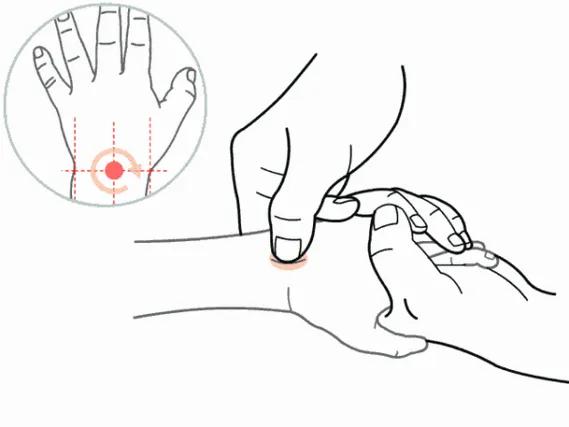
Timing matters more than force. Do it about 30 minutes before bed, after you’ve washed up and before you switch off the light — it becomes the bridge between your waking day and sleep. You can also do a round before an afternoon nap, again 3 to 5 minutes. Skip the 30 minutes right after a meal: blood is busy in the gut, the relaxation effect is weaker, and pressing then can leave your stomach unsettled. While you press, slow your breathing down — press gently as you breathe in, release as you breathe out. After a few rounds, most people notice their shoulders have dropped an inch without them trying.
How hard is hard enough? Press until you feel soreness and a dull ache, but never a sharp or stabbing pain. Afterwards the skin should look faintly pink and fade within a few minutes — that’s the right level. If your wrist or fingers go numb or tingly, you’ve pressed on a nerve: stop, re-find the dip, and go lighter. Once or twice a day is plenty. There is no prize for pressing all day, and overdoing it just leaves the wrist sore.
Who It Helps Most
People who struggle to fall asleep reach for this point first. You lie down and half an hour later you’re still awake, replaying the day, and every thought makes you more alert — press Shenmen for five minutes, lights off, phone face-down, and many people find the slide into sleep gets easier. If you wake in the middle of the night and can’t get back, you can press it lying down in the dark — no lamp, no phone — for about three minutes, then try to drift off again.
It also helps when your heart is racing and your mind won’t settle. Before an exam, a job interview, or a deadline presentation, when your pulse is fast and your palms are damp, sit down, press the point for a few minutes, and breathe slowly; the jitter usually softens. Travellers crossing time zones use it the same way in the first few days after a long flight, when the body clock is scrambled and bedtime feels wrong — a short session before bed gives the body a small anchor of routine.
Office workers get a bonus: pressing Shenmen doubles as a wrist break. After the point work, roll each wrist gently — 10 slow circles clockwise, 10 counter-clockwise — then spread your fingers wide and make a fist a few times. The stiffness from a day at the keyboard eases noticeably.
When Not to Press It Yourself
Skip it if your wrist is injured — freshly sprained, swollen, bruised, or with broken skin, eczema, or an infection. Pressure will only make the damage worse; wait until it has healed. If you are pregnant, ask your doctor before pressing acupoints for sleep or relaxation — don’t improvise. For children, the wrist is small and the skin is delicate: if a parent wants to try it, use a very light touch, keep it to 1 or 2 minutes, and ask the child afterwards whether anything hurt.
Five Things Not to Overlook
- Never press with a nail. Use the thumb pad. A nail can scratch the skin and leave a bruise — cut your nails short before you start.
- Don’t chase harder or longer. Soreness is enough; pain means you’ve gone too far. Three to five minutes per session, once or twice a day. Over-pressing leaves the wrist achy and numb.
- Stop if the skin is broken. Cuts, redness, inflammation, or a fresh layer of medicated cream on the wrist — skip that day and resume once the skin is back to normal.
- Don’t expect one session to fix everything. Acupressure is a daily habit, not a switch. Some people notice easier sleep within a few days; others feel little change. Give it one to two weeks before deciding whether it suits you — and don’t respond to a slow start by pressing harder.
- Don’t treat massage as medicine. If you’ve slept badly for more than two weeks, have three or more bad nights a week, or poor sleep is clearly affecting your work and daily life — or if sleeplessness comes with chest tightness, shortness of breath, an irregular heartbeat, or low mood, or even sleeping pills don’t help — see a doctor promptly and find the cause before trying anything else.

A Five-Minute Ritual Before Bed
Shenmen is easy to find: palm up, on the wrist crease, in the dip just inside the tendon on the little-finger side. The method is just as simple: press with the thumb pad for 3 to 5 seconds, repeat 30 to 50 times, or rub in small circles for two minutes, keeping the pressure at “sore but not sharp.” Do it 30 minutes before bed, lights off, phone away, and it works better.
Try it tonight. After you wash up and before you lie down, press your left wrist for three minutes, then your right for three minutes, breathing slowly and letting the day go. Keep it up for a week and watch whether the time it takes you to fall asleep changes. And if your sleep doesn’t improve, or anything else feels off, don’t tough it out — getting checked by a doctor is the right move.
Quick Answers
Where exactly is Shenmen? On the inside of your wrist, on the wrist crease, in the small dip on the thumb side of the tendon nearest your little finger. Palm up, wrist relaxed, slide your opposite thumb toward the little finger until you feel the tendon, then drop into the dip beside it.
How long should I press it? Three to five minutes per wrist, 30 to 50 presses of 3 to 5 seconds each, or two minutes of small circles. Once or twice a day is enough.
When is the best time? About 30 minutes before bed, or before an afternoon nap. Avoid the half hour after eating.
How hard should I press? Until you feel a dull soreness and faint warmth — never sharp pain. Faint pinkness that fades in a few minutes is right; numbness or tingling means you pressed too hard or in the wrong place.
Can I press it in the middle of the night? Yes. If you wake up and can’t get back to sleep, press it lying down for about three minutes, without turning on a light or checking your phone.
Who should avoid it? Anyone with a sprained, swollen, or broken-skinned wrist; pregnant people should check with a doctor first. Children need a very light touch, 1 to 2 minutes only.
How soon will it work? Some people notice a difference within a few days; others feel little. Give it one to two weeks before judging — and don’t press harder if it feels slow.
Disclaimer: This article is educational information about an acupoint. Acupressure is not a substitute for medical care and cannot diagnose or treat any condition. If your insomnia is severe or long-lasting, or you have an underlying health condition, consult a doctor before trying it. No results are promised. Stop immediately and seek medical advice if you feel unwell.