It is 3 p.m. You have been staring at a laptop for three hours straight. Your neck feels like a rusted hinge, your shoulders have crept up toward your ears, and when you finally turn your head to look at the clock, something in there clicks. You are not injured. You are just stuck — the way millions of desk workers are stuck every afternoon. There is a movement for exactly this moment, and it takes about two minutes: the fourth form of Baduanjin, “Look Back to Ease the Five Strains and Seven Injuries.”
Baduanjin, literally “Eight Pieces of Brocade,” is a set of eight gentle qigong movements — qigong being the Chinese practice of coordinating slow movement, breathing, and attention — that has been practiced in China for over 800 years. This guide takes just one of those eight movements and breaks it down completely: what it trains, how to do it step by step, how to breathe with it, the five mistakes that trip up nearly every beginner, and how to fit it into a workday without changing your schedule.
What This Movement Actually Trains
The name sounds dramatic, and it is worth unpacking. The “five strains” refer to five kinds of long-term overuse described in classical Chinese medicine: staring too long strains the blood, lying down too long strains the breath and energy (qi, the body’s vital energy in traditional Chinese thought), sitting too long strains the flesh, standing too long strains the bones, and walking too long strains the tendons. The “seven injuries” add seven more ways of wearing the body down, including overeating, strong emotions, and exhaustion. Taken together, the phrase is an old way of naming a very modern problem: the slow damage of doing one thing, in one posture, for too long.
The remedy this movement offers is disarmingly simple — turn your head and look behind you. Slowly. That is the whole idea. The turn mobilizes the cervical spine and the muscles of the neck and upper back, the exact territory that stiffens after hours of sitting and screen-staring. What it trains is not strength but range of motion. Most people spend all day looking down or straight ahead, and the angle they can turn their head gradually shrinks. This movement asks the head to rotate slowly to its limit, pause there for 2 to 3 seconds, and let the muscles on both sides of the neck get one complete stretch and release.
The feeling afterward is specific and easy to recognize: warmth at the base of the neck, shoulders that sit half an inch lower than before, and a sense that your eyes focus a little more easily. It is not a workout feeling. It is the feeling of something that was wound tight being gently unwound.
It also makes more sense inside the full set. The first three movements prepare the ground: the opening “Holding Up the Sky” stretches the torso, the second “Drawing the Bow” opens the chest and shoulders, and the third “Single Lift” works the sides of the waist and the digestive area. The fourth movement then brings the attention up to the neck. All eight together are a head-to-toe pass over the whole body, from the outside in — and this one is the neck’s turn.
Step by Step: Head to Toe
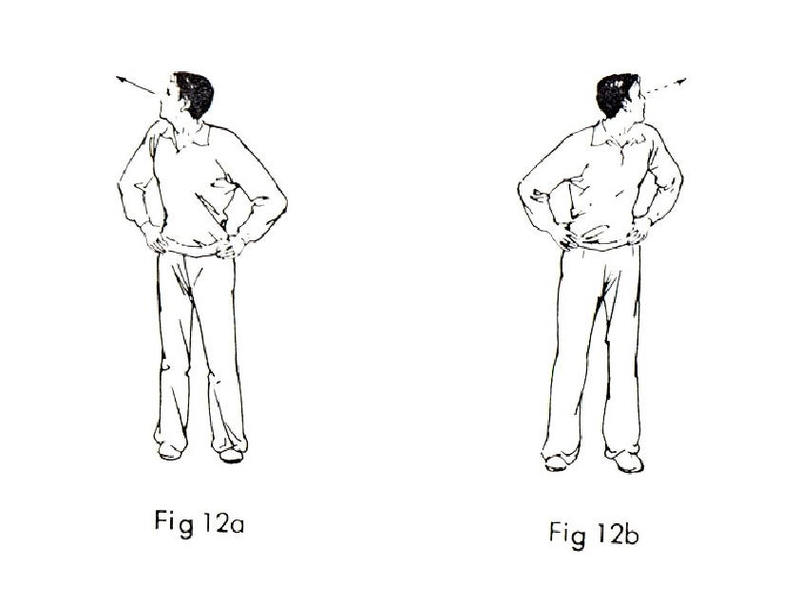
Start by standing well. Place your feet shoulder-width apart, toes turned very slightly outward, knees soft and never locked. Let both arms hang naturally at your sides, palms resting against the outer thighs. Drop your shoulders, tuck your chin a fraction inward, and look straight ahead. This is the opening stance of Baduanjin — whole body relaxed. Take three slow, even breaths before you move at all.
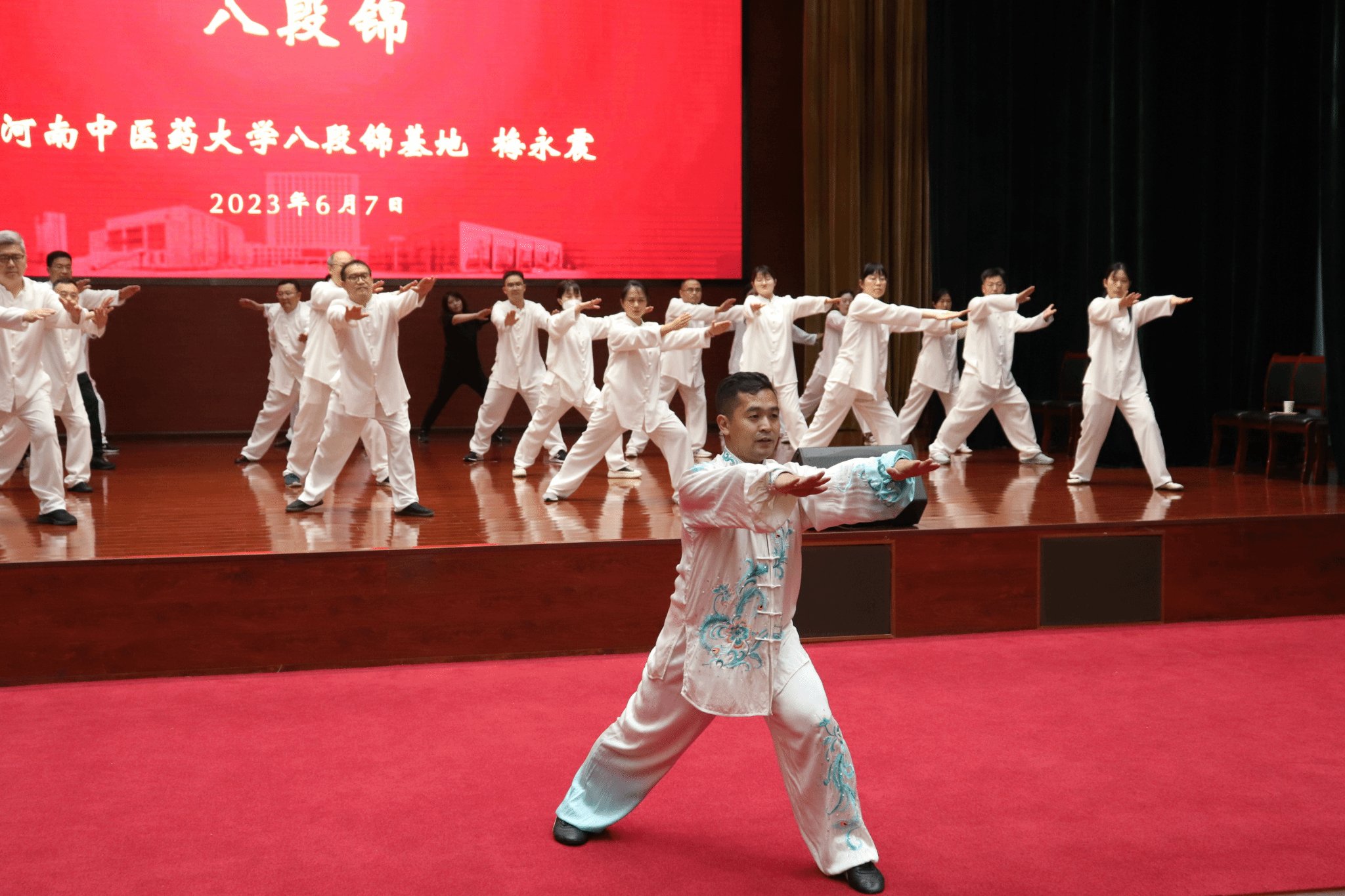
From there, raise both hands slowly, palms facing down, fingers gently spread, until they reach shoulder height — and stop. Do not straighten the arms fully; keep a slight bend in the elbows, as if you were holding an invisible ring in front of you. Turn the palms inward so the fingertips point out to the sides. You are now ready to turn.
The head turn is the heart of the movement, so give it time. Turn your head slowly to the left, letting your eyes lead the way toward the space behind your left shoulder. Count to four as you turn: one to begin, two to pass the halfway point, three to approach the limit, four to arrive and stop. Do not rush the count — each number should take about a full second. When you reach the point where you can turn no further, hold for 2 to 3 seconds. You should feel a gentle lengthening along the line from behind your left ear down to your shoulder, and a mild tightening in the muscles on the right side of your neck. That stretch, not pain, is the signal you are in the right place.
After the hold, turn your head slowly back to center, then repeat to the right: turn, hold 2 to 3 seconds, return. One left and one right makes a single repetition. Do 6 repetitions in total — 3 to each side. When you finish, lower both hands slowly back to your sides, stand steady, and take two easy breaths. That is the complete movement.
Two details matter more than anything else while you turn. First, your body does not twist. The shoulders and hips stay exactly where they are; only the head rotates. Second, your chin stays level. Do not lift it and do not drop it — imagine you are balancing a book on the crown of your head and turning without letting it slide. Your chin should trace a flat, horizontal arc, and your eyes should stay at the same height throughout.
Breathing: Inhale on the Turn, Exhale on the Return
The breathing pattern for this movement is simple enough to learn in one try: inhale as you turn, exhale as you return to center. As your head begins to rotate left, breathe in slowly through your nose, and let the inhale finish at exactly the moment you arrive at your limit and hold. During the 2 to 3 second hold, breathe naturally — do not hold your breath. Then, as your head turns back to face forward, let the air out slowly through slightly parted lips, so the exhale ends just as your head reaches center.
One full left-right cycle takes about 20 to 25 seconds. Six repetitions take roughly 2 minutes. If that feels long at first, start with 4 repetitions and build up to 6 after a week. The rhythm of the breath matters more than the number of repetitions: the inhale should be even, not gulped in all at once, and the exhale should last about one second longer than the inhale. That longer exhale is what lets the shoulders drop.
The most common breathing mistake is the one beginners rarely notice: holding the breath without realizing it. The moment the head starts turning, the chest locks and the breath freezes. The fix is to put your attention on the airflow at the tip of your nose. Before you begin a turn, let out a small breath first, then start inhaling as the head moves. After a few sessions, breath and movement fall into step on their own, and you will not need to count anymore.
Five Mistakes Almost Everyone Makes
- Turning too fast and too far. A sharp whip of the head gives the neck muscles no time to respond, and that is how strains happen. Keep the turn at an even speed — four counts to arrive — and when you reach your limit, stop. Do not force the head further back with an extra push.
- Letting the shoulders rise. Many people shrug as they turn, and the neck disappears into the shoulders. Settle the shoulders before you start: with your arms hanging, imagine your shoulders dropping a full centimeter. Keep them at that height for the whole movement.
- Twisting the body with the head. The head turns left and the waist follows, and suddenly the movement is something else entirely. Practice in front of a mirror, or ask someone to watch: while you turn, both shoulders should stay on the same horizontal line and your chest should keep facing forward.
- Lifting the chin or dropping the head. Chin up compresses the back of the neck; chin down means the back of the neck never gets stretched. The correct feeling is the chin gliding along a flat arc, eyes fixed at one constant height.
- Holding your breath through the hold. Bracing through the 2 to 3 second pause leaves you lightheaded when you finish. Keep breathing naturally during the hold, as if the breath were moving gently through the neck instead of getting stuck in the chest.
There is a simple diagnostic here: if your neck feels more sore or stiffer after practice than before, the turn was almost certainly too fast or too far. Halve the speed, halve the range, and try once more. The soreness usually drops away immediately.
How to Fit It Into Your Day
Practice once or twice a day, about 6 repetitions each time — 2 to 3 minutes total. Two moments work best. The first is right after waking up, when the body has not fully loosened yet and one round wakes the neck up. The second is mid-afternoon, around 3 or 4 p.m., when you have been at a computer for hours and the shoulders and neck are at their stiffest. Standing up and doing one round then is when the effect is most obvious.
Office workers can use this movement on its own, without the other seven. You do not need to wait for a full Baduanjin session. It can even be done sitting in a chair, though at a discount: sit tall with your back straight and both feet flat on the floor, and keep the same turning range as standing. Standing is better, because the whole line of force through the body is open, but a seated round at your desk still beats skipping it entirely.
Frequency matters more than intensity. The point is to do it every day, not to hammer out 20 repetitions in a single session. Flexibility in the neck is built gradually. After about two weeks of daily practice, most people notice the turning angle has grown — a spot that used to catch halfway now lets the head rotate another 10 to 15 degrees. After a full month, the frequency of that stiff-neck feeling after long sitting usually drops noticeably.
It pairs well with the second movement, “Drawing the Bow to Shoot the Eagle.” Do the bow first to open the chest and shoulders, then the look-back to mobilize the neck, and in five minutes you have a complete shoulder-and-neck routine. On a rushed morning, those two movements alone are enough.
Quick Answers
How many repetitions should I do? Six repetitions — 3 turns to each side — once or twice a day. Each full round takes about 2 minutes. Beginners can start with 4 repetitions and add the rest after a week.
How slow is slow enough? Four counts to turn, about one second per count, then hold 2 to 3 seconds at the limit. One left-right cycle should take 20 to 25 seconds. If you finish a round in under a minute, you went too fast.
Should I turn until it hurts? No. Turn until you feel a clear stretch, then stop. Pain, dizziness, or tingling in the arms means you went too far or too fast — ease off and slow down.
Can I do it sitting at my desk? Yes. Sit upright, feet flat on the floor, and keep the same range of motion. Standing gives a better result, but a seated round is far better than none.
When will I feel a difference? Warmth and loosening in the neck often come after the very first session. A visibly larger turning range usually takes about two weeks of daily practice; a real drop in post-sitting stiffness takes about a month.
Does it help with headaches from screen time? Many people find the neck release eases tension-type discomfort, but this is a gentle exercise, not a treatment. Persistent or severe headaches deserve a doctor’s opinion.
The whole movement comes down to three phrases: turn slowly, pause, breathe evenly. Four counts to arrive, hold for 2 to 3 seconds, 3 turns to each side, once or twice a day. Two weeks in, your head turns further. A month in, the afternoon stiffness shows up less often. You can start right now: stand up, feet shoulder-width apart, drop your shoulders, and turn slowly to the left — four counts, hold for two seconds, come back. Do one turn to each side and feel the stretch along both sides of your neck. Then put it in a fixed slot in your day, once after waking and once mid-afternoon, until it becomes as automatic as brushing your teeth.
Safety note: Build up gradually — start with a smaller range and fewer repetitions, and increase both slowly. Practice gently and never force the neck to its limit on the first day. If you have cervical spine problems, dizziness, or an old neck injury, practice with caution; stop immediately and consult a doctor if you feel dizzy, experience sharp pain, or notice tingling or numbness in your arms. This article is a cultural introduction to a traditional health practice. It makes no promises about results and is not a substitute for medical advice.