Three days after Lao Wang got the keys to his new apartment, his renovation foreman called: “Can we start next Tuesday? The workers and materials are already scheduled.” Lao Wang suddenly realized he had not picked a start date at all. In a rush he chose a weekend, only to find out the building management did not allow construction on weekends, and a whole day of labor went to waste.
Picking a start date for a home renovation is, in Chinese folk tradition, a small ceremony about timing. It is also, in practice, a project-management checklist. A well-chosen day gives you peace of mind, but more importantly it lines up three parties that rarely agree on their own: the construction crew, the building management, and the material deliveries. This guide walks you through the whole process, step by step.

Step 1: Fix the Hard Constraints Before You Open the Almanac
Most people start by flipping through the traditional Chinese almanac, known as the Huangli, looking for a day marked “suitable for breaking ground.” They pick three lucky days, and the building management rejects all three. The correct order is the reverse: list the hard constraints first, then choose a lucky day from what is left.
There are four hard constraints. First, the building rules: most residential compounds only allow noisy work on weekdays, typically from 8:00 a.m. to 6:00 p.m., and ban it on weekends and holidays. Get the written construction schedule from the property office before anything else. Second, the crew’s availability: a good foreman is often booked two weeks ahead, so the lucky day has to fall on a day he can actually show up. Third, material delivery: cement, sand, and plumbing and electrical supplies need to arrive at least three days early. You cannot start work while waiting for materials. Fourth, your own schedule: the opening ceremony works best with the homeowner present, so reserve at least half a day.
Once you stack these four constraints, a month usually leaves only 6 to 10 workable days. Now open the almanac and pick a day marked “yi dongtu” (suitable for breaking ground) or “yi xiuzhao” (suitable for renovation).
Step 2: Avoid Three Kinds of Days Before Chasing a Lucky One
The almanac may mark ten or more days a month as suitable for breaking ground, but families who take this seriously first cross out three categories.
The first category is days that clash with the homeowner’s Chinese zodiac sign. In Chinese astrology, each year and each day is linked to one of twelve animals, and certain pairs are considered incompatible, for example Rat and Horse. If the homeowner was born in the Year of the Horse, tradition says to avoid Rat days. Even if you do not believe in this system, the point is simply to feel comfortable in your own home.
The second category is “Yuepo” days and “Sili Sijue” days. A Yuepo day is a day whose earthly branch clashes with the month’s governing branch, and the Sili Sijue days are the days just before each seasonal change. In the traditional date-selection system, these days are seen as energetically unstable and unsuitable for breaking ground. Modern almanac apps label them directly, so a quick glance at the day’s notes is enough.
The third category is personal: if the family has recently had a bereavement or a parent is in the hospital, tradition says to postpone. The old rule is that happy occasions and mourning should not collide. Pushing the start back by two weeks is better than rushing a date during a difficult time.
After crossing these out, pick the nearest remaining day that works for the crew and the building management. A lucky day is not supposed to be rare. A day on which work actually starts smoothly is a good day.
Step 3: Picking the Hour – Earlier Is Not Always Better
Once the day is set, the next question is the hour. Traditional start times usually fall between 7:00 and 11:00 a.m., which covers two traditional two-hour periods: the Chen hour (7:00-9:00) and the Si hour (9:00-11:00). In the old Chinese time system, the day was divided into twelve two-hour periods, each named after an earthly branch, and these morning hours were favored for beginnings. There are practical reasons too: daylight is good, workers are fresh, the property office has just opened so paperwork and material checks are easy, and a morning start leaves time to finish the first real tasks of the day, such as marking demolition lines and confirming electrical layouts.
But two practical problems can spoil a morning plan. First, the building’s allowed start time: if management only permits work from 8:30 a.m., a 7:00 ceremony can only include firecrackers and red cloth, not actual hammering, which feels awkward. Second, winter sunrise: in northern China in December, it is still dark at 7:00 a.m., so moving the ceremony to 8:30 or 9:00 is perfectly reasonable. There is no need to cling to the traditional hour labels.
A practical approach is to set the ceremony within half an hour after the building allows work to begin. If management opens at 8:00, start at 8:18 or 8:28. The number 8 sounds like the word for prosperity in Chinese, so 8:18 carries a nice meaning while still falling inside the allowed window.
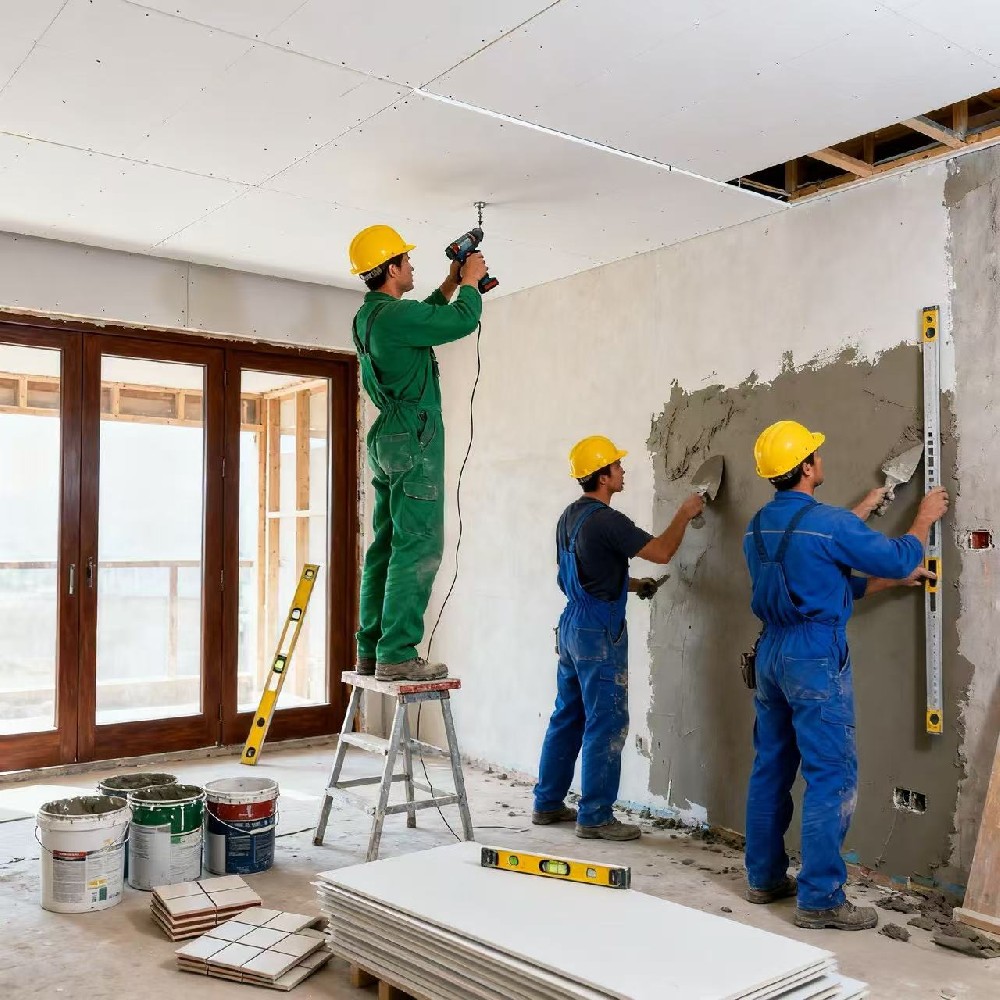
Step 4: The Opening Ceremony, Step by Step in 30 Minutes
Regional names for the ceremony vary, but the flow is similar across most Chinese cities, and the preparations are simple. Here is a streamlined version that takes about 30 minutes:
- Hang red paper and cloth: Paste a red paper sign reading “Kai Gong Da Ji,” meaning “great luck on starting work,” on the front door, and hang a strip of red cloth in the living room or on the balcony. Red is the traditional color of celebration in China. It also signals to neighbors that renovation is starting, which is a polite heads-up.
- Set up a small offering table: Place a small table in the middle of the living room with fruit (five apples and five oranges), some pastries, and three cups of tea. No big feast is needed. The point is sincerity, not extravagance.
- Light incense and exchange good wishes: The homeowner and the foreman each light three sticks of incense and say something simple, like “may the work go smoothly and finish safely.” Skip long speeches. The real purpose is that the homeowner, foreman, and designer meet formally for the first time and speak openly.
- The homeowner strikes the first hammer blow: This is the highlight. The homeowner takes a hammer and taps lightly three times on the first wall marked for demolition, symbolizing the official start of the project. Many renovation companies prepare a new hammer tied with red cloth, which the homeowner takes home afterward as a keepsake.
- Firecrackers or a confetti popper: If the compound allows it, a small string of firecrackers can be set off in an open area downstairs. In cities where fireworks are banned, an electronic firecracker or confetti popper does the same job. Tell the property office in advance either way, so nobody files a complaint.
- Hand out red envelopes: Give each worker a red envelope, called a hongbao, with 20 to 100 yuan inside. In Chinese culture, red envelopes are a traditional way to share good fortune. The amount matters less than the gesture. The foreman’s and designer’s envelopes can be a little thicker.
- Walk the site together: Do not scatter right after the ceremony. While everyone is present, walk through the electrical outlet positions, the demolition scope, and the protection requirements for finished surfaces, and take photos for the record. This step does more for project quality than the ceremony itself.
The walkthrough is the step most people skip, and most disputes trace back to it: missing outlets, arguments over removable walls, confusion about old furniture. Settling these in 15 minutes on opening day saves a dozen phone calls later.
Step 5: Three Common Mistakes to Avoid
Mistake 1: Treating a lucky day as a guarantee. A chosen date only covers the first day, not the 90 days of construction that follow. What actually determines the schedule is the contract’s timeline clause, on-time material delivery, and the crew’s skill. If you pin all your hopes on the date and then stop paying attention, even the best date cannot save a delayed project.
Mistake 2: Starting work early to “hold” a lucky date. Some homeowners let workers start quietly before the chosen date and then hold the ceremony later. This can backfire: management may fine unpermitted construction, and if an accident happens before the permit is in place, liability gets messy. It is better to push the lucky date later than to start without permission.
Mistake 3: Making the ceremony too grand. Some families hire a feng shui master, prepare elaborate offerings, and spend two or three thousand yuan plus half a day. Feng shui, the traditional practice of arranging spaces in harmony with their surroundings, emphasizes respect, not luxury. A simple 30-minute ceremony carries the same meaning, and the money saved is better spent on waterproofing and electrical work, the hidden parts of the project that actually protect your home.

Your Checklist: Just Follow This
Choosing a renovation start date is really a blend of folk tradition and modern project management: use tradition for a good start, and use a checklist to control real risks. Here is the checklist:
- Two weeks ahead: Get the building’s construction schedule in writing, confirm the foreman’s availability, and confirm material delivery dates.
- One week ahead: From the remaining workable days, pick one marked suitable for breaking ground that does not clash with the homeowner’s zodiac sign, and set the hour within half an hour after the building allows work to begin.
- Three days ahead: Prepare red paper, red cloth, fruit, tea, and red envelopes, and a new hammer tied with red cloth.
- On the day: 30 minutes of ceremony plus a 15-minute site walkthrough, with photos taken throughout.
- After the start: Post the schedule milestones and inspection standards in the group chat, and visit the site on a fixed day each week.
Once the date is picked and the ceremony is done, the real work begins. Keep a close eye on three checkpoints: the electrical and plumbing inspection, the waterproofing flood test, and checking floor tiles for hollow spots. Those three will protect your renovation quality far better than any date on the calendar.
Note: This article introduces the customs and practical steps of choosing a renovation start date from the perspective of traditional Chinese folk culture. It is for cultural education only and does not make any predictions about fortune or promises of good luck. Renovation work should follow your contract, building management rules, and applicable national standards.
Quick Answers
When should I pick the start date? About two weeks before you want to begin. That leaves time to check building rules, crew availability, and material deliveries before you look at the almanac.
What if no lucky day fits my schedule? Choose the nearest workable day after removing clash days and unstable days. A day on which work starts smoothly is a good day.
What time of day is best for the ceremony? Morning, within half an hour after the building allows construction to begin. Morning light and fresh workers make the ceremony and the first tasks of the day run smoothly.
How much should the ceremony cost? Very little. Red paper, fruit, tea, and small red envelopes are enough. Spend the savings on waterproofing and electrical work instead.
What is the single most important step? The 15-minute site walkthrough after the ceremony. Confirming outlet positions, demolition scope, and protection rules in person prevents most later disputes.