On a Tuesday evening in a Guangzhou martial arts gym, a new student named Ajie stood in front of a wooden dummy for the first time. He expected to learn how to punch. Instead, his coach asked him to stretch both arms forward, palms facing each other, and hold that one position for twenty minutes. Only later did Ajie understand the point: in Wing Chun, the first lesson is never about hitting someone. It is about standing steady and guarding your own centerline.
That scene surprises almost every beginner, and it is the best possible introduction to this art. Wing Chun does not reward the biggest muscles or the fastest fists. It rewards structure, timing, and the ability to feel what your partner is doing a split second before it happens. This guide walks you through the three foundations every beginner needs: Siu Nim Tao, the centerline theory, and your first Chi Sao lesson.
Where Wing Chun Comes From, and What Makes It Different
Wing Chun is a close-range Chinese martial art that developed in the southern provinces of Guangdong and Fujian. According to the most widely told origin story, a Buddhist nun named Ng Mui taught a compact system of short-bridge, narrow-stance boxing to a young woman named Yim Wing Chun, and the art took her name. Beyond the legend, the documented lineage runs through Leung Jan, Chan Wah Shun, and Ip Man, whose teaching in Hong Kong carried Wing Chun around the world. Bruce Lee studied under Ip Man in his early years, which is one reason the art became famous far beyond China.
The style can be summed up in three ideas: fight close, move straight, and borrow force instead of meeting it head-on. Unlike northern long-fist styles with their wide, sweeping movements, Wing Chun works at about one step from the opponent. Punches, blocks, and stance turns all travel the shortest possible line. An old saying in the art goes, “When it comes, stay with it; when it goes, send it away.” In other words, when your opponent’s arm touches yours, you stick to it and redirect it rather than shoving back with brute strength.
That approach is why body size matters less here than in many other arts. Wing Chun relies on structure and angles. In the basic stance, called Yee Jee Kim Yeung Ma, the knees turn slightly inward and the hips tuck under, so your weight sits balanced between both feet and you are hard to push over. Power comes from short, explosive releases known as inch power, where a fist can generate surprising penetration within just a few centimeters of travel. Smaller or less muscular practitioners can still make it work, which is why many adults choose Wing Chun as their first martial art.
Siu Nim Tao: The First Form, and a Lifetime of Basics
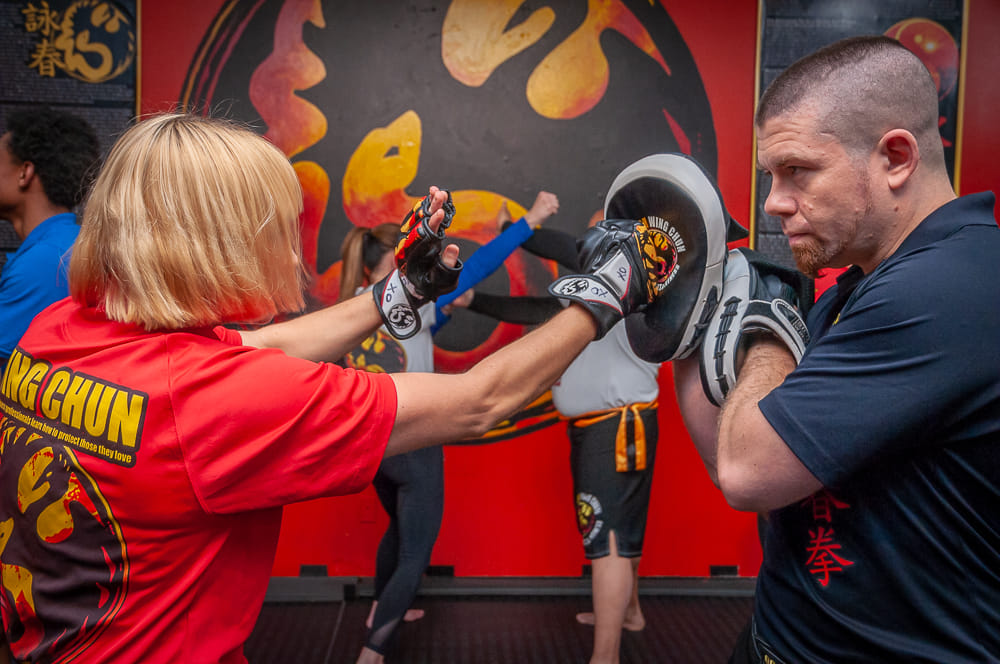
Siu Nim Tao, which means “Little Idea” or “Small Thought,” is the first empty-hand form in Wing Chun, and it is also the foundation practitioners keep refining for life. The word “little” is a hint about how to train it: keep your intention small and gathered, focus on precise hand shapes, and forget about looking flashy. The form divides into three sections, and each section solves one problem.
Section One: Hand Shapes and Structure
The first section trains hand shapes and body structure. After the opening, you practice Tan Sao (palm-up hand), Huen Sao (circling hand), Wu Sao (guarding hand), and Fook Sao (bridge-on hand), one move at a time. The details matter enormously: the wrist must stay straight, the elbow must sink down, and the shoulders must stay relaxed. Most beginners shrug their shoulders or lift their elbows without noticing, so coaches often have students practice in front of a mirror, working only on section one every day until the shapes stop drifting. Expect this stage to take two to four weeks. There is no shortcut, and rushing it only builds bad habits you will have to unlearn later.
Section Two: Generating Power
The second section trains power generation. Gaan Sao (low sweeping hand), Kwan Sao (rotating arm), Pak Sao (slapping hand), and Bong Sao (wing arm) appear in turn, and the key principle is sinking the elbow to issue force. Power should start from the feet, travel through the waist and stance, and arrive at the hand, rather than coming from swinging the arm alone. A useful drill pairs stance training with the form: hold Yee Jee Kim Yeung Ma for five minutes, then run through section two once, and repeat for three rounds. The burning feeling in your arms will tell you exactly where you are still forcing it with muscle instead of structure.
Section Three: Change and Closing
The third section trains change and closing. Both hands move together, split left and right, and return to the opening position to finish. The movements are slightly larger here, and they lay the groundwork for the two advanced forms, Chum Kiu (Seeking the Bridge) and Biu Jee (Thrusting Fingers). Remember the training order: get the hand shapes right before you worry about power, and get the power smooth before you chase speed. Skip a step and go straight for speed, and all you will build is an empty shell.
The Centerline Theory: One Line Governs Attack and Defense
The centerline theory is the single most important concept in Wing Chun. The centerline is an imaginary vertical line running from the top of your head down through the tip of your nose, your throat, your chest, your abdomen, and your groin. The body’s most vulnerable targets sit along this line, and an opponent’s attacks most easily travel along it too. So Wing Chun’s first rule is simple: guard your own centerline, and attack your opponent’s.
The classic application is the vertical fist punch, sometimes called the sun punch because the fist shape resembles the Chinese character for sun. The fist shoots straight out from the center of the chest and returns along the same straight line, while the other hand stays ready to guard your own centerline. When two people face each other, whoever’s fist occupies the shared centerline first has the advantage. A practical solo drill is to tape a vertical line on a wall, punch always toward that line for fifty repetitions, and check whether your punches drift left or right.
The centerline also decides footwork. In Wing Chun, turning the stance is not a big circling step. You pivot a small amount on your heels so that your centerline keeps facing the opponent, while their centerline slides onto the extension of your punching line. Advancing and retreating follow the same rule: step forward and the punch moves forward with you; step back and the guarding hand fills the gap. The centerline is never abandoned.
Your First Chi Sao Lesson: Start With Single-Hand Sticking Hands
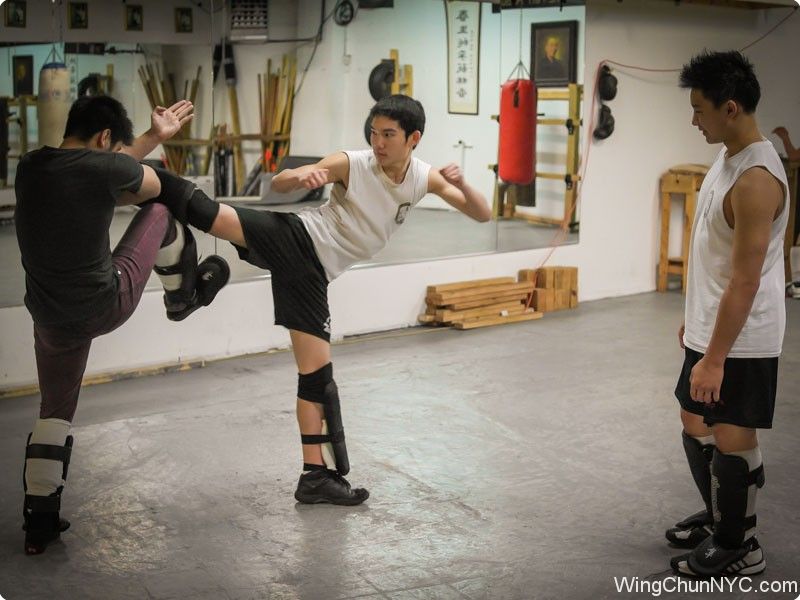
Chi Sao, literally “sticking hands,” is Wing Chun’s two-person sensitivity training. The word “chi” means to stick or adhere: two practitioners keep their forearms in contact and learn to feel the direction of each other’s force through touch, then respond with blocks and counters. Beginners should not jump straight into double-hand Chi Sao. Start with single-hand Chi Sao. Two people stand facing each other, each extends one arm to connect, one performs Tan Sao while the other performs Bong Sao, and then they switch, cycling slowly like turning a millstone.
Single-hand Chi Sao trains three things. First, keep the arms relaxed and use only about thirty percent of your strength when making contact, so that the slightest movement from your partner registers immediately. Second, keep the elbows sunk in front of the body and never let the arm lock straight, or your partner can press right through it. Third, watch your partner’s shoulders and elbows rather than staring at the hands. The shoulder moves first, and it gives away the next intention before the hand does. In the early weeks, three minutes per round, three minutes on the other side, four rounds a day is plenty.
Only once single-hand Chi Sao feels comfortable should you add Fook Sao and Gaan Sao variations and move into double-hand Chi Sao. The most common mistake in double-hand practice is that it gets faster and harder until it turns into an arm-wrestling match. Good Chi Sao should stay slow and clear: when your partner’s hand sinks, you open it with Tan Sao; when your partner’s hand pushes, you hold it with Bong Sao. The whole exchange should feel like two people pushing a door together on its hinge: the hinge never breaks, and neither side jams the door shut.
Putting It Together: Stand Steady Before You Talk About Punching
The beginner’s path in Wing Chun is actually very clear: Siu Nim Tao builds the foundation, the centerline theory sets the direction, and Chi Sao develops sensitivity. None of the three can be skipped. Practice forms without Chi Sao and your hands will have no feeling; practice Chi Sao without Siu Nim Tao and your structure will collapse on contact. A sensible weekly plan for a beginner looks like this: fifteen minutes of Siu Nim Tao every day, plus two thirty-minute single-hand Chi Sao sessions per week. Stick with that for three months, and your hand shapes, footwork, and sense of distance will all change noticeably.
For your next step, find a reputable gym that offers a trial class, and check that the coach starts from Yee Jee Kim Yeung Ma and the first section of Siu Nim Tao, rather than jumping straight into sparring combinations. At home, check your hand shapes in a mirror and film your form on your phone, comparing the recording once a week. Measured progress beats training by feel every time.
Quick Answers
What should I learn first in Wing Chun? Start with Siu Nim Tao, the first form. It teaches correct hand shapes, a stable stance, and the habit of relaxed, structured movement. Everything else in the art builds on it.
What is the centerline? It is the vertical line down the middle of your body, from the top of your head to your groin, where the most vulnerable targets sit. Wing Chun teaches you to protect your own centerline while directing your attacks along your opponent’s.
What is Chi Sao? Chi Sao, or “sticking hands,” is a partner drill in which your forearms stay in contact so you learn to sense force and direction through touch. Beginners start with single-hand Chi Sao before progressing to double-hand practice.
How long does it take to see progress? With fifteen minutes of daily form practice and two partner sessions a week, most beginners notice clearer hand shapes, steadier footwork, and a better sense of distance within about three months.
Do I need to be strong or athletic to start? No. Wing Chun emphasizes structure, angles, and short-range power rather than size or brute strength, which makes it a realistic first martial art for adults of many body types.
Safety note: Progress gradually and train under qualified instruction. Stop immediately if stance work or Chi Sao causes joint pain, and never train through an injury. Partner drills should be done with a reputable instructor, with controlled speed and force, avoiding strikes to the head and joints; minors should practice with an adult present. This article is cultural education only and makes no promise about self-defense outcomes. If you have an old injury or a chronic condition, consult a doctor before starting practice.