Picture a small training hall on a rainy Tuesday evening. A dozen students stand in a loose circle, feet turned slightly inward, arms relaxed at their sides. Nobody is jumping, kicking, or shouting. The instructor claps once, and the whole room moves as slowly as if it were underwater. If you walked in expecting a martial arts movie, you might be disappointed. Stay for ten minutes, though, and something changes: you start to notice how still these people are, how straight their punches travel, and how little wasted movement there is in anything they do. That quiet, almost boring-looking practice is Wing Chun, and its first form is called Siu Nim Tao.
Siu Nim Tao means “Little Idea” in Cantonese. The name is a clue to the whole system: before you learn to move fast, you learn to think clearly about a few simple ideas. Where do your feet go? Where does your elbow sit? What does your hand do when it meets resistance? This guide answers those questions for a complete beginner, covering the three things every Wing Chun student starts with: the Yee Jee Kim Yeung Ma stance, the straight punch, and the first lesson of Chi Sao, the famous “sticky hands” drill.
First, Stand Right: Yee Jee Kim Yeung Ma
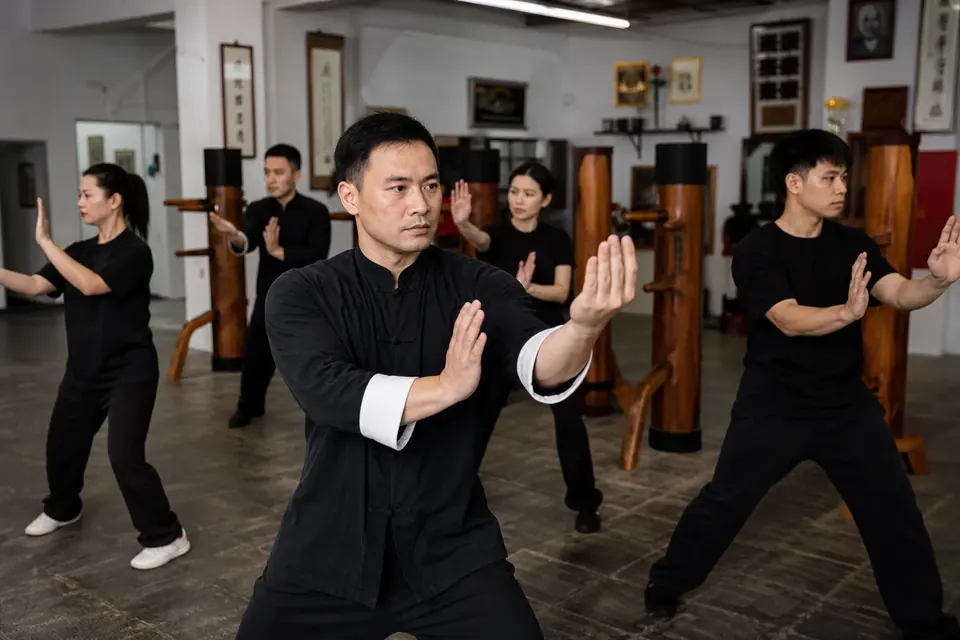
Yee Jee Kim Yeung Ma, often shortened to “the goat stance” because the feet pinch inward as if gripping a goat between the knees, is the foundation of everything in Wing Chun. It looks simple, and that is exactly why beginners get it wrong. Stand with your heels about one fist-width apart and turn both toes slightly inward. Bend your knees a little, following the direction of your toes rather than letting them collapse inward or splay outward. Tuck your hips gently under, keep your back tall but not stiff, and imagine a thread lifting the crown of your head toward the ceiling.
Your weight should sit between your feet, slightly forward, so that the whole sole of each foot stays in contact with the floor and your toes can still grip the ground. Here is a quick test you can do with a training partner: stand in the stance and ask them to push your shoulder lightly from the side. If you rock backward at once, your weight is too far back. If your toes lift off the floor, you are leaning too far forward. Done right, you feel like a tree with roots: the push arrives, your body absorbs it, and you stay put.
Do not try to hold the stance for a long time on your first day. Most beginners find their legs shaking after two or three minutes, and that is normal, not a sign of poor fitness. It usually means the alignment is off somewhere, often in the knees or the lower back. Start with three rounds of three to five minutes, moving your knees and ankles gently between rounds. After about a week of daily practice, most people can stand steadily for five minutes and the shaking fades noticeably. One warning matters more than any other: if your knees hurt sharply, stop immediately and check their direction. Pain is not a badge of honor in training, and a sore knee is your body telling you the alignment needs fixing, not more effort.
The Straight Punch: Send It Out, Don’t Swing It
Wing Chun’s punch is called the Yat Ji Chung Kuen, or “sun-character punch,” because the four knuckles of the fist line up in the shape of the Chinese character for “sun.” The fist travels straight down the centerline of your body, which is the imaginary line running from the top of your head down through your nose, chest, and between your feet. The elbow stays low and close to the body, like a train running on its track rather than a door swinging on a hinge. The power does not come from the arm alone. It travels up from the feet pressing into the floor, through a small turn of the waist, and out through a relaxed shoulder.
You can feel this chain at home with a simple wall drill. Stand about one arm’s length from a wall, punch slowly, and let your fist touch the wall lightly before pulling it back. Notice whether your elbow stays down and your shoulder stays relaxed. Once that feels natural, switch to shadow punching in the air: alternate left and right, fifty punches per hand, and check that at full extension your fist, wrist, and forearm form one straight line. If the wrist collapses, the line is broken and the punch loses both power and safety.
Beginners usually make two mistakes here, and both are easy to spot. The first is shrugging: after a few punches the neck gets sore because the shoulders have crept up toward the ears. The fix is to drop the shoulders before every punch and keep them down. The second is the elbow flaring outward, which turns the straight punch into a curved swing. The fix is to slow down to half speed and practice in front of a mirror, watching your elbows rather than your fists. The moment an elbow drifts out, stop and start again. Speed is not something you force; it grows on its own once the movement is correct.
Siu Nim Tao: Slow Is the Whole Point
Siu Nim Tao is the first of Wing Chun’s three empty-hand forms, and it is also the most important. You perform the entire form standing in the goat stance, without stepping, jumping, or shifting your feet. It looks slow because it is slow, and that slowness is deliberate. The form packs in the system’s basic hand techniques, its way of generating power, and its ideas about attack and defense, all in a sequence that takes about ten to fifteen minutes to complete.
The form falls roughly into three sections. The first section trains the core hand shapes and the focused intent behind them: the sinking elbow, the Tan Sao (a palm-up dispersing hand that redirects an incoming force outward), and the circling Huen Sao (a rotating wrist movement that frees a trapped hand). The second section adds the Bong Sao (a wing-shaped deflecting arm that covers the upper body), the Fook Sao (a bridging hand that rests on the opponent’s arm to feel its movement), and the Wu Sao (a guarding hand that protects the centerline). This is where defense starts turning into counterattack. The third section brings in short bursts of power and the closing movements, tying everything you have learned into one continuous flow.
How to Practice the Form
The most common beginner mistake is rushing through it to get to the end. Resist that urge. Do each movement fully before moving to the next, keep your breathing natural, and never hold your breath. When you extend a Tan Sao, keep the wrist firm rather than floppy. When you raise a Bong Sao to deflect, keep the elbow sunk in front of your body; if you lift the arm to shoulder height, you leave the center of your chest wide open.
A good daily habit is to treat the form as your warm-up: five minutes of stance work, then two full rounds of Siu Nim Tao, then your straight-punch practice. After a month of this routine, most students notice their hands feel steadier and their shoulders stop wandering during punches. That is not magic. It is what happens when the same correct movements are repeated until the body remembers them.
Chi Sao, Lesson One: Learn to Listen Before You Learn to Hit
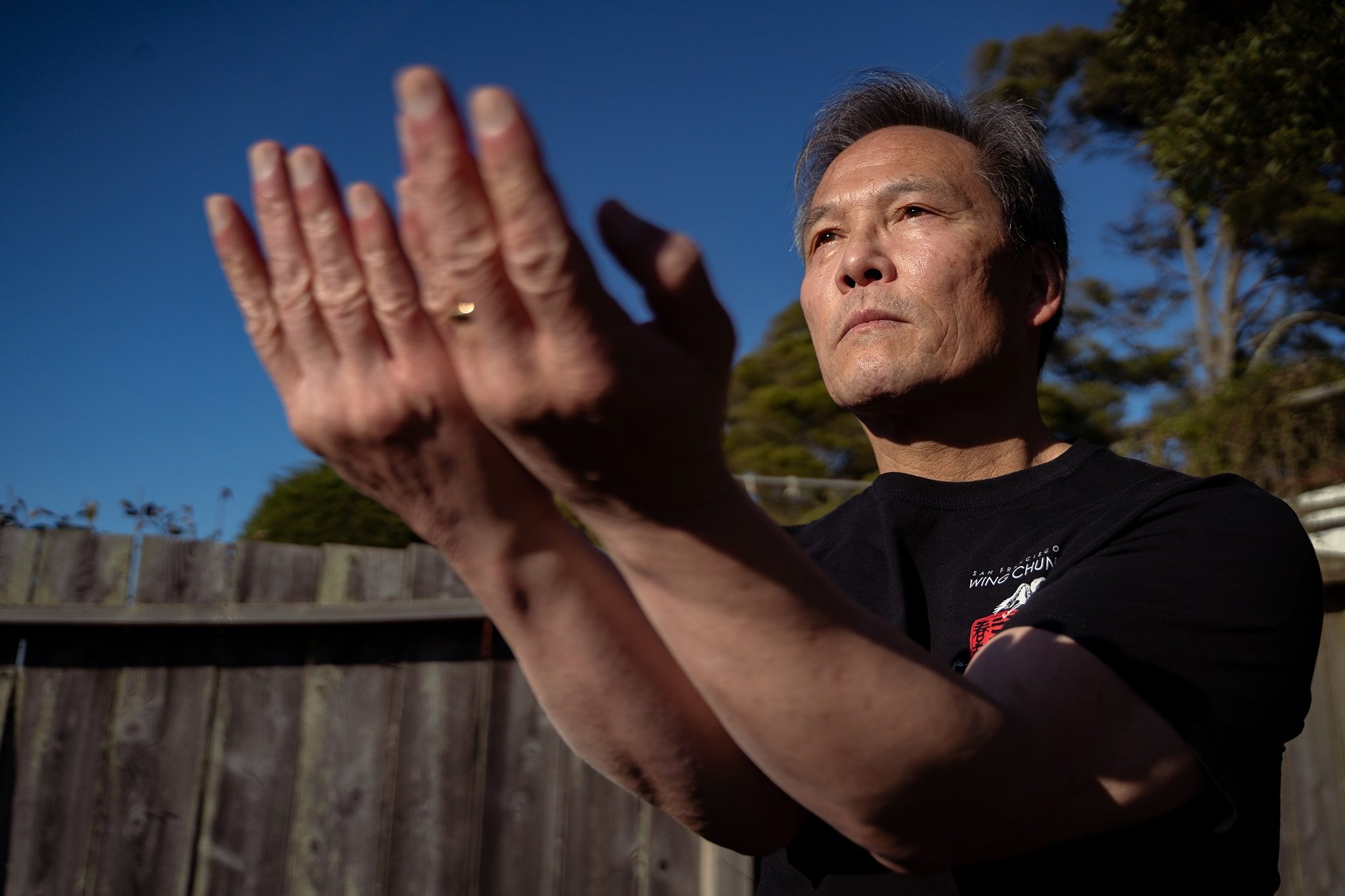
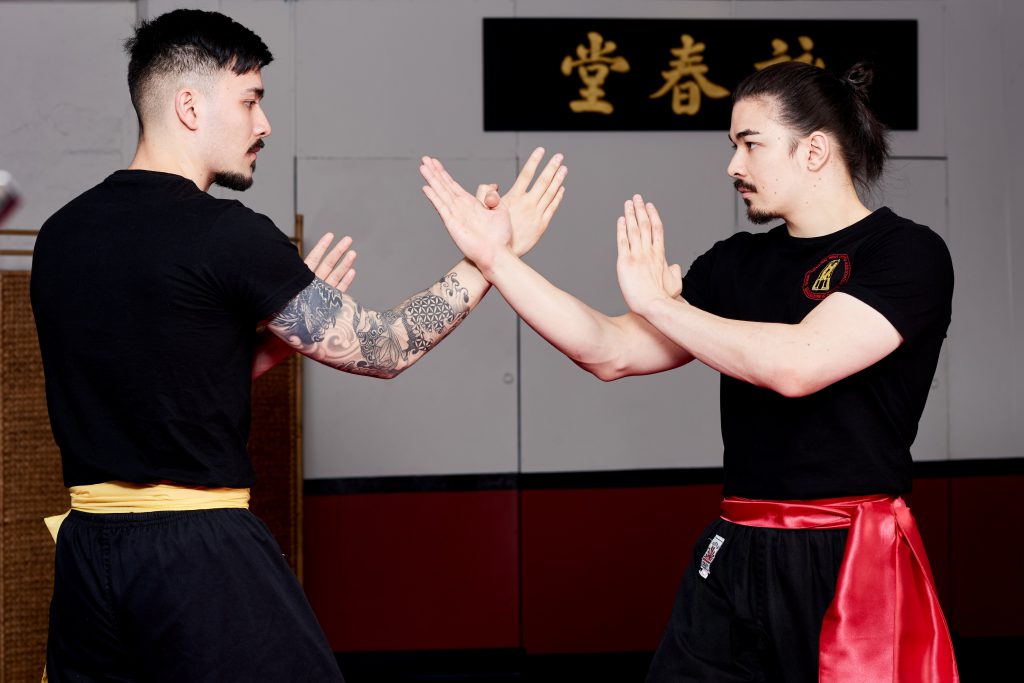
Chi Sao, literally “sticking hands,” is Wing Chun’s signature partner exercise. Two people keep their forearms in contact and move together, learning to feel the direction of each other’s force and to find the gaps in each other’s defense. In a real encounter you will not have time to think through a plan, so the drill trains your arms to respond to touch faster than your eyes and brain can react.
The first lesson does not involve hitting anyone. It uses Dan Chi Sao, or single sticking hand: one partner extends a Tan Sao while the other rests a Fook Sao on top of it, and the two hands roll through a slow, repeating cycle. Use only about a third of your strength, move slowly enough that you could explain every change of direction out loud, and swap roles every five minutes. Twenty minutes per session is plenty.
Three rules keep the drill honest. First, keep the force light: your partner should feel the weight of your arm without being pushed around. Second, keep the speed slow: if you cannot describe each transition, you are going too fast to learn anything. Third, treat being caught as good news. When your partner finds a gap in your defense, you have just discovered exactly what you need to fix.
The classic beginner error in Chi Sao is turning it into a contest. The moment both partners start pressing harder to “win,” the drill becomes arm wrestling, and all it trains is brute strength. Here is the test: after practice, your arms should feel loose and warm, not stiff and sore. If your shoulders and wrists ache afterward, you used too much force. Next time, use half as much again.
A One-Week Plan That Ties It All Together
These three pieces are not three separate subjects. They are one line: the stance gives you a stable base, Siu Nim Tao gives you correct hand techniques, and Chi Sao teaches you to use those techniques against a live person. Train them together from the start and they reinforce each other.
A practical first-week schedule looks like this:
- Four days a week, thirty minutes a day: five minutes of stance work, two rounds of Siu Nim Tao (about twenty minutes), and five minutes of straight-punch shadow practice.
- Two of those days: add twenty minutes of Dan Chi Sao with a partner, after your solo practice.
- Every session: finish by shaking out your arms and legs and checking that nothing hurts. Soreness from new effort is normal; sharp or joint pain is a signal to stop.
Film yourself on day one, even if the footage embarrasses you. After a month of this routine, film yourself again and compare. The difference in your stance, your punch line, and the calm in your shoulders will be larger than you expect. Wing Chun rewards the student who practices a little, correctly, every day, far more than the student who trains hard once and disappears for a month.
Quick Answers
How long should I hold the stance? Start with three to five minutes per round, three rounds a day. Build toward five steady minutes before you try longer holds.
Why is Siu Nim Tao so slow? Because it is a thinking exercise as much as a physical one. Speed practiced on top of a wrong movement only makes the wrong movement faster.
Do I need a partner to start? No. The stance, the form, and the punch are all solo practice. A partner only becomes necessary once you begin Chi Sao, and even then a qualified instructor or an experienced training partner is the safest way to start.
What if my legs shake during the stance? That is normal in the first weeks. Check your knee alignment, shorten the round, and rest between rounds. Shaking that comes with sharp knee pain is different: stop and get the alignment checked.
How long until I notice progress? Most beginners feel steadier hands and quieter shoulders within a month of regular practice. Real skill takes years, but the first improvements come quickly because the basics are so simple.
Practice safely: Train within your limits and build up gradually. Do not train through an injury or push into high-intensity partner drills before you are ready. If you have a history of knee, back, or wrist problems, or any condition that affects your joints, consult a qualified professional before starting a regular practice routine. Stop immediately and rest if you feel pain, dizziness, or joint discomfort during training. This article is a cultural introduction to Wing Chun basics for general interest only; it makes no fitness or medical claims, and Chi Sao partner practice should be done under the guidance of a qualified instructor whenever possible.