It is 6:30 in the morning in the park. An elderly man stands alone on an empty stretch of pavement, a long sword in his right hand. He raises it slowly, and the tip traces a silent arc through the cool air. Nothing about it looks forceful — yet nothing about it looks loose, either. That quiet control is the whole appeal of taijijian, the tai chi sword.
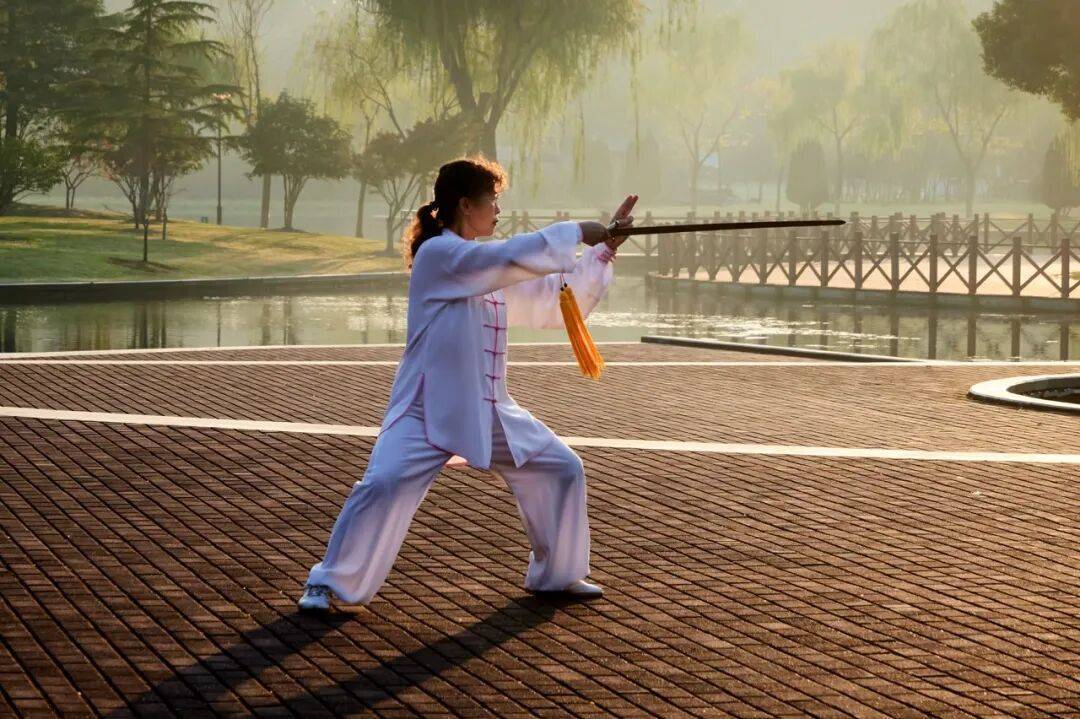
Most beginners make the same mistake: they try to learn an entire sword form on day one. The grip slips, the feet fall behind, and two weeks later everything still feels frantic. Taijijian for beginners really comes down to three things: holding the sword correctly, mastering a handful of basic techniques, and getting your footwork to keep up with the blade. Break those three apart and practice them separately, and within a couple of months you will have a beginner form that actually looks like taijijian.
Choosing a Sword and Holding It Right
You do not need an expensive sword to start. A wooden practice sword or a plain stainless steel training sword is plenty. There is a simple way to check the length: stand the sword upright beside you. The tip should reach roughly ear height — not dragging on the ground, not poking above your shoulder. A sword that is too long will clip the ground every time you turn; one that is too short will leave you reaching on every chop.
The grip is called the sword hold, and it is more about the wrist than the fingers. Place the web between your thumb and index finger against the inside of the grip, wrap your index and middle fingers around it, let your ring and little fingers close gently, and press your thumb against the side of your index finger. The test for tightness is simple: the sword must not slip out of your hand, but your wrist must still turn freely. Grip too hard and the wrist locks up, so every technique turns into arm-waving. Grip too loosely and the tip will wobble on every thrust.
Your left hand is not idle, either. In taijijian it usually forms the sword fingers: index and middle fingers extended together, the other three curled in. The sword fingers help with balance and guide your gaze — during a cloud sword movement, for example, the left hand often follows the direction of the tip, helping your body find its turning axis.
Here is a quick self-check. Hold the sword and thrust straight ahead three times, stopping dead each time. If the tip lands pointing straight forward every time, with no up-and-down wobble, your grip is basically sound. If the tip stops somewhere different each time, do not rush on to new moves yet. Practice the straight thrust until the tip lands in the same spot, then move on.
The Eight Basic Techniques: From Pointing to Chopping
Taijijian has plenty of named techniques, but beginners only need eight: point, thrust, chop, hang, lift, cloud, wipe, and carry. Practice each one about 50 times and the feeling starts to arrive.
Point and Thrust: Training Accuracy
The point is a wrist-driven flick, the tip dipping down and back like a dragonfly touching water — small range, quick speed. The thrust is the arm sending the sword straight forward, the tip aimed directly at the target, and the whole point is that it travels in a straight line. For practice, hang a fist-sized cloth target about 1.5 meters in front of you: a good thrust should land near the center at least eight times out of ten. Once your accuracy is there, the whole form starts to look sharp and focused.
Chop and Hang: Training the Line
The chop brings the sword down from above toward the front, the power arriving at the front part of the blade, and the finish keeps the tip no lower than knee height. The hang draws the tip upward close beside your body, and it is often used to link into a turn. The classic beginner error in both is swinging the whole arm in a big circle. Remember: the power comes from the wrist and the waist. The arm is only the channel that carries it through.
Lift, Cloud, Wipe, and Carry: Training Flow
The lift flicks the tip upward from below. The cloud circles the tip in a flat circle beside the head. The wipe sweeps the blade horizontally. The carry draws the sword back to one side of the body. None of these is hard on its own — the difficulty is in the transitions. When cloud flows into wipe, the waist turns first and the sword follows. When carry flows into thrust, the feet arrive first and only then does the tip go out. Once the transitions are smooth, there are no more pauses or stuck moments between movements.
A practical training rule: practice only two techniques a day, three sets of 20 reps each, in both directions. Trying to cram all eight at once just dilutes them. Split across four days, you can cycle through all eight twice in a single week.
Footwork: Where the Sword Goes, the Foot Follows
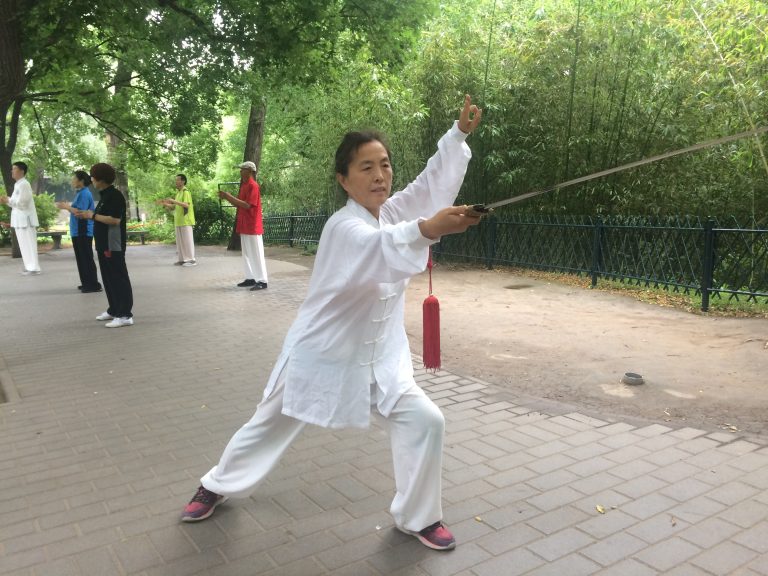
There is an old saying in taijijian: hand arrives, eyes arrive, step arrives. If the footwork falls behind, even beautiful swordwork will not hold together. Beginners need three stances plus one turning step: bow stance, empty stance, crouch stance, and the turn.
The bow stance — front leg bent, back leg straight, weight settled between the two — pairs with thrusts and chops. Check yourself: the front knee stays behind the toes, the back heel stays on the ground, and the torso does not lean forward. The empty stance — front foot lightly touching the ground, weight on the back leg — pairs with points and hangs. The crouch stance — one leg squatting low while the other extends flat to the side, weight pressed down — pairs with the low body position of a lift.
The rhythm of sword and step has a simple pattern: as the sword starts, the foot moves half a step first, and just as the tip arrives, the foot lands. Take the bow-stance thrust as an example: the back foot pushes off, the front foot steps forward, the weight shifts, and the tip goes out — all four happen almost on the same beat. Beginners can break it down: ten minutes of footwork with no sword, ten minutes of swordwork standing still, then ten minutes of the two together at half speed.
Turning is where beginners get tangled most often. Pivot on the ball of the front foot, let the back foot swing around in an arc, look toward the turning direction first, and let the sword turn with the body — never swing the sword first and then turn. Start with 90-degree turns and only move to 180 degrees once those feel steady. In a small park space, check behind you before turning: no people, no tree trunks, no stone benches. Leave at least an arm plus a sword length of clear space around you.
A 20-Minute Daily Routine
Put the three pieces together and you get a daily session that fits into 20 minutes. Follow it for a month and the change is visible:
- Warm up, 5 minutes: loosen your wrists, shoulders, waist, and knees, then switch between bow stance and empty stance 20 times until you feel lightly warm.
- Solo technique work, 8 minutes: the two techniques of the day, four minutes each, done slowly, watching whether the tip travels on the right line.
- Combined footwork, 5 minutes: bow-stance thrust, empty-stance point, and turning hang, ten reps each, at half your normal speed.
- Linking it together, 2 minutes: run the day’s techniques in sequence once through. Not fast — just continuous, without stumbling.
Afterward, take three minutes to cool down: put the sword down, shake out your wrists, and walk two slow laps until your breathing settles. Keeping a small notebook helps too: write down which two techniques you practiced and which movement felt most awkward, then start the next session by fixing that awkward one first.
Quick Answers
How long until I look like I know what I am doing? About a month of steady daily practice for the basics to feel coordinated, and around two months before a short beginner sequence looks smooth. Taijijian rewards patience, not talent.
Do I need a real sword? No. A wooden or blunt stainless training sword is the right tool for the first year. A sharp blade adds risk without adding anything to your learning.
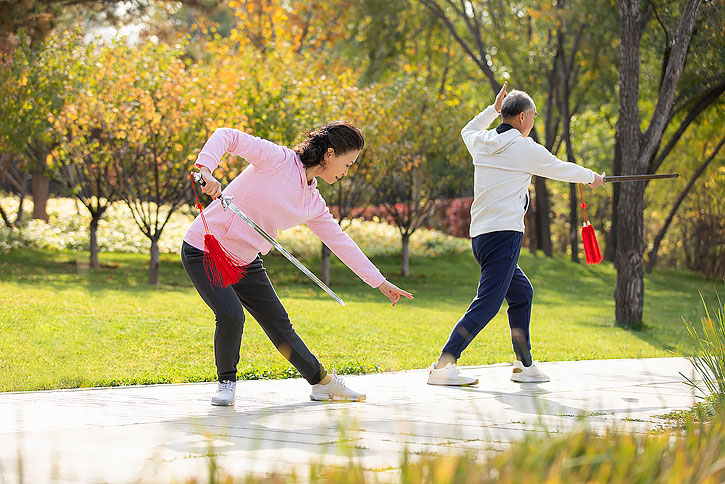
What if I have no one to practice with? Solo practice is how most people start, and it is enough for the beginner stage. Practicing with a partner mainly helps with footwork timing — the third photo above shows two practitioners drilling exactly that.
Can I practice indoors? Only if you have real clearance: a full sword length plus an arm in every direction, and nothing breakable within reach. Outdoors on flat, open ground is almost always the better choice.
What is the single most common beginner mistake? Gripping too tightly. A white-knuckled grip freezes the wrist, and a frozen wrist turns every technique into arm-waving. Loosen up, and the sword starts to move the way it should.
Start Today, the Slow Way
Taijijian for beginners is not a talent contest. It is about breaking movements down finely enough and practicing steadily enough, day after day. Get the grip right, cycle through the eight basic techniques, and let your footwork keep pace with the tip — do those three things well, and a complete beginner form will follow naturally.
The action plan is simple: find a practice sword of the right length today, spend ten minutes on the grip and the straight thrust, and add the point tomorrow. In one week you will have cycled through all eight techniques; in one month your footwork and swordwork will be moving in step. Once the basics are solid, learning a full form will be faster — and far more solid — than jumping straight into one.
Safety note: progress gradually and practice within your limits. Keep the speed slow and the range modest at the beginner stage, and stop and rest if a joint feels uncomfortable. Choose flat, open ground with no foot traffic, check that your practice sword is secure before you start, and keep a full safety distance around you — never swing a sword in a crowded place. Taijijian is a traditional fitness activity; this guide shares cultural background and practice methods only, and makes no promise of any health benefit. If you have any medical condition, consult a doctor before starting.