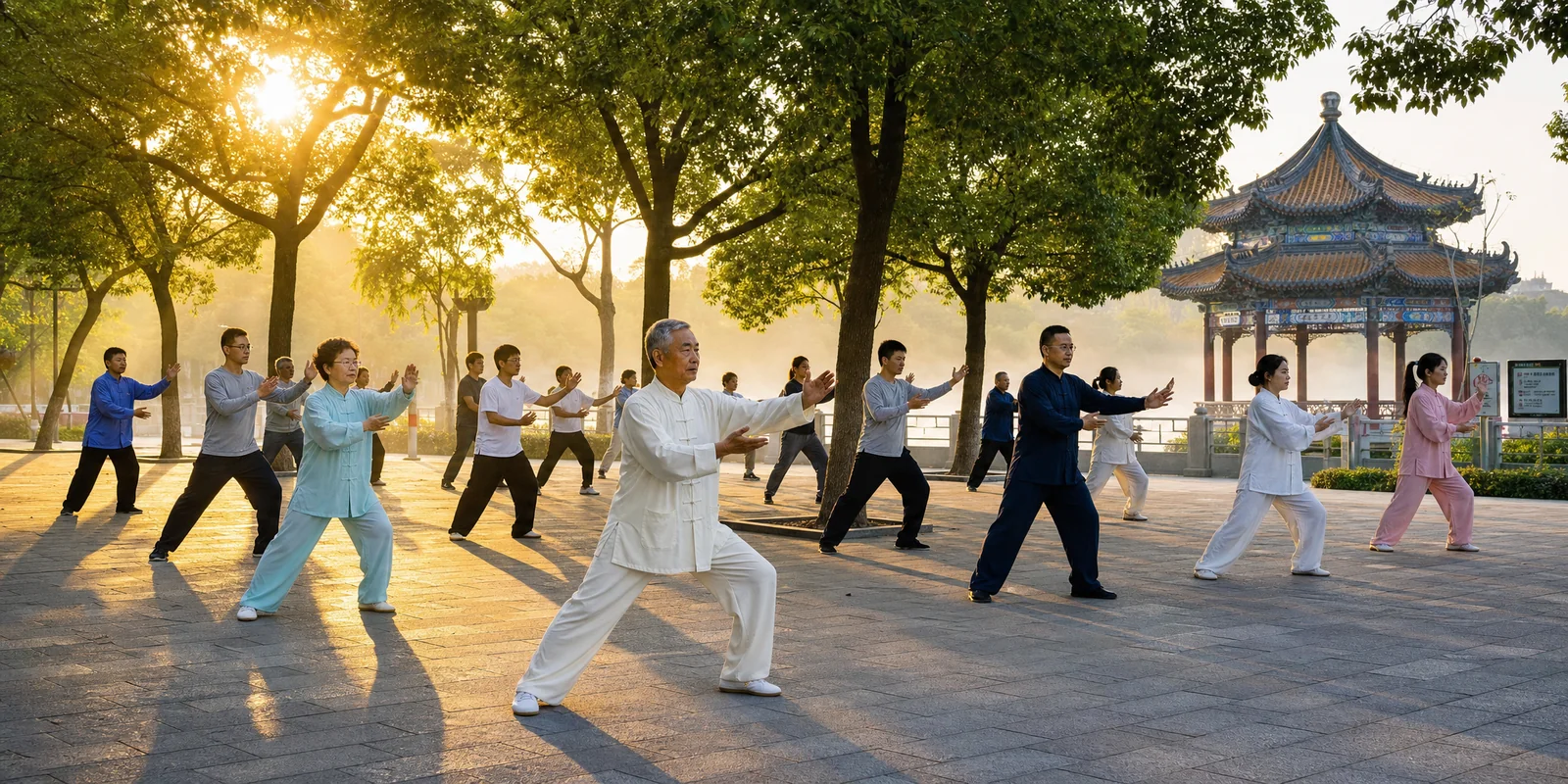
It’s 7 a.m. in the neighborhood park. An old man with graying hair presses both hands downward, and a thin “ssshh…” escapes his lips. The morning joggers glance over, curious: what is he doing? He’s practicing a qigong routine that has survived fifteen centuries — Liuzijue.
Liuzijue (literally “six-character formula”) is a set of six healing breath-sounds from traditional Chinese qigong — a practice of slow, mindful body movement and breathing that has been part of Chinese wellness culture for over two thousand years. Six sounds, ten minutes a day, no equipment, no gym. Here’s how it works, and how to start tonight.
What Liuzijue Is: Six Sounds for the Five Viscera
The earliest written record of Liuzijue appears in Yangxing Yanming Lu (Records on Nourishing One’s Nature and Extending Life), a 6th-century health manual by Tao Hongjing, one of the great scholar-physicians of China’s Northern and Southern Dynasties period (roughly the 5th–6th centuries). A thousand years later, the Ming-dynasty scholar Gao Lian organized the sounds into the complete routine still practiced today.
The idea isn’t mystical. Each of the six sounds shapes the mouth and throat differently, so the exhaled air vibrates the chest and abdomen in different ways. Classical Chinese medicine — the traditional system that describes the body through the Five Viscera (heart, liver, spleen, lungs, and kidneys) and their energetic pathways — held that each sound resonates with a specific organ. A modern reader can simply think of Liuzijue as “breathing gymnastics with sound”: a low-barrier routine anyone can pick up.
The six sounds and what they target — learn this table and you’re halfway in:
- Xu (like “shh”) — the liver. Lips slightly closed, air slips out of the throat in a long, quiet sigh — “shhhh…” Meanwhile, open your eyes wide. In traditional Chinese medicine, the liver is said to “open into the eyes,” so widening the eyes is thought to help disperse stuck liver energy — the kind of tension you feel after a stressful week.
- He (like “huh”) — the heart. Open the mouth wide and let the breath pour out — “haaaah…” Most people feel their chest loosen immediately. Reach for this sound when you’re restless, irritated, or can’t sleep.
- Hu (like “hoo”) — the spleen and digestive center. Round your lips into a circle; as you exhale, let the belly gently swell, with your attention resting on the navel area. It helps the digestive system wind down.
- Si (like “ssee”) — the lungs. Close the teeth lightly, rest the tongue tip against the lower teeth, and let the air leak through the teeth — “ssseee…” This is the classic sound for the respiratory system.
- Chui (like “choo-ee”) — the kidneys. Purse the lips into a small round opening, as if blowing out a candle without extinguishing the flame. The stream is thin and long; let your attention sink to the lower back, around the waist.
- Xi (like “shee”) — the Sanjiao, or “Triple Burner.” The Triple Burner is a traditional Chinese medicine concept describing the body’s three main cavities (chest, abdomen, pelvis) as one connected system that keeps energy and fluids flowing. Mouth slightly open, tongue tip touching the upper palate, air flowing past both sides of the tongue — a clear, bright “sheee…” This final sound settles the whole system.

Before You Begin: Get the Setup Right
Liuzijue works anywhere — living room, balcony, park — but don’t skip these three preparations:
- Stand or sit, your choice. Standing: feet shoulder-width apart, knees slightly bent, shoulders dropped, elbows relaxed, the crown of your head feeling as if gently lifted by a thread. Sitting: perch on the front third of a chair, back upright, feet flat on the floor. Both work equally well — if your knees are sensitive, sit.
- Settle your breath first. Close your mouth and breathe through your nose, in and out, 3 to 5 times, tongue tip resting on the upper palate. Only start the sounds once the breath feels steady; otherwise your exhale will float upward and strain you.
- Loose clothes, half-empty stomach. Don’t practice right after a meal — wait at least 30 minutes. Put your phone on silent; ten uninterrupted minutes beats twenty distracted ones.
The 10-Minute Beginner Routine: Follow Along
A full round takes about 10 minutes: each sound repeated 6 times, each exhale lasting 6 to 8 seconds — roughly 7 minutes for the six sounds, plus warm-up and closing for an even 10. Keep the fixed order: xu, he, hu, si, chui, xi. Don’t shuffle it.
1. Xu — soothing the liver
Look straight ahead. As you inhale, raise both hands slowly up along your sides; as you exhale with “shhhh…”, press your hands down in front of your abdomen while slowly widening your eyes. Imagine every frustration of the day leaving with that sigh. Repeat 6 times.
2. He — calming the heart
As you inhale, cross your hands and lift them above your head; as you exhale with “haaaah…”, open your mouth wide and let your hands part and fall along your sides. People with a racing mind or trouble sleeping often describe this sound as “opening a window in the chest.” Repeat 6 times.
3. Hu — settling digestion
Stack both hands in front of your lower belly. Inhale as the abdomen naturally expands; exhale with “hooo…” while the hands follow the belly wall gently inward and press down. When you feel bloated after lunch, 3 reps here works better than sitting around rubbing your stomach. Repeat 6 times.
4. Si — opening the lungs
Inhale while lifting both hands from the front up to chest level; exhale with teeth lightly closed, tongue against the lower teeth — “ssseee…” — turning the palms and slowly pressing the hands downward. If you get seasonal congestion or a springtime cough, keep this sound extra gentle. Repeat 6 times.
5. Chui — supporting the kidneys and lower back
Hands on your hips or hanging naturally at your sides. Inhale with your attention on the lower back; exhale with lips pursed in a small circle — “choo-ee…” — a thin, even stream of air, like sending your breath out through a straw. Desk workers with an aching lower back usually notice relief after a few days of this one. Repeat 6 times.
6. Xi — the closing sweep
Inhale with hands resting on the waist; exhale “sheee…” with the tongue tip on the upper palate, air flowing past both sides of the tongue, hands sliding gently down along the ribcage. This is the finale of the six — helping the body’s energy “settle back into place.” Repeat 6 times.
The closing minute: don’t skip it
When the six sounds are done, rub your hands warm and “wash” your face from forehead to chin, 3 passes. Then take 3 deep breaths and sit quietly with eyes closed for one minute. Many people feel warmth in their palms and looseness through their whole body — that final minute is doing more than you think.
4 Beginner Mistakes to Avoid
- Shouting the sounds. Liuzijue calls for breath “thin as a thread” — each sound should be soft, long, and even. Shout it out and you’ll end the session with a sore throat and a tight chest, which means you’ve got it wrong. The test is simple: after practice your mouth shouldn’t be dry, your voice shouldn’t be hoarse, and your mind should feel clear.
- Holding your breath. When an exhale runs out, inhale naturally — never hold and strain. If you can’t sustain 6 seconds, drop to 4 and build up over weeks. Easy breathing always comes first.
- Dizziness after practice. Usually caused by tucking the chin too far down or exhaling too forcefully — a momentary dip in oxygen to the brain. Sit down, drink some warm water, and it passes in a few minutes. Next time, drop to 3 reps per sound and keep your gaze level; the dizziness rarely returns.
- Chasing the “qi feeling.” Warm palms or tingling fingertips are individual differences — having or lacking them says nothing about how well you’re doing. Give yourself 21 days, 10 minutes a day, then look back at your sleep and energy instead. That’s a far more honest measure than chasing sensations.
When and How Long to Practice
For timing, 6 to 8 a.m. is the sweet spot: clean air, a clear head, and 10 to 15 minutes fits neatly before work. A 5-minute add-on between 3 and 5 p.m. perks you up better than coffee. One evening caution: don’t do the chui sound in the half hour before bed — it’s a deeply grounding sound for the kidneys, and practicing it late may have you up using the bathroom at night.
For frequency, once a day for 21 days is the beginner’s benchmark. When you have a fever or feel thoroughly exhausted, pause and resume when you recover — no guilt required. Once the routine is familiar, you can stretch it to 20 minutes a day (9 reps per sound). There’s even a “silent version” for the office lunch break: mouth shapes and breathing only, no sound. Your coworkers won’t even notice.
Quick Answers
Is this religious or spiritual? No. As practiced today, Liuzijue is a breathing and movement exercise — closer to slow yoga breathing than to anything spiritual. You don’t need to believe anything for it to work.
Can children or elderly people do it? Yes — it’s one of the gentlest qigong routines, and the seated version works for anyone. That said, anyone with a medical condition should check with a doctor first (see the disclaimer below).
What if I can’t exhale for 6 seconds yet? Start with 4 seconds. Most beginners reach 8 seconds comfortably within three weeks.
Does it actually do anything? It’s a breathing exercise: it slows your heart rate, relaxes the diaphragm, and calms the nervous system. People report better sleep and a calmer mind within a few weeks. It is not medicine and doesn’t replace medical treatment.
Your Turn: 10 Minutes, Tonight
Everything in Liuzijue comes down to six mouth shapes and six streams of air: xu for the liver, he for the heart, hu for digestion, si for the lungs, chui for the kidneys, xi as the closing sweep. No space needed, no equipment — run through the whole set in 10 minutes, rub your face warm at the end, and your whole body will feel looser.
The action step is simple: tonight, take 10 minutes, find a quiet corner, and walk through all six sounds — xu, he, hu, si, chui, xi — from start to finish. Set your alarm for 7 a.m. tomorrow and keep it up for 7 days; your sleep and your state of mind will give you the verdict. Something that has survived fifteen centuries is worth one trial run.
Safety Disclaimer
If you have a chronic condition — high blood pressure, heart disease, asthma, diabetes, or similar — please consult your doctor before starting this practice. If you feel persistent dizziness, chest tightness, or difficulty breathing during practice, stop immediately and seek medical help. This article is an educational introduction to a traditional wellness practice: it is not medical advice, promises no results, and does not replace professional diagnosis or treatment.