Picture someone studying a BaZi chart for the first time. The chart has only eight characters — four Heavenly Stems on top, four Earthly Branches below. Simple enough. Then they look closer: next to every Earthly Branch, two or three extra Stems are squeezed in. Where did all these extra characters come from? A chart of eight symbols suddenly has twenty more hiding inside it.
That confusion is normal — and this guide exists to end it. By the end, you will know exactly what Hidden Stems (the “canggan” contained inside Earthly Branches) are, why the ancient Chinese astrologers put them there, how they rank into primary, middle, and residual qi, and — the most important point of all — why the Ten Gods (the ten relational labels BaZi uses, such as Friend, Output, and Wealth) are always derived from Hidden Stems, never from the Branch itself.
Why Earthly Branches Need Hidden Stems at All
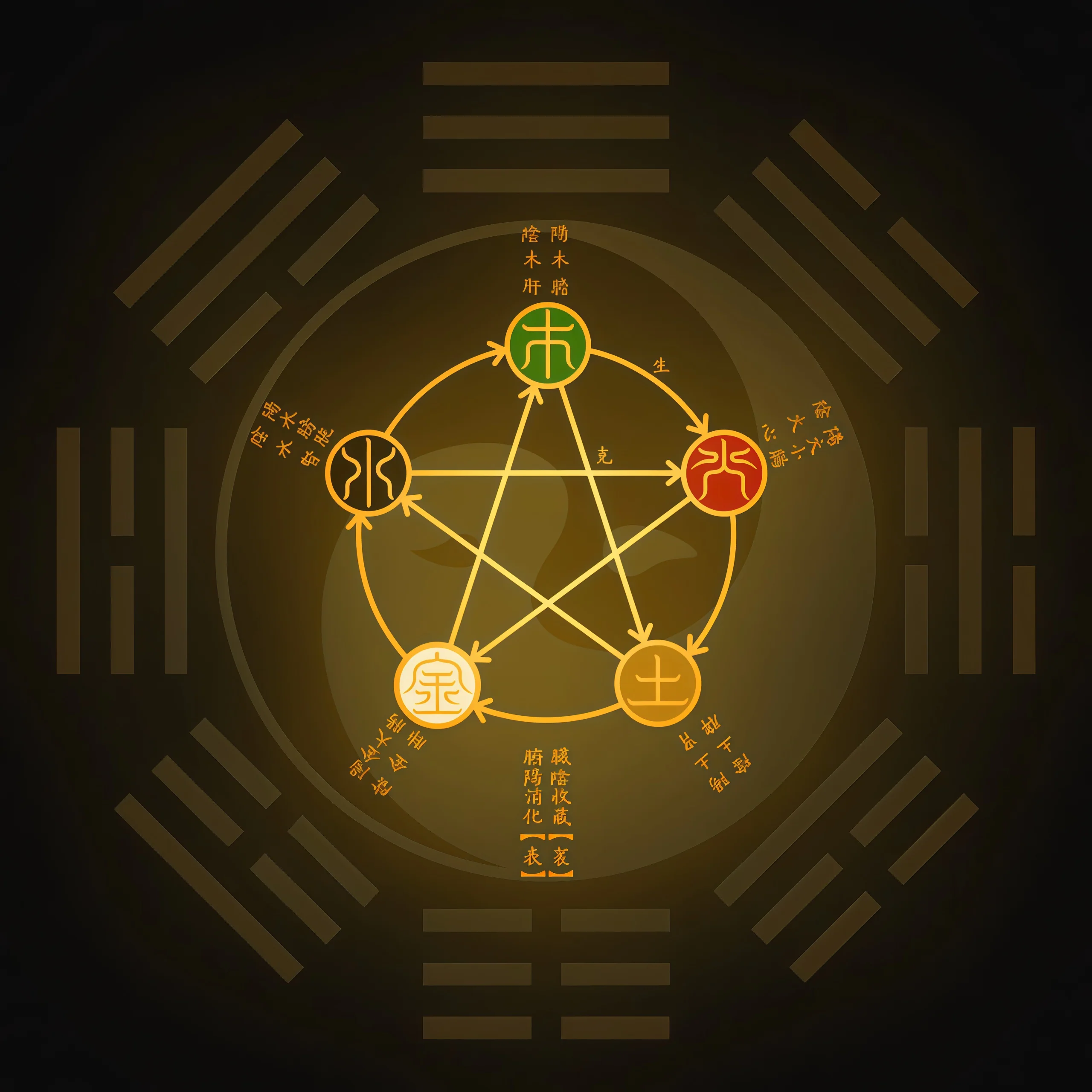
Start with an analogy. The Heavenly Stems are like weather: Jia and Yi are the sprouting wood energy of spring; Bing and Ding are the midday fire of summer. Visible, tangible, out in the open. The Earthly Branches are the earth itself: real soil is never one single ingredient — it always holds humus, minerals, and water at the same time.
Ancient scholars took the mixture of elemental qi blended inside each Earthly Branch and wrote each component out as a Heavenly Stem. That is what Hidden Stems means — the Stems “hidden” within a Branch. It is also called the “Human Origin,” completing the classical trio: the Heavenly Stems are the Heavenly Origin, the Earthly Branches are the Earthly Origin, and the Hidden Stems are the Human Origin. Heaven, Earth, and Human together make the complete threefold structure.
Take the branch Yin as an example. On the surface Yin belongs to wood, but it actually sits at the convergence of early-spring wood qi newly sprouting, hidden fire qi warming up, and earth qi not yet dispersed — the moment around Lichun (the Beginning of Spring). So Yin contains three Stems: Jia, Bing, and Wu. Jia is the wood’s dominant energy, Bing is the residual warmth of fire, Wu is the leftover trace of earth. One character, three kinds of qi — that is exactly why Hidden Stems exist.
Primary, Middle, and Residual Qi: Hidden Stems Have a Hierarchy
Not every branch hides three Stems. Zi, Mao, and You are the “purest” — each hides only one. Wu and Wei hide two; all the rest hide three. And where several Stems share one branch, they rank by weight:
- Primary qi (benqi, the host energy): the largest component — for example, Jia wood is the primary qi of Yin.
- Middle qi (zhongqi, the transitional energy): the bridge between seasons — for example, Bing fire is the middle qi of Yin.
- Residual qi (yuqi, the leftover energy): the tail of the previous solar term — for example, Wu earth is the residual qi of Yin.
Here is the complete table of Hidden Stems for all twelve Earthly Branches. Beginners are advised to save it:
- Zi hides Gui; Chou hides Ji, Xin, Gui; Yin hides Jia, Bing, Wu
- Mao hides Yi; Chen hides Wu, Yi, Gui; Si hides Bing, Geng, Wu
- Wu hides Ding, Ji; Wei hides Ji, Ding, Yi; Shen hides Geng, Ren, Wu
- You hides Xin; Xu hides Wu, Xin, Ding; Hai hides Ren, Jia
Notice the pattern: branches with fewer Hidden Stems carry the purest qi; branches with more carry the most mixed qi. This pure-versus-mixed distinction will come up again and again when you study chart structures.
The Ten Gods Are Derived from Hidden Stems, Not Directly from Branches
This is the single most important sentence in the entire guide: the Ten Gods always describe a relationship between two Stems. A branch must first be “translated” into its Hidden Stems before it can take part in any Ten Gods derivation.
Remember the rule from the Ten Gods primer: the Ten Gods are determined by the Five Elements interaction — generating or controlling — between the Day Master (the Stem of the birth day, which represents the person the chart is read for) and every other pillar, together with their yin-yang polarity. But an Earthly Branch is not a Stem, so it cannot be compared with the Day Master for polarity or for generating-and-controlling. The ancient solution was elegant: pull each Hidden Stem out of the branch, pair each one with the Day Master, and whatever Ten Gods result are the Ten Gods “carried” by that branch.
As many Stems as a branch hides, that many Ten Gods it brings along. Take Yin again: it hides Jia, Bing, and Wu, so for the Day Master it carries three layers of Ten Gods information at once — with the primary qi’s layer weighing the heaviest.
Worked Example: A Jia Day Master Meets Yin, Mao, and Hai
Rules alone can feel abstract, so let us run through three concrete derivations with the Day Master Jia wood. First, a quick refresher on the two iron rules:
- The Five Elements cycle: wood generates fire, fire generates earth, earth generates metal, metal generates water, water generates wood; wood controls earth, earth controls water, water controls fire, fire controls metal, metal controls wood.
- “Same polarity is off-center, opposite polarity is centered”: a yang Stem paired with a yang Stem, or yin with yin, is the “off-center” variant; a yin-yang pairing is the “centered” one.
Round 1: Jia Day Master, Branch Yin
Yin hides Jia, Bing, and Wu. Pair each with Jia:
- Jia with Jia: both yang wood — the “same element” relationship, same polarity — Friend (Bijian)
- Bing fire is generated by Jia wood (wood generates fire); yang wood generating yang fire, same polarity — Output God (Shishen)
- Wu earth is controlled by Jia wood (wood controls earth); yang wood controlling yang earth, same polarity — Indirect Wealth (Piancai)
So “a Jia Day Master sitting on Yin” means this Yin carries Friend, Output God, and Indirect Wealth — with Friend, the primary qi’s Ten God, carrying the most weight.
Round 2: Jia Day Master, Branch Mao
Mao hides only one Stem: Yi. Jia is yang wood, Yi is yin wood — “same element” but opposite polarity — Rob Wealth (Jiecai). The qi is pure, so for Jia, Mao delivers one clean, unambiguous Rob Wealth with no mixed qi to muddy it.
Round 3: Jia Day Master, Branch Hai
Hai hides Ren and Jia. Pair each with Jia:
- Ren water generates Jia wood (water generates wood); yang water generating yang wood, same polarity — Indirect Resource (Pianyin)
- Jia with Jia: both yang wood — Friend (Bijian)
After three rounds, a pattern emerges: with the same Jia Day Master, different branches hide different Stems and produce completely different Ten Gods combinations. That is why two people with the “same Day Master” can have wildly different temperaments and life circumstances — the things hiding inside their branches are different.
Three Practical Ways for Beginners to Learn the Hidden Stems Table
Memorizing the full twelve-branch table is basic training, but rote memorization slips away fast. Use these three methods together and it sticks:
Method 1: Learn the four “single-hide” branches first
Zi hides Gui, Mao hides Yi, You hides Xin, and Wu hides Ding and Ji — start with the simplest structures to build confidence. Of the remaining eight, Chou, Chen, Wei, and Xu are the four “earth storehouses” with slightly trickier combinations, while Yin, Si, Shen, and Hai all follow the same fixed formula of “primary qi + growing qi + residual qi.” Once you know the formula, you no longer need to memorize them one by one.
Method 2: Use the solar terms to understand “why it hides this”
Why does Yin hide Bing and Wu? Because Yin falls at Lichun, when wood qi takes command (Jia), yet the deep winter’s cold has not fully retreated — the transition expresses itself as fire about to be born and earth about to flourish (Bing and Wu). Every branch’s Hidden Stems are a snapshot of elemental waxing and waning around its solar term. Once you grasp the solar-term logic, the table becomes something you can derive, not just memorize.
Method 3: Verify with a chart tool
Plot a few charts by hand, then compare the Hidden Stems a tool lists against the table you memorized. Every comparison reinforces the memory. When a branch feels uncertain, check the tool first, then ask yourself, “Does this Hidden Stem fit the solar-term logic?” — three rounds of that and you will rarely get it wrong again.
One caution: different schools disagree slightly on individual branches — whether Wu should hide Ji, or whether Wei’s middle qi counts as Ding. At the beginner stage, just pick one mainstream table (like the one above) and stick with it; save the disputed details for after you are comfortable with the basics.
Quick Answers
Do I really need to memorize all twelve branches? Yes, eventually — it is one of the few pieces of BaZi that rewards pure memorization. But start with the four “single-hide” branches and the fixed formula for Yin, Si, Shen, and Hai; the rest falls into place.
Why can’t I just read the branch’s element directly? Because a branch is a mixture, not a single element. Reading only “Yin is wood” is like reading only the soil’s color — you miss the fire and earth blended into it. The Ten Gods need Stems to work with, so the mixture must be unpacked first.
What if different schools give different tables? Stick with one mainstream version while learning. The differences touch only one or two branches, and they do not affect the core logic: derive Ten Gods from Hidden Stems, with the primary qi weighing most.
Does this tell me anything about my future? No — and that is the point. Hidden Stems are a descriptive language for reading chart structure. They describe relationships between symbols; they do not predict events. Keep the study cultural and analytical.
Summary and Next Steps
Looking back, this guide covered three things: an Earthly Branch is not a single element but a “mixture of elements,” so its Hidden Stems must be unpacked; unpacked Stems rank by weight into primary, middle, and residual qi; and the Ten Gods can only be derived through Hidden Stems — as many Stems as a branch hides, that many Ten Gods it carries.
Your next steps come in two parts. Step one: take your own BaZi chart (or plot one with the BaZi chart tool on this site), write out the Hidden Stems of all four branches by hand, and derive each Stem’s Ten God using the rules from the Ten Gods primer — doing it once by hand beats reading about it ten times. Step two: pay special attention to the month branch’s Hidden Stems, because in the classical tradition its primary qi is called the “Month Command” (yueling), the starting point of all chart analysis. Once you can answer “what Ten God is the Month Command’s primary qi,” you have truly pushed open half the door of BaZi.