It’s 2 p.m. Your health checkup came back normal — everything green — yet your shoulders feel like stone, your eyelids are heavy, and last night you lay in bed for an hour with a brain that refused to switch off. Western medicine calls this “nothing wrong.” Traditional Chinese medicine (TCM) has a different name for it: sluggish qi and blood flow. And the twelve meridians — the channels through which qi and blood flow in traditional Chinese medicine — are the routes that flow travels on.
What Are the Twelve Meridians? Your Qi Highway Network
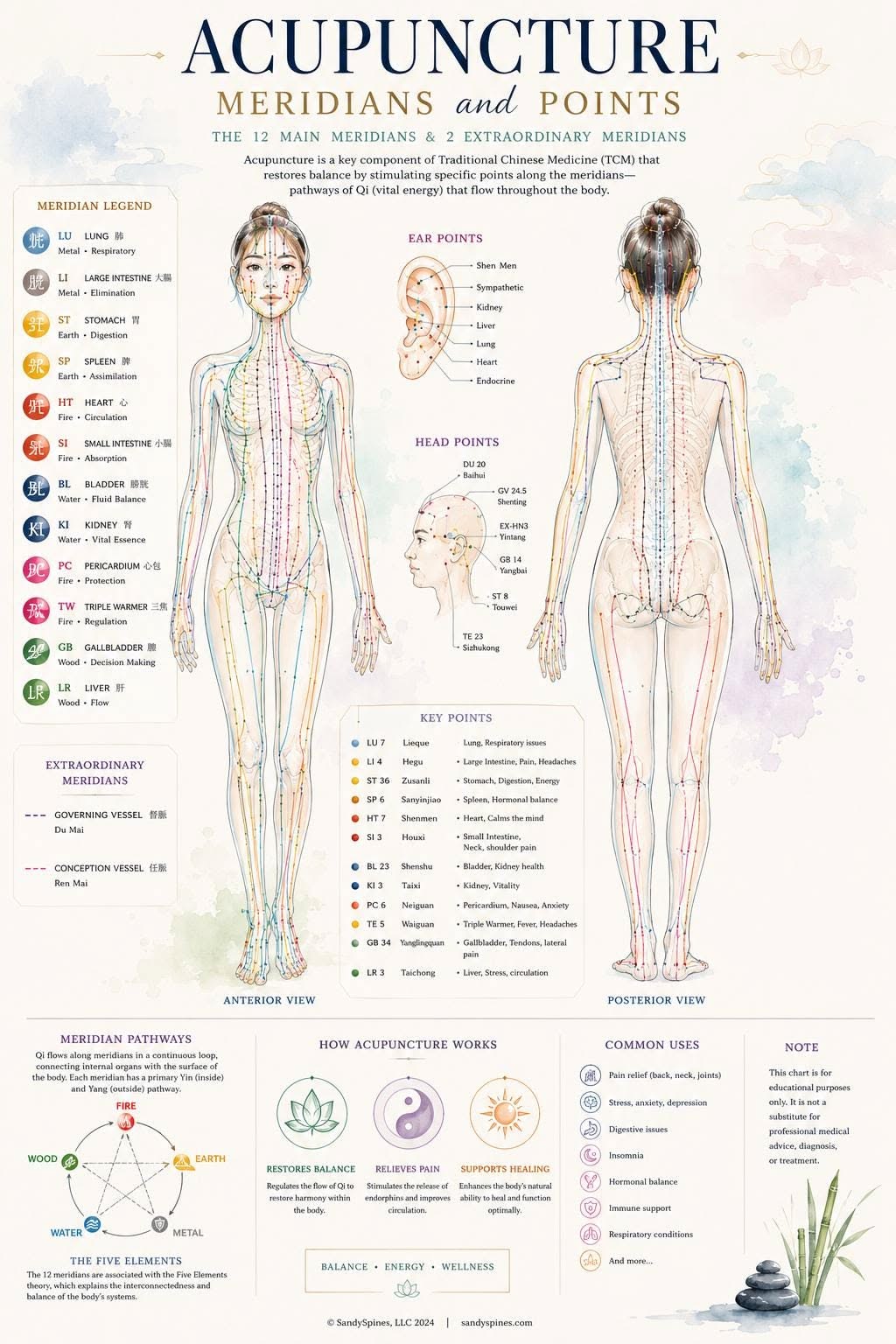
Think of your body as a city. Blood vessels are the water pipes, nerves are the electrical wiring — and the meridian system is the highway network running through it. Its job is to move qi (vital energy) and blood, delivering nourishment to your organs and limbs while carrying signals back. The concept was first recorded systematically in the Huangdi Neijing (the Yellow Emperor’s Inner Classic), over two thousand years ago.
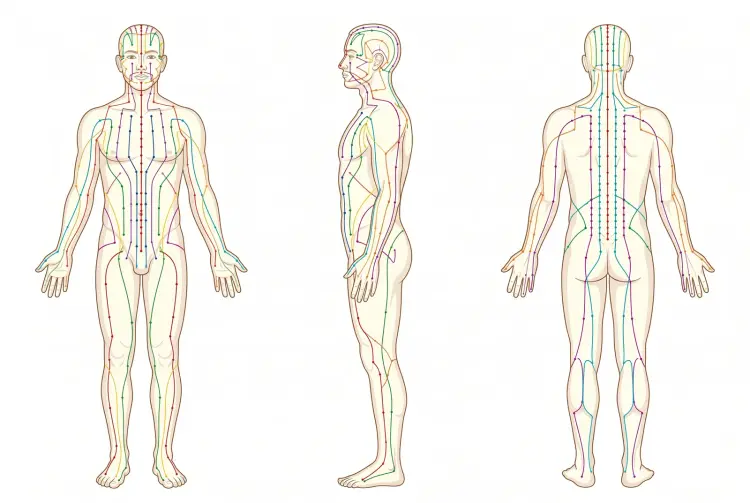
The system has two parts: jing (the main vertical highways) and luo (the small connecting side streets). There are twelve main highways, called the twelve primary meridians, running symmetrically on both sides of the body — twenty-four in total. Beyond them sit the eight extraordinary vessels, of which the Ren (conception) and Du (governing) vessels are the most famous.
Each meridian’s name is built from three parts: hand/foot + one of the three yin or three yang categories + its paired organ. “Hand Taiyin Lung Meridian,” for example, runs along the arm and connects to the lungs; “Foot Taiyang Bladder Meridian” runs along the leg and connects to the bladder.
Qi and blood circulate through the twelve meridians in a fixed order: starting at the Hand Taiyin Lung Meridian, flowing through the large intestine, stomach, spleen, heart, small intestine, bladder, kidney, pericardium, triple burner, and gallbladder meridians, and finally arriving at the Foot Jueyin Liver Meridian before returning to the lungs — one closed loop.
One Formula to Remember Them All: Three Yin and Three Yang
The twelve meridians fall into four groups based on location and yin-yang nature. A four-line formula from the classics covers the entire map:
- The three hand yin meridians run from chest to hand: the Lung, Pericardium, and Heart meridians travel from the chest along the inner arm to the fingertips.
- The three hand yang meridians run from hand to head: the Large Intestine, Triple Burner, and Small Intestine meridians travel from the fingers along the outer arm to the head and face.
- The three foot yang meridians run from head to foot: the Stomach, Gallbladder, and Bladder meridians travel from the head down the front, side, and back of the body to the toes.
- The three foot yin meridians run from foot to chest: the Spleen, Liver, and Kidney meridians travel from the toes up the inner leg back to the chest and abdomen.
There is also a pattern: yin meridians mostly connect to the zang organs (lung, pericardium, heart, spleen, liver, kidney — the solid, storing organs), while yang meridians mostly connect to the fu organs (large intestine, triple burner, small intestine, stomach, gallbladder, bladder — the hollow, digesting ones). Each zang-fu pair is “paired inside and outside” — lung with large intestine, for instance — which is exactly why lung meridian flow hands off directly to the large intestine meridian in the circulation order above.
A handy memory trick: on the inner arm, from thumb to pinky, it’s Taiyin, Jueyin, Shaoyin. On the inner leg, from front to back, it’s the Spleen (Taiyin), Liver (Jueyin), and Kidney (Shaoyin) meridians. Trace them on the diagram a few times and they’ll stick.
The Meridian Clock: A Shift Schedule from Ancient China
The twelve meridians don’t share the flow evenly. Ancient practitioners observed that each meridian gets a two-hour window when its qi and blood run strongest — like shifts on a roster. This is called zi wu liu zhu, the “meridian clock.”
- 11 p.m. – 1 a.m. (Zi), Gallbladder meridian on duty: the time for restoration to begin. This is why “a good night’s sleep starts before midnight” is such a persistent piece of traditional advice — staying up past this window often means a foggy head the next day.
- 3 – 5 a.m. (Yin), Lung meridian on duty: the lung governs qi itself. A few deep breaths after waking up can make your chest feel noticeably clearer.
- 5 – 7 a.m. (Mao), Large Intestine meridian on duty: time for the body to clear waste. A glass of warm water and a regular morning bowel routine line up with this window.
- 7 – 9 a.m. (Chen), Stomach meridian on duty: qi and blood flow strongest here, so breakfast digests best at this hour. Skip it and you’ll feel hungrier sooner by lunch.
- 11 a.m. – 1 p.m. (Wu), Heart meridian on duty: the heart houses the shen, the mental spirit. A twenty-minute midday nap can transform your afternoon focus.
- 5 – 9 p.m. (You to Xu), Kidney then Pericardium meridians on duty: time to slow down. An easy evening walk and unhurried conversation with family fit this window perfectly.
Treat the meridian clock as a rhythm reference, not a rigid rulebook. The ancients weren’t prescribing appointments — they were summarizing the lifestyle rhythm they observed over centuries. The core message is simple: sleep on time, eat properly, move moderately.
Daily Care: Four Gentle Techniques
All four techniques below are gentle, safe, and need no equipment:
1. Hair Combing: 50–100 Strokes a Day
The head is where many meridians meet — the classics call it the “meeting of all yang.” Use a wooden comb or your fingertips to stroke from the forehead hairline to the back of the head, 50 to 100 times daily, with enough pressure to feel gentle warmth and comfort. After two weeks, most people notice their morning grogginess easing.
2. Dry Face Washing: 30 Reps in the Morning
Rub your palms together until warm, then wash your whole face with dry hands, moving upward and outward, 30 times. Perfect for those who can’t quite wake up — it rouses the facial muscles and circulation.
3. Tapping the “Eight Hollows”: 30–50 Taps Each
The elbow creases, armpits, groin creases, and the hollows behind the knees are where qi and blood tend to gather — together they’re called the “eight hollows.” Tap each spot with a loose cupped hand, 30 to 50 times, until the skin feels slightly warm and relaxed. Remember: harder is not better. If it hurts enough to make you wince, you’re pressing too hard and may bruise the tissue.
4. Foot Soak + Downward Leg Strokes Before Bed
Soak your feet in warm water (around 40°C / 104°F) for 15–20 minutes, water covering the ankles. Then press and stroke both hands from the top of the thigh down toward the ankle — exactly along the “head to foot” direction of the foot yang meridians. Warm feet usually mean faster sleep.

Safety note: keep everything light and comfortable; skip any area with broken or irritated skin; if you are pregnant, have serious heart or vascular conditions, or are recovering from surgery, consult your doctor before starting.
Two Common Myths to Avoid
Myth 1: “Blocked meridians cause all disease.” This slogan is everywhere in wellness marketing, but it dangerously oversimplifies health. Meridians are a concept within the TCM theoretical system — “blockage” describes a state of qi and blood flow, not literal clogs like a blocked artery. Any practitioner who blames every headache and bout of insomnia on “blocked meridians” and then upsells an expensive “clearing” package deserves serious skepticism.
Myth 2: “If it hurts, it’s blocked — more pain means better results.” Mild soreness during massage is normal; sharp pain and heavy bruising usually mean the technique was too forceful. The goal of these routines is relaxation and comfort, not enduring pain to “break through” something. Pain is a signal to ease off, not to push harder.
One more thing to be clear about: meridian care is everyday wellness maintenance — it cannot replace medical treatment. Persistent pain or obvious dysfunction means seeing a doctor, not tapping harder.
Quick Answers
Do I need to memorize all twelve meridian names? No. Start with the four-line formula above — the flow directions matter more than the names. The names will come naturally as you practice.
What if my schedule can’t match the meridian clock? Don’t stress. The clock is a reference, not a contract. If you can only take one lesson from it, make it this: stop staying up past midnight.
Do these techniques work immediately? The relaxation effect — looser shoulders, calmer mind — is often felt the same day. Longer-term benefits build over weeks of consistency. Be wary of anyone promising to “open all your meridians in three days.”
A simple 10-minute daily routine: morning dry face washing (30 reps) plus hair combing (50 strokes) — about 3 minutes; midday, press the Hegu point (the fleshy web between thumb and index finger) on each hand for 1 minute — about 2 minutes; before bed, soak your feet and stroke downward along your legs — about 5 minutes.
This is traditional wellness culture, not medical advice. If you have health concerns, please see a doctor. No efficacy claims are made.