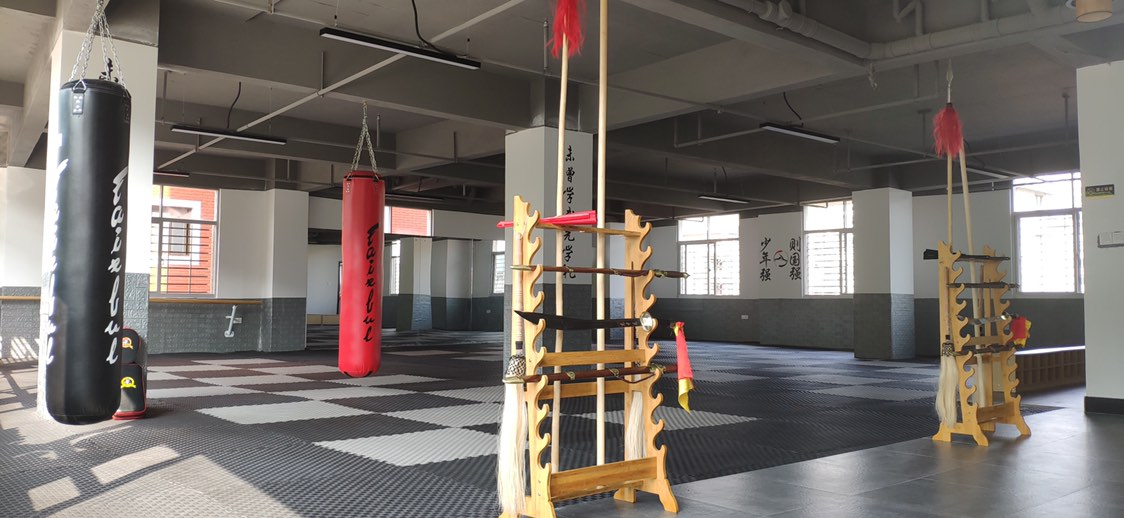
You step into a martial arts school for the first time, and the weapon rack along the wall stops you in your tracks: ringed sabers, long spears with red tassels, nunchucks, soft whips — row after row of cold steel. Your coach says just one thing: “Don’t touch anything yet. Picking the right first weapon matters more than a hundred days of hard practice.”
He is not exaggerating. The spear builds your waist and stance, the straight sword trains your footwork, the saber builds your presence, the staff trains whole-body power. Every weapon develops a different physical ability. Pick the wrong one and three months later everything feels awkward. Pick the right one and you will find your groove within the first month.
The Eighteen Arms: Think in Four Families
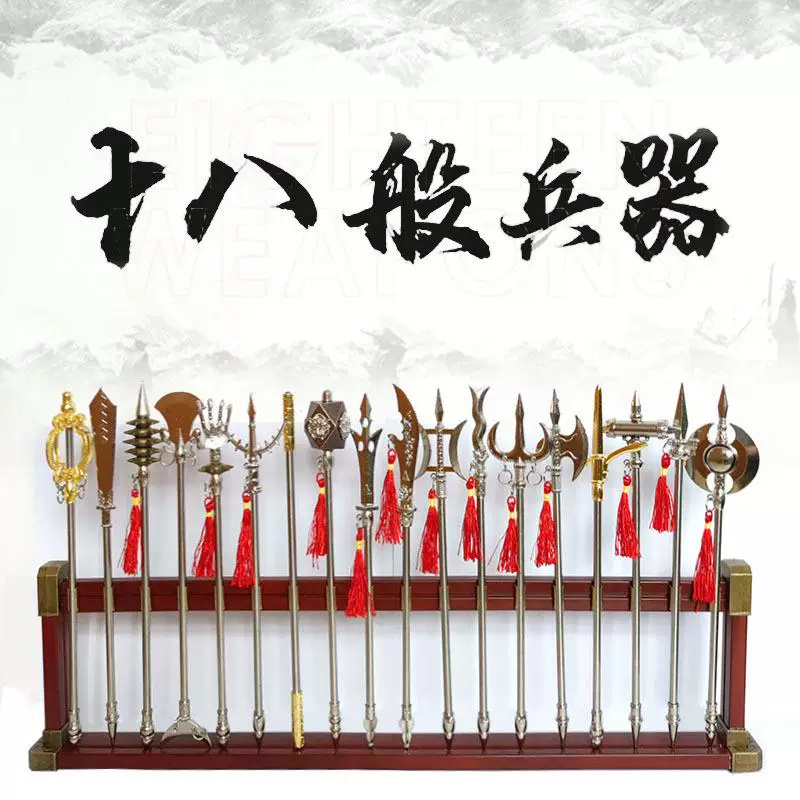
“The eighteen traditional arms” (shiba ban bingqi) is not a fixed list — historical texts from different dynasties all give different versions. But every weapon fits into four families. Learn these four and you will know exactly where any weapon belongs:
- Long weapons: “An inch longer is an inch stronger.” Spears (qiang), staffs (gun), halberds. Usually over 2 meters long, they train waist-and-leg power and full-body coordination. The catch: they need space — three people practicing spear at once need half a basketball court.
- Short weapons: “An inch shorter is an inch riskier.” Sabers (dao), straight swords (jian), maces (jian). From 0.8 to 1.2 meters, compact movements, fine in small rooms — the easiest category for anyone training after work.
- Soft weapons: rope darts, nine-section whips, meteor hammers, three-section staffs. They strike with centrifugal force and look spectacular — but never start with a soft weapon. Getting hit by your own nine-section whip is a rite of passage you do not want on day one.
- Paired weapons: double sabers, double swords, double hooks. One in each hand doubles the coordination demand. Touching paired sabers before your single saber is solid is like trying to play piano with both hands before you have learned the keys.
One rule of thumb: begin with “single, short, and rigid” — one weapon in one hand, moderate length, rigid construction. Leave soft and paired weapons for after your first year of basics.
The Big Four for Beginners: Saber, Sword, Spear, Staff
Narrow the field to the four mainstream beginner weapons. Each has a very distinct personality:
The Saber (Dao): Like a Tiger — the Easiest Way In
Saber technique centers on chopping, hacking, lifting, and wrapping — big, open movements with a clear start and finish to every move. In your first week you will already pull off flowing combinations like “wrapping the head and neck” that look impressively real. A blunt practice steel saber weighs about 1.2 kg, and it is the cheapest of the four to get equipped for.
The Straight Sword (Jian): Like a Dragon — the Ultimate Footwork Test
The sword is all about lightness: point, crash, thrust, stir — everything runs through the wrist and the footwork. Where a saber can muscle through a bow-stance thrust, a sword demands the sword tip, the nose, and the front toe in one straight line. Your first two weeks will feel wrong everywhere. That is normal — the sword is forcing you to unlearn every compensation habit. Tai chi sword moves slowly, which makes it especially friendly for middle-aged beginners.
The Spear (Qiang): “King of All Weapons” — the Hardest on Your Core
Spear technique comes down to one word: thrust. A proper middle-level thrust (zhongping qiang) needs the back leg driving, the front leg bent, the waist twisting, and both arms — one extended, one bent — driving forward together. Nothing gets to slack off. A waxwood shaft 2 to 2.4 meters long flexes on the thrust, making the tip quiver. If you cannot hold the spear level for 30 seconds without shaking, do not worry — the spear is building your shoulders and core for you.
The Staff (Gun): “First of All Weapons” — the Best Value
A waxwood staff costs 30 to 80 yuan — the cheapest of the four by far. Staff work centers on swinging, chopping, and spinning “flower” techniques (wuhua), and its sweeping arcs make it a staple of group practice and performances. Do not cry if you break your first staff — snapping one is a badge of honor. It means you are actually putting power into it.
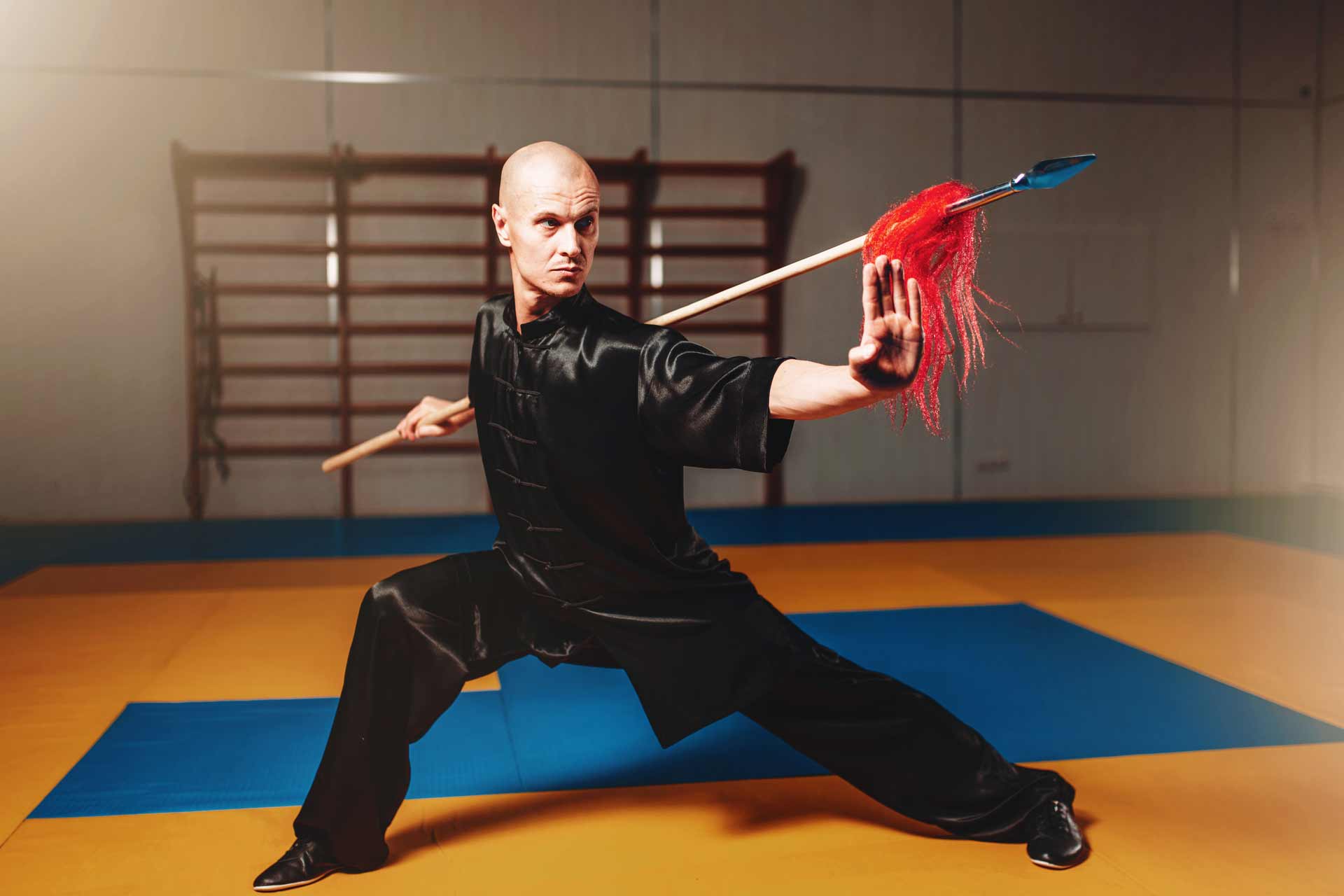
How to Choose Your First Weapon: Body, Interest, Schedule
There is no “best” weapon — only the best fit for you right now. Run through these three:
- Your body: weak wrists or old joint injuries? Start with the sword or saber. Strong core and want a workout? Spear or staff. Under 170 cm? Buy a 2-meter spear shaft, not 2.4.
- Your temperament: love big, powerful, dramatic moves? Saber. Love flowing grace and the feeling of “sword and body as one”? Sword. Want rock-solid fundamentals? Spear. Want something cheap and indestructible to just get going? Staff.
- Your space and time: only 10 square meters of clear floor? Saber or sword only. Can get to a school or a park regularly? Spear and staff are on the table. Twice a week, one hour each time? Saber and sword come in smaller “practice units” that fit fragmented schedules better.
One factor most people miss: find out what your local coach actually teaches. If the school specializes in Bagua saber and you insist on learning Miaodao from videos, nobody will be there to tell you when your form drifts. Weapons training lives or dies by direct, in-person transmission. Choosing what your coach is good at is choosing the fastest path to progress.
Buying Your First Weapon: Five Pitfalls
Remember these five “nevers” when shopping:
- Never buy a sharpened weapon. Practice weapons must be unsharpened, full stop. Sharpened blades are restricted items in most cities, and beginners cannot control edge direction anyway.
- Never go too heavy. The sweet spot for beginners: saber 1 to 1.5 kg, sword 0.7 to 1 kg, spear (shaft plus head) 1.5 to 2 kg. If it has some heft but you can hold it level for a minute, the weight is right.
- Never buy the “9.9-yuan legendary sword.” Ultra-cheap online “swords” are often hollow tubes with plating that can snap mid-spin and fly apart. The three reliable beginner choices — waxwood shaft, hardwood shaft, one-piece stainless steel — run roughly 30 to 80, 80 to 200, and 150 to 400 yuan.
- Match the length to your height. Hold a saber or sword upright: the tip should reach your eyebrows or the crown of your head. A spear should be about your height plus one arm’s length. Shopping online? Read the size chart — never order by feel.
- Never pay for “looks authentic.” Antiqued finishes, blood grooves, dragon engravings — those sell display pieces, not training quality. A 200-yuan plain stainless saber beats an 800-yuan “replica antique” for practice every time.
One more tip: for your first purchase, ask your coach to take you to a physical shop. Picking one up and feeling the weight and balance tells you in seconds what photos cannot. If you must buy online, only order from pages that list exact material, weight, and dimensions.
History vs. Legend: Two Stories About Famous Weapons
The Yue family spear: real spear work, legendary branding. The Southern Song general Yue Fei was a genuine spear fighter — the official History of Song praises his mounted combat skills. But most “Yue family spear” routines passed down today were composed by Ming and Qing martial artists trading on Yue Fei’s name to burnish their reputation — the martial world calls this “borrowing from antiquity” (tuogu). The spear skill is genuine; the founding story got a dose of legend.
Guan Yu’s great blade: 82 jin is fiction, the blade itself is later history. Romance of the Three Kingdoms claims Guan Yu’s Green Dragon Crescent Blade weighed 82 Han jin — roughly 20 kg in today’s terms, impossible to swing in real combat. Research shows the crescent-blade form matured in the Song and Yuan dynasties; it did not exist in Guan Yu’s time. But once the blade entered martial arts routines as a symbol of loyalty (the Spring-and-Autumn great saber), it became an excellent weapon system in its own right.
Your First Four Weeks: A Starter Plan
Once you have picked a weapon, do not rush into learning a full routine. Follow this four-week rhythm and your foundation will be far more solid:
- Week 1: Get to know the weapon. Twenty minutes a day, one task: hold it right. Saber: wrap-the-head-and-neck drills. Sword: wrist flowers. Spear: hold the spear level. Staff: spinning flowers. The goal is to make the weapon an extension of your hand.
- Week 2: Add footwork. Five minutes each of bow stance, horse stance, and empty stance, paired with the simplest chop, thrust, and lift. Slow is fine — correct structure beats speed ten to one.
- Week 3: Learn your first short combination. Ask your coach for a 4-to-8-move sequence and drill it 30 minutes a day. Film yourself — comparing footage is the fastest way to improve.
- Week 4: Run it all the way through. Link the combination together smoothly, minding your breath and your eyes. At month’s end, ask your coach to watch once and correct bad habits before they set — the single most valuable step.
After four weeks you will feel in your body what “the weapon is an extension of the body” actually means. Whether to pick up a second weapon or take on a soft weapon can wait until then — you are not late.
Quick Answers
Which single weapon should most beginners start with? The saber (dao). Big clear movements, fast early wins, lowest equipment cost. If you prefer grace over power, the straight sword is the alternative.
How much space do I need? For saber or sword, 10 square meters of clear floor is enough. For spear or staff, you need a school hall or a park — budget for that before you buy.
How much should I spend on my first weapon? 150 to 400 yuan for a one-piece stainless practice saber, 30 to 80 for a waxwood staff, 80 to 200 for a hardwood practice sword. Never buy the cheapest listing.
Can I learn from videos alone? Not recommended for weapons. Unlike empty-hand basics, a wrong edge angle or grip shows up nowhere until someone watches you in person. At minimum, get a coach to check your form monthly.
When can I try soft or paired weapons? After at least a year of solid single-weapon basics — and only under a coach who trains them.
Safety note: Always practice under a qualified instructor. Never buy a sharpened weapon. Train in a clear, non-slip space with protective gear as appropriate, and never in crowded or cramped areas. This article covers traditional culture and fitness methods only — it makes no claims about self-defense or combat effectiveness. In any emergency, call the police first; no weapon should ever be used as a self-defense tool.