Two families meet for dinner to finalize the wedding. The groom’s mother insists the ceremony must be in October; the bride’s grandmother pulls out a folded almanac and points: “The 18th is a “huangdao” day — good for marriages. The 24th is a black-path day. Don’t even think about it.” Everyone nods. But has anyone asked — who decided the 18th is “lucky” and the 24th is not? A master guessing over tea, or a two-thousand-year-old calculation system? Let’s take it apart.
The “Huangdao” in “Lucky Days” Is an Astronomy Word
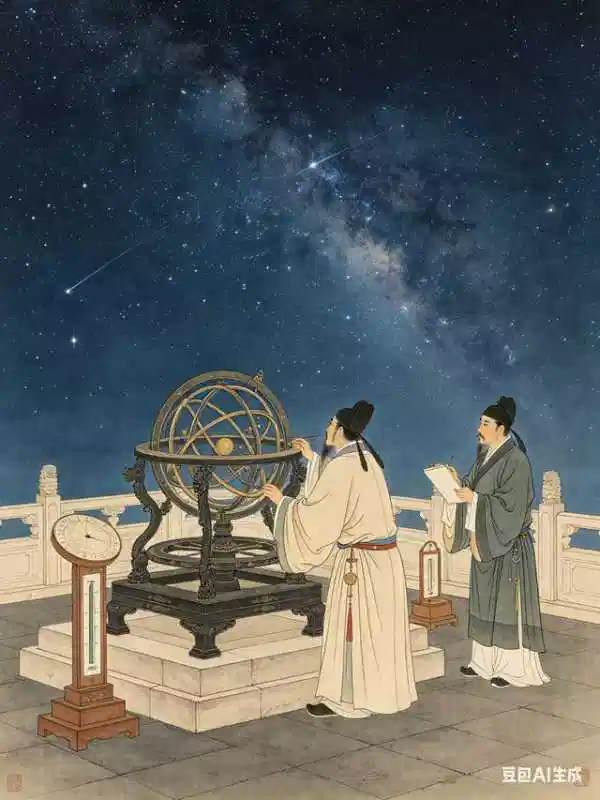
In astronomy, the ecliptic is the sun’s apparent yearly path across the sky. Ancient Chinese skywatchers noticed that the sun, moon, and planets all travel roughly the same band, and mapped this band against the twenty-eight lunar mansions to mark time and direction.
Traditional date selection borrowed the name. Here’s the core mechanism: the entire year is laid out on the sexagenary cycle (the “stems and branches” pairing system, often called “ganzhi”, “a 60-day rotation of ten heavenly stems and twelve earthly branches”), tagged with the five phases and lunar mansions — and each day is assigned an Officer on Duty. The system is called “jian-chu” twelve spirits, the “twelve Day Officers,” a rotating cycle of twelve spirits that label each day auspicious or not. Their names: Jian, Chu, Man, Ping, Ding, Zhi, Po, Wei, Cheng, Shou, Kai, Bi.
Their origin is tied to the handle of the Big Dipper: “Jian” corresponds to the first month’s alignment, “Chu” to the next month, and so the twelve officers cycle once per year. Whichever officer lands on duty that day sets the day’s “personality.” The ancients used this cycle for a very practical purpose: the first month (“Zhengyue”) anchored the year’s start in the calendar, so knowing the month’s officer immediately told farmers and officials where they were in the annual rhythm — a two-thousand-year-old scheduling framework.
How the Twelve Officers Split into “Yellow Path” and “Black Path”
Of the twelve, six are “Yellow Path” (auspicious) officers and six are “Black Path” — a fixed pairing that hasn’t changed in a thousand years:
- Yellow Path six: Qinglong (Jian), Mingtang (Man), Jinkui (Ding), Tiande (Zhi), Yutang (Cheng), Siming (Kai). For big events, people traditionally preferred days when one of these was on duty.
- Black Path six: Tianxing (Chu), Zhuque (Ping), Baihu (Po), Tianlao (Wei), Xuanwu (Shou), Goulian (Bi). On these days, tradition says skip the big decisions.
A concrete example: a “Jian” day is presided over by Qinglong — a Yellow Path day, traditionally good for travel and money matters. A “Po” day is under Baihu — a Black Path day, traditionally “suitable for nothing much.” Those two lines of “suitable / avoid” printed under every almanac date start here.
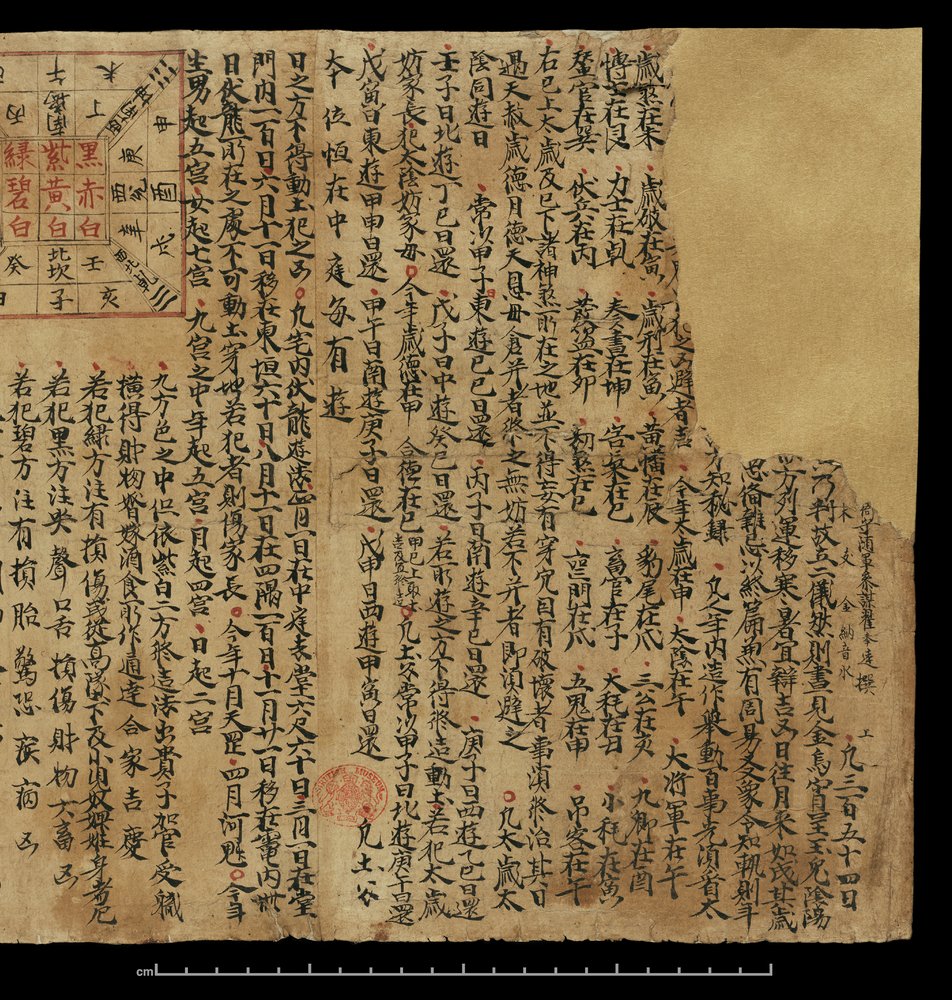
But that’s only the first layer. A serious date-picker stacks several more layers on top before calling it done.
Date Selection Is Four Layers of Information Stacked
A professional almanac master runs a candidate day through at least four screens:
1. Stems, branches, and the five phases
Every day has a stem-branch label — “Jiazi day,” “Bingwu day.” Each stem and branch carries a five-phase (wuxing, “five-phase elements”) attribute: wood, fire, earth, metal, water. The day’s phases interact with yours through a grammar of generating, controlling, clashing, and combining. A day that “generates” your phase is traditionally considered smooth; a day that “clashes” — like Zi clashing Wu — is avoided. This step turns a generic lucky day into “your” lucky day.
2. The twenty-eight lunar mansions on duty
Besides the Day Officer, each day also has one of the twenty-eight mansions on duty — constellations along the moon’s path used to track days, similar in function to lunar houses in other traditions. Each mansion got a traditional character: the seven eastern mansions of the Azure Dragon lean auspicious, but mansions like Ghost or Willow were traditionally avoided. The mansion’s verdict and the Officer’s verdict both count; when they disagree, each school has its own mnemonic for which side wins.
3. The fine print under each Officer
The twelve officers aren’t just yellow or black — each has a detailed list of its own. “Ding” days suit offerings and prayers but not lawsuits; “Kai” days suit openings and school enrollment but not burials. Most of the specific “good for weddings,” “avoid breaking ground” entries in an almanac come from this layer.
4. The spirit-and-bane system
This is the thickest layer: “shensha”, dozens of named spirits and banes — Tiande, Yuede, Tianshe, Suipo, Yuepo, Wuhuang, Sansha — each with its own orbit and jurisdiction. “Tianshe” (“Heaven’s Pardon”) days occur only four or five times a year and were traditionally considered suitable for anything — the jackpot. “Suipo” (“Year Breaker”) days were good for nothing. The master stacks all of these onto the earlier layers and makes a final call.
A Worked Example: Walking One Day Through the Whole System
Theory is dry; let’s trace a real day. Take October 18, 2026 — a date a Chinese almanac might print as “good for weddings.”
First, the officer: October 18, 2026 lands on a “Man” day, and “Man”‘s officer is Mingtang — Yellow Path, and its fine print reads “good for gatherings, celebrations, and housewarmings.” Second, the stem-branch: it falls in the Wuzi month on a Bingwu day; for a couple whose phases are “water,” fire generating earth generating metal means the day’s energy traditionally “feeds” them rather than clashes. Third, the mansion: the duty mansion that day is “Wei” (Stomach), one of the traditionally favorable ones. Fourth, the spirits: no Year Breaker, no Five-Yellow, and a “Yuede” (Moon Virtue) spirit lands on the day — a mild bonus point.
Four screens, four passes, and the day earns its red “good for weddings” stamp. Notice what’s happening: nobody consulted a ghost. The whole thing is a scoring system — a day accumulates points from four independent tables, and the total decides the label. Now flip one card: if October 18 had landed on a “Po” day with Baihu on duty, the same wedding would have been stamped “avoid,” even though nothing else changed. The system’s inner logic is consistent; the only question is whether you grant the scoring system authority over your life.
This System Was Never Folk Magic — It Was State Bureaucracy
Date selection wasn’t a street-corner trade. From the Han dynasty onward, every imperial court ran an Imperial Astronomical Bureau (“Qintianjian”, “the office that observes the heavens”), whose job included publishing the official calendar. The Ming and Qing calendars — the “Datong” and “Shixian” almanacs — both carried official “selection” entries. The emperor’s accession, wedding, heaven-worship rituals, and military campaigns all used bureau-approved dates.
A fun detail: the construction start dates of the Meridian Gate and the Hall of Supreme Harmony in the Forbidden City were picked by the Astronomical Bureau. The system lasted two millennia on two supports: genuinely precise astronomical math underneath (the stem-branch, solar-term, and moon-phase calculations are remarkably accurate), and imperial authority lending it credibility.
Authority is not science, though. The officers’ auspiciousness and the spirits’ do’s and don’ts are a symbolic system, not a causal law. Ancient almanacs bundled the precise astronomy (when the new moon falls, when the solar term turns) together with the symbolic interpretation (whether weddings are favored that day), and later readers often couldn’t tell which part was astronomy and which was culture.
A Modern, Sane Way to Read the Almanac
Three things to keep straight:
- Auspicious dates can’t change outcomes. Whether a shop survives depends on location, product, and management; a “grand opening day” won’t revive a losing store. Treating a lucky date as insurance gets the cause and effect backward.
- Its real value is psychological and social. A wedding date both sets of parents accept means fewer family arguments; a groundbreaking ceremony on a chosen day genuinely lifts the team’s morale. Those are real social-psychological effects — nothing to do with fate.
- Don’t let “masters” sell you fear. Anyone who says “skip date selection and blood will be shed” or “you must pay to dissolve this” is running a fear business. Traditional date selection was public almanac knowledge, not a secret art.
The bottom line compresses to one sentence: a stem-branch calendar is the skeleton, the twelve officers set each day’s tone, and mansions, phases, and spirits add the fine print — together they produce the complete “suitable / avoid” list.
Next time you open an almanac, look for three things. The twelve Officers tell you whether it’s a Yellow or Black Path day — the master switch. The “suitable / avoid” lines come from each officer’s detailed rules — weddings, ground-breaking, and openings each have their own logic. And spirits and banes are bonus or penalty points — a Heaven’s Pardon day shows up only a few times a year, so catching one is pure luck.
Quick Answers
Is a “lucky day” picked by a fortune teller? Not originally. The system grew out of the imperial astronomical office’s calendar work; fortune tellers were just applying its published tables.
Why are some days good for weddings but not for funerals? Because the detailed rules live at the officer level — “Kai” (Opening) days suit beginnings like weddings and business launches, while burials follow a completely different set of rules. The verdict is activity-specific, never one-size-fits-all.
Do the twelve officers’ names repeat every year? Yes — twelve officers, twelve months, one full rotation per year, aligned with the Dipper’s handle. That’s why the pattern feels stable across decades.
Can I just trust an almanac app’s verdict? Treat it as a cultural reference, not a decision engine. The app can tell you what tradition says; it can’t tell you whether your marriage or business will succeed.
What’s the single most useful way to use this knowledge? As timing wisdom, not fate hacking. The ancients’ idea was “shun tian ying shi” — “follow heaven, act in season,” or simply: do the right thing at the right time. Read the almanac as a two-thousand-year-old culture of time, and it becomes genuinely interesting. Read it as a tool for changing destiny, and it will disappoint you. The date was never the point — how much preparation you put into the event was.
Start tonight: pick any date on your phone’s calendar app, find its “suitable / avoid” line, and see if you can trace it back to one of the twelve officers.