Dawn in the park. A woman in white moves through the morning mist, and the sword in her hand traces slow silver arcs through the air — rising, circling, settling. It looks like calligraphy written with steel. This is tai chi sword (taijijian), and despite its graceful appearance, the Chinese have a saying about it: the sword is the “gentleman of weapons” — the hardest to master, and the most rewarding.
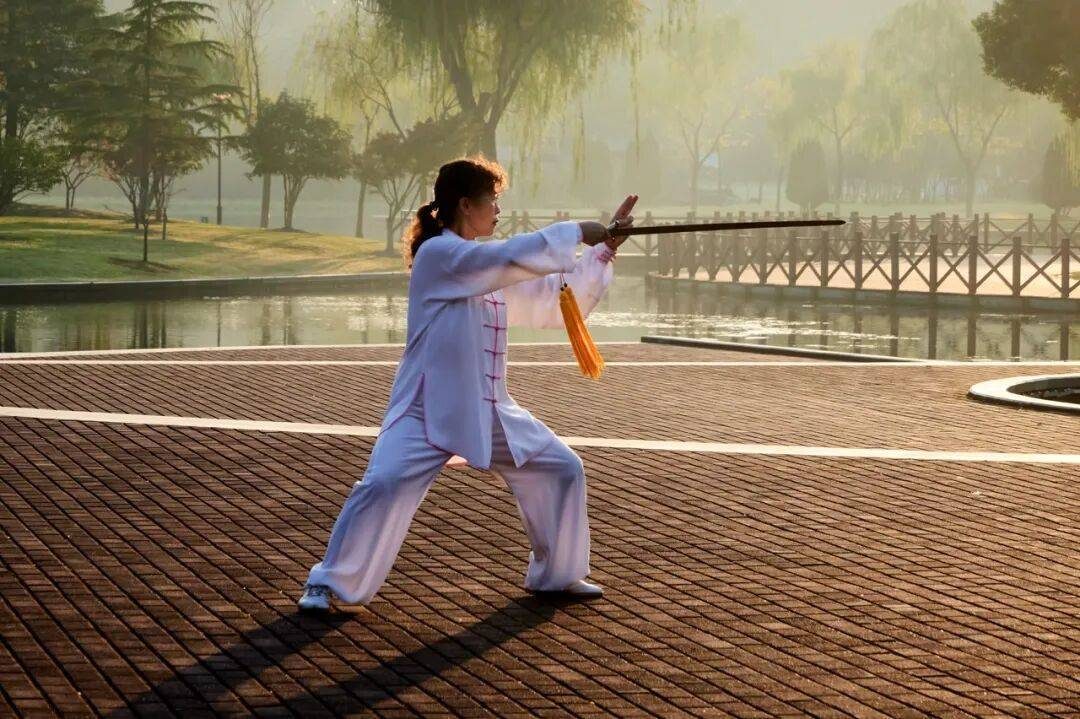
If you already practice tai chi, adding the sword is the natural next step. If you don’t, this guide will take you from zero to your first complete movement pattern. No prior martial arts experience needed — just a practice sword and some open space.
Why the Sword? The “Gentleman of Weapons”
Traditional Chinese martial arts rank weapons by character: the staff is the “father of weapons” (simple, direct), the spear the “king” (dominant on the battlefield), and the sword the “gentleman” — refined, precise, demanding both strength and finesse. Unlike heavier weapons, the sword rewards relaxation and whole-body coordination, which is exactly why it pairs so perfectly with tai chi principles.
Practically speaking, sword training fixes the most common tai chi flaw: “empty” arm movements. The moment you hold two feet of steel, every lazy wrist and disconnected shoulder becomes obvious. The sword is a strict but honest teacher.
Choosing Your First Sword: Three Numbers That Matter
Don’t buy a sharp sword. Don’t buy a heavy “display” sword. For beginners, a lightweight practice sword (usually aluminum alloy or stainless steel, unsharpened) is the only sensible choice. Three measurements matter:
- Length: Hold the sword at your side, arm relaxed. The tip should reach roughly your earlobe. A common rule of thumb: sword length ≈ your height minus 10 cm. Too long and the tip wobbles; too short and your stances feel cramped.
- Weight: 500–700 grams for most adults. If your wrist aches after five minutes, it’s too heavy. Women and smaller practitioners often do better at 400–500 g.
- Balance: Hold it at the guard. A beginner-friendly sword balances 8–12 cm in front of the guard — nimble enough to control, stable enough to feel.
A red tassel tied at the guard isn’t decoration — watch it while you practice. If it wraps around your wrist, your circles are too tight; if it flies wildly, you’re using arm strength instead of body rotation. The tassel is your free coach.
The Grip: Where Everything Starts (and Most Beginners Go Wrong)
The standard tai chi sword grip: thumb and index finger pinch the handle just below the guard (“tiger’s mouth” pressed against the guard plate), the middle three fingers wrap loosely. The grip should feel like holding a baby bird — firm enough it can’t escape, gentle enough you don’t crush it.
The two classic mistakes: a death grip (your forearm tires in minutes and the sword moves like a stick) and a floppy wrist (the tip lags a half-second behind your hand). Fix both with one drill: hold the sword and draw slow horizontal figure-eights for three minutes. If your forearm burns, you’re gripping too hard. Relax until the burn fades but the sword stays controlled.
Six Core Techniques, in Plain Language
Ci (thrust) and Pi (chop)
Thrust: sword arm extends straight from the shoulder, tip aimed at an imaginary target at chest height — power comes from the back leg driving forward, not from the arm. Chop: the sword rises overhead and cuts straight down, the body sinking slightly as the blade falls. Practice each 20 times per side.
Dian (point) and Beng (flick-up)
Point: a short, sharp downward tap with the tip, wrist snapping like you’re tapping a touchscreen. Flick-up: the reverse — the tip snaps upward, as if flicking water off the blade. These train wrist agility, the soul of sword work.
Jiao (stir) and Gua (hook)
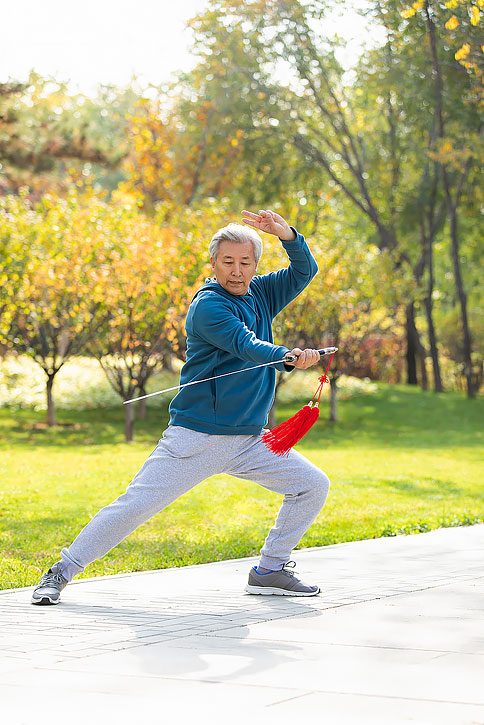
Stir: the tip draws small circles in front of you, wrist leading, elbow quiet — imagine stirring a pot with the very tip. Hook: the blade arcs overhead and sweeps down-back in a protective circle. Stirring is the foundation of the famous “sword flower” (jianhua), the twirling flourish that beginners love and masters use to redirect incoming force.
Your First Two Weeks: A Beginner Plan
- Days 1–3: Grip and stance only. Stand in a bow stance, sword extended in a thrust, and hold. Switch sides. 10 minutes a day — boring, essential.
- Days 4–7: Add the six techniques, 20 reps each, slow. Film yourself once; compare your sword tip’s path to a smooth line vs. a wobbly one.
- Days 8–10: Link thrust → chop → stir into a flowing three-move sequence. This is your first “form.”
- Days 11–14: Practice the sequence with stepping — advance on the thrust, retreat on the hook. Congratulations: you’re doing tai chi sword footwork.
Safety Rules (Non-Negotiable)
Give yourself a clear circle of at least 3 meters — swords don’t forgive furniture or bystanders. Never practice thrusts toward people, even “as a joke.” Keep the tip pointed away from your own body during twirls; beginners’ most common self-injury is a tassel-assisted tip to the forearm. And stretch your wrists before every session — sword work loads them more than empty-hand tai chi.
Quick Answers
Can I learn from videos alone? For the basics, yes — but get one in-person correction session within the first month. A teacher spots in ten seconds the grip flaw you’d practice wrong for a year.
How long until I look decent? The six techniques feel natural in 2–3 weeks; a full 32-form routine takes most people 4–6 months. The sword punishes rushing — slow practice is fast progress.
Is tai chi sword a workout? A 30-minute session burns roughly what a brisk walk does, but the real payoff is shoulder mobility, wrist strength, and balance — the exact things desk workers lose first.
The sword doesn’t care how strong you are. It cares how relaxed you are. Pick one up, slow down, and let the steel teach you.
Practice within your limits; stop if you feel pain and consult a qualified instructor for form correction.