It is 6:30 in the morning in the neighborhood park. A man in his seventies stands on the open ground, a white folding fan in his right hand. With a soft swish, the fan snaps open, then folds shut again as he sinks into a bow stance. Is the fan a real training tool, or just a prop for show? Tai chi fan is one of the few weapon forms in tai chi — and when you practice it properly, it trains both your body and your focus at the same time.
Tai chi fan grew out of tai chi itself. It took shape in the 1990s, when masters such as Li Deyin wove the opening, folding, chopping, lifting, thrusting, and circling motions of a folding fan into the traditional tai chi frame. The most common routines are the 42-form and the 56-form; beginners almost always start with the 42-form.
What Makes the Fan Different
The biggest difference between the fan and the tai chi sword or saber is its lightness. A fan weighs only 200 to 300 grams, yet its movements are wide and brisk, and the snap of the fan opening adds a rhythm of its own — like a beat keeping time for your body. The core principle of fan practice is simple to say and hard to do: the fan follows the body, and the body follows the fan. The fan is not a prop in your hand; it is an extension of your body. Your waist turns, and the fan draws an arc through the air. You step forward, and the tip of the fan arrives exactly three inches in front of you.
If you have practiced empty-hand tai chi before, the fan will feel familiar and strange at the same time. The footwork and the waist-driven power are the same, but the fan forces you to be precise. A sloppy turn that goes unnoticed with empty hands shows up immediately when a fan is in your hand: the fan opens halfway, or the tip wobbles off line. That is exactly why it is such a good teacher.
Choosing Your First Practice Fan
You do not need an expensive fan to start. A practice fan costing roughly 5 to 12 US dollars is perfectly fine. When you choose one, pay attention to three numbers:
- Length: With the fan open, the ribs should be 33 to 36 centimeters long. If you are around 170 centimeters tall, 34 centimeters will feel most natural. Too long, and the fan will hit you when you turn; too short, and the movements lose their presence.
- Weight: The whole fan should weigh 150 to 250 grams. Too light, and the fan flutters when you chop; too heavy, and your arm will be exhausted before you finish one 42-form routine. Pick it up and give it a couple of test swings — it should feel like it has some weight to it, without dragging your hand down.
- Material: Choose bamboo or bamboo-look plastic ribs, which are flexible and survive being dropped. For the fan face, silk cloth or synthetic fabric works well — a good one opens with a crisp swish. Do not buy a fan worth hundreds of dollars as a beginner. Learn with a practice fan first, and upgrade later when your movements are solid.
Before you buy, open and close the fan a few times in the shop. It should open smoothly in one motion and fold shut neatly, with the ribs stacking evenly. If it catches or opens only halfway, pick a different one.
The Grip: Three Small Details That Decide Everything
The most common grip is the standard grip. The web between your thumb and index finger catches the end of the fan handle, your index and middle fingers rest along the outside of the ribs, your ring and little fingers curl lightly around the handle, and your thumb presses on the inside of the ribs. The tension matters: grip too tightly and the fan will not open; grip too loosely and it will fly out of your hand.
Three details trip up almost every beginner:
- Leave a finger’s width at the end of the handle. Do not push your palm all the way to the end of the handle. Leave about one finger’s width of space so the handle can slide slightly in your palm when you lift or circle the fan. Without that little bit of play, your turns will feel jammed.
- Relax the wrist first. Opening the fan is not about finger strength — it is about a flick of the wrist. With a relaxed wrist, a gentle shake lets the fan open by its own momentum. With a stiff wrist, you end up prying the ribs apart with your fingers, the fan opens halfway, and sooner or later you will snap a rib.
- Listen for the sound. A good opening is a single crisp swish; a good closing is a light snap as the ribs stack together. Before each practice session, stand in place and open and close the fan 20 times. When the sound turns crisp, your hands have found the feeling.
Five Basic Fan Techniques, One at a Time
There are more than a dozen fan techniques in tai chi, but you only need to master five to start. Everything else is a combination or a variation of these five.
Chop
The fan sweeps downward from above, like a knife cutting through vegetables. Raise your right hand above your head with the fan open, turn your waist to the right to gather power, then let the waist drive the arm downward, stopping when the fan is level with your waist. The power starts at the waist and travels through the shoulder, elbow, and wrist to the tip of the fan, all in about one second. The most common mistake is swinging with the arm alone while the waist stays still — the chop comes out soft and powerless.
Lift
The fan sweeps upward from below, like scooping something off the ground. Step half a pace forward with your left foot and lift the fan from your right hip upward, the tip tracing a diagonal line that ends in front of your left shoulder. The lift is the technique most likely to hurt your wrist: let the wrist follow the direction of the fan face, and never twist it against the motion.
Thrust
Fold the fan and use it like a short stick, thrusting straight forward. Aim the tip at your target, keep the elbow slightly bent, and send the arm forward about two-thirds of the way, keeping one-third in reserve. The thrust is about short, sharp power — not about straightening your arm and poking. Your waist gives a small push, your arm follows, and the tip taps and comes back.
Close
The fan goes from open to shut in one smooth motion. Flick your wrist inward and the ribs fold together one by one with a light snap. The hard part is neatness: the ribs must stack in order, with none sticking out. Practice closing until every rib lands in place.
Circle
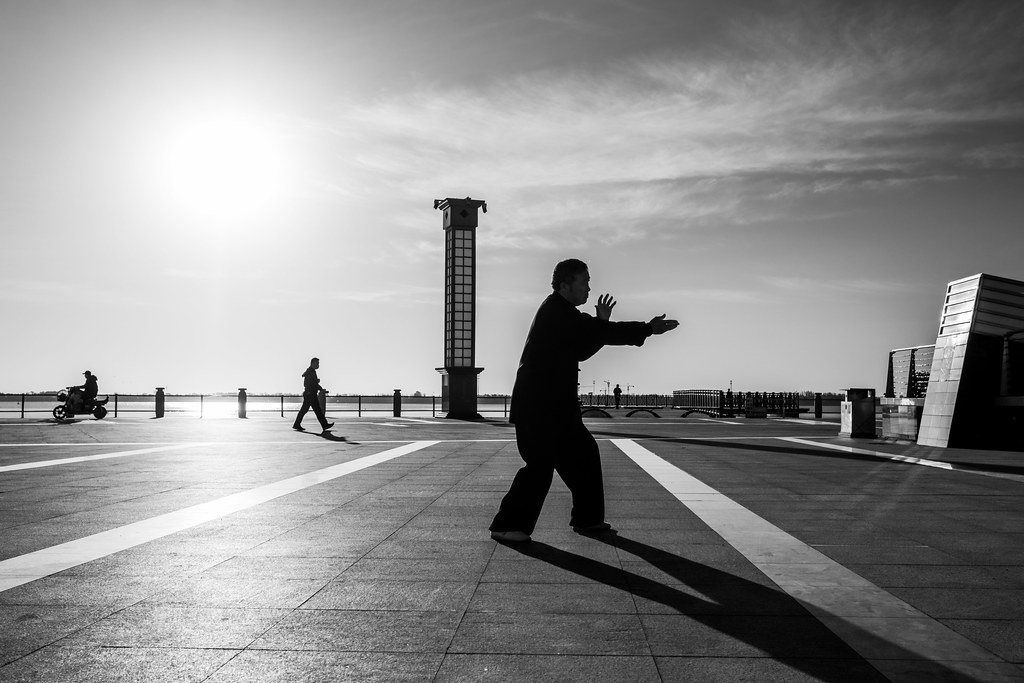
The fan draws a full circle in front of your body or above your head, like drawing a period at the end of a sentence. The circle comes entirely from the wrist turning; the elbow barely moves, and the fan face stays open the whole time. When you first try it, the circle will wobble — sometimes wide, sometimes narrow. Practice in front of a mirror and watch the path of the fan tip. When the path is close to a true circle, you have passed the test.
Practice each technique 20 times before moving on to the next. It is tempting to rush through all five in one session, but the fan rewards patience: twenty clean chops teach you more than a hundred sloppy ones.
Matching Fan Techniques with Footwork
Fan techniques without footwork are just waving your arms in place. The three most common stances in tai chi fan each pair with a different technique:
- Bow stance with the chop: Your front leg bends and your back leg pushes, with about 70 percent of your weight on the front leg. At the moment of the chop, press the ball of your front foot into the ground — the power rises from the foot, travels through the waist, and reaches the fan tip. Keep your stance about two and a half foot-lengths wide: too narrow and you will wobble, too wide and you cannot turn in time.
- Empty stance with the thrust: Your front foot touches the ground lightly while your back leg carries the weight — about 80 percent on the back leg. As you thrust, the front foot taps the ground and your body springs forward like a coil, the fan tip darting out and pulling straight back.
- Turn with the circle: Your body turns 180 degrees while the fan circles above your head. The pivot is your back heel: the heel turns, the waist turns, and the fan turns, all at the same time. Look toward the direction of the turn first — the head leads the body, and the body leads the fan. When it clicks, the whole movement flows like water.
The secret to coordination is simple: hand and foot arrive together. The instant your foot lands, the fan technique should be exactly in place. Beginners can slow it down and split each movement into three beats: step on the first beat, turn the waist on the second, send the fan out on the third. When the three beats merge into one, you have truly started.
Five Mistakes Beginners Make Most Often
- Gripping the fan too tightly. White knuckles and a stiff wrist, prying the fan open by force. Fix it: shake your hands loosely for 30 seconds to soften the wrists before you pick up the fan.
- Moving the arms but not the waist. The whole technique comes from the arms, and your shoulders ache after ten minutes. Fix it: place both hands on your waist and turn left and right 20 times each to feel the waist leading the hands, then pick up the fan.
- Feet lagging behind the hands. The hand arrives but the foot has not, or the foot lands and the hand is still on its way. Fix it: practice one step, one technique — a single stance paired with a single fan movement — and only link them together once each pair feels natural.
- A fan that opens halfway and never quite closes. The movements drag and look unfinished. Fix it: practice opening and closing alone 50 times a day, and count it only when you hear both sounds — the swish and the snap.
- Holding your breath. You catch yourself holding your breath with every movement and finish the routine red-faced. Fix it: inhale as the fan opens, exhale as it closes, and match your breathing to the opening and closing first.
How Long to Practice, and How to Plan Your Sessions
Twenty to thirty minutes a day is enough for a beginner, and three parts work best. Spend the first 5 minutes warming up: turn your waist, circle your wrists, stretch your legs, and loosen the joints. Spend the next 15 minutes on the techniques: 20 repetitions of each of the five basic fan movements. Spend the last 5 to 10 minutes walking through the routine, linking the movements you have learned together — not fast, but smooth.
Practice 4 to 5 days a week and rest 1 to 2 days; your wrists and shoulders need recovery time. After about a month, you should be able to walk through the 42-form routine in rough shape. After about three months, the sound of the opening and closing, the coordination of the footwork, and the rhythm of the breathing should all start to come together. There is a simple test: if you finish a routine with steady breathing and a calm heartbeat, the intensity is right. If you finish gasping with sore wrists, you pushed too hard — take it easier the next day.
You only need a flat patch of ground about 3 meters square, with no obstacles within 2 meters. A park, a courtyard, or even a spacious living room will do.

Quick Answers
How do I choose my first fan? Look for ribs 33 to 36 centimeters long, a total weight of 150 to 250 grams, and bamboo or bamboo-look plastic ribs. A practice fan in the 5 to 12 dollar range is all you need to start.
What should I learn first? The standard grip, the open-and-close, and the five basic techniques: chop, lift, thrust, close, and circle. Only then should you worry about the full routine.
How long until I can do the 42-form routine? About a month to walk through it in rough shape, and about three months before the movements feel smooth and coordinated. Twenty to thirty minutes a day, 4 to 5 days a week, is enough.
Why does my fan keep opening halfway? Usually a stiff wrist or a grip that is too tight. Shake your hands loose for 30 seconds first, and practice opening and closing alone 50 times a day until you hear a crisp swish and a clean snap.
Do I need a teacher? A teacher helps, especially for the turning footwork, but you can start alone with the grip, the five techniques, and the opening-and-closing drills in this guide. Joining a morning park group is the easiest next step.
The Bottom Line: Get the Grip Right Before the Routine
The path in is just three steps: pick a bamboo practice fan, 33 to 36 centimeters long and 150 to 250 grams; master the standard grip, the open-and-close, and the five basic techniques one by one; then link them together with the bow stance, the empty stance, and the turn. Twenty to thirty minutes a day will carry you through the routine in a month, and the movements will feel smooth in three.
You can start tonight: get a practice fan, and open and close it 50 times at home. Tomorrow morning, head to the park, find someone who practices, and try a bow-stance chop with them — feel the power rising from the soles of your feet.
Practice safely: Check that there are no people, branches, or obstacles within 2 meters before you begin, so the fan cannot strike anyone. Build up gradually, and do not force wide turns or deep squats. If you have an old wrist, shoulder, or lower-back injury, or you feel unwell, stop and consult a doctor. This article is a cultural and fitness introduction to a traditional practice and does not promise any health benefits.