It’s 7:30 in the morning. You push open the bathroom door, the mirror is fogged with steam, and your slippers skid on the wet tiles. Before the day has even started, this three-square-meter room has already set its tone.
The bathroom is the smallest room in the house — and the most overlooked. In traditional feng shui, a Chinese system for arranging living spaces so that energy, or qi, flows well, the bathroom is the “wettest” place in the home, and the rules around it are plentiful. Modern home design talks about the same things in different words: ventilation, drainage, layout, and cleaning. The two perspectives don’t conflict. Many of the old rules, translated into plain language, are simply solid, practical advice for living well. This guide breaks it down into five practical tips, each paired with something you can actually do.
1. Location: Not in the Center, Not Facing the Door, Not Against the Bed
Traditional teaching says a bathroom belongs in one of the home’s less favorable positions, and never in the exact center of the house. In today’s apartments, that rule has a very concrete logic: a bathroom in the center usually has no window, so moisture can only be pulled out by an exhaust fan. Over time, mold on the walls and peeling paint on the ceiling become almost inevitable. When you’re buying or renovating, check whether the bathroom has a window to the outside first. A windowed bathroom ventilates far more efficiently — open the window for 10 minutes after a winter shower and most of the steam is gone.
Next, look at the door. A bathroom door facing straight at the front door is one of the most commonly cited taboos, and the practical trouble is easy to see: guests walk in and immediately see the toilet and the sink, which hurts privacy and first impressions. The airflow from opening and closing the door also carries damp air out into the living room. A bathroom door facing a bedroom door — or worse, sharing a wall with the head of the bed — causes a similar problem: flushing and pipe noise travels straight into the bedroom at night, and light sleepers get woken up.
Already moved in and can’t change the layout? Three cheap fixes help: keep the bathroom door closed; hang a fabric curtain or add a sliding door at the entrance to block both the sightline and the airflow; and add a layer of soundproofing insulation to the shared bedroom wall, which costs only a few hundred yuan. You can’t move the room, but you can change the flow and the partitions.
2. Wet-Dry Separation: One Partition Solves Half Your Problems
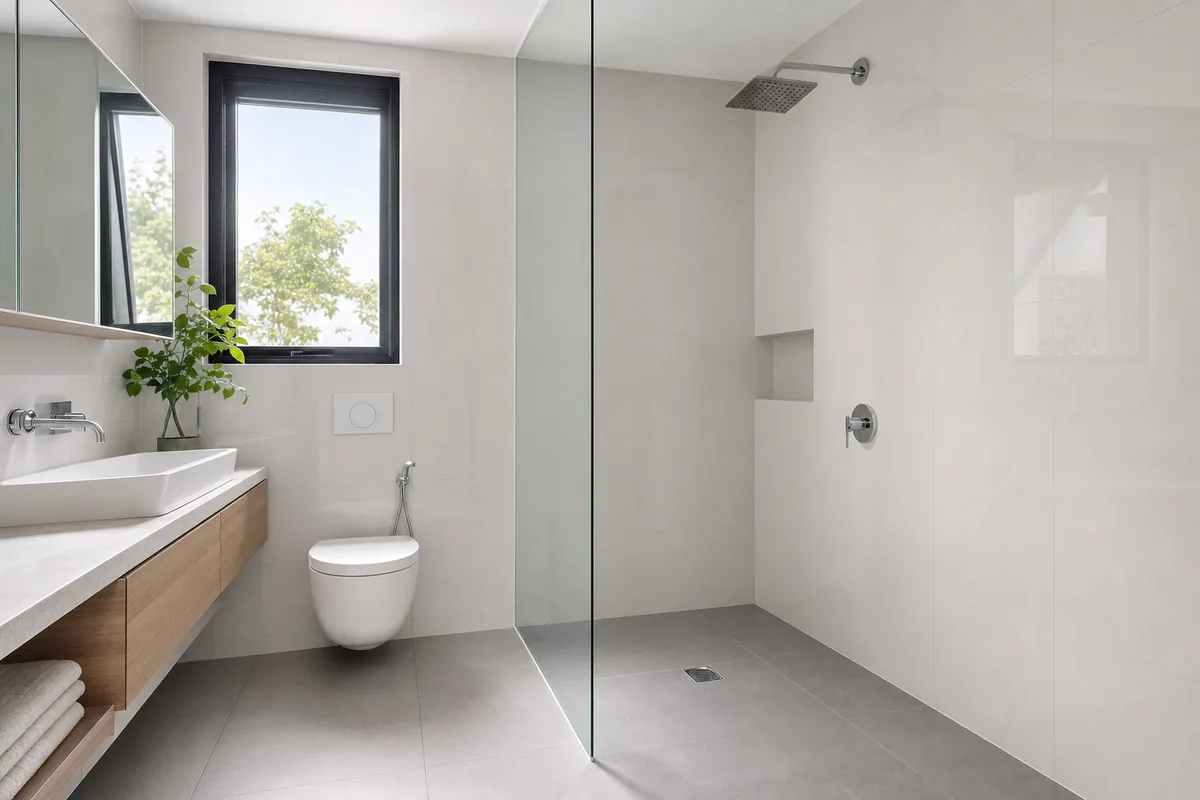
In a bathroom with no wet-dry separation, one shower leaves everyone’s towels, toilet paper, and slippers damp. In a bathroom of about 5 square meters, a 120-centimeter-wide glass partition is enough to fence off the shower area, and a 2-centimeter height difference in the floor keeps the water from running everywhere. A shower curtain can work too, but pick one with a magnetic strip along the bottom that sticks to the floor — an ordinary curtain won’t stop splashes from reaching the toilet seat.
Once separated, the dry zone stays dry for good, and your anti-slip mat, vanity cabinet, and power outlets all last longer. The wet zone keeps only the floor drain and the showerhead, and cleaning it is a quick rinse. This matters most for households with elderly people or small children: in bathroom slip-and-fall accidents, more than half happen in the few minutes right after a shower, when the whole floor is wet. With the zones separated, an older person getting up at night always steps onto a dry floor.
Can’t fit a glass partition in a small bathroom? A “half separation” still works: lay anti-slip tiles plus a water-retaining strip in the shower area, keep the sink and toilet area dry, and add a fast-absorbing diatomaceous-earth bath mat. Two steps on it after a shower and the floor is basically dry. Separation doesn’t have to be a big renovation — the point is simply to keep water where it belongs.
3. Mirrors: Three Places to Avoid, One Place That Works
The mirror is the most talked-about object in bathroom feng shui. The traditional rules are: don’t let a mirror face the door, don’t let it face the toilet, and don’t let it reflect the bed in the bedroom. In everyday language, the reasons are straightforward: when you get up at night and push the door open, bumping into your own reflection startles you; sitting on the toilet facing a mirror leaves you nowhere comfortable to rest your eyes; and a mirror reflecting the bed means you’ll catch a moving shadow every time you turn over at night, which chips away at sleep quality.
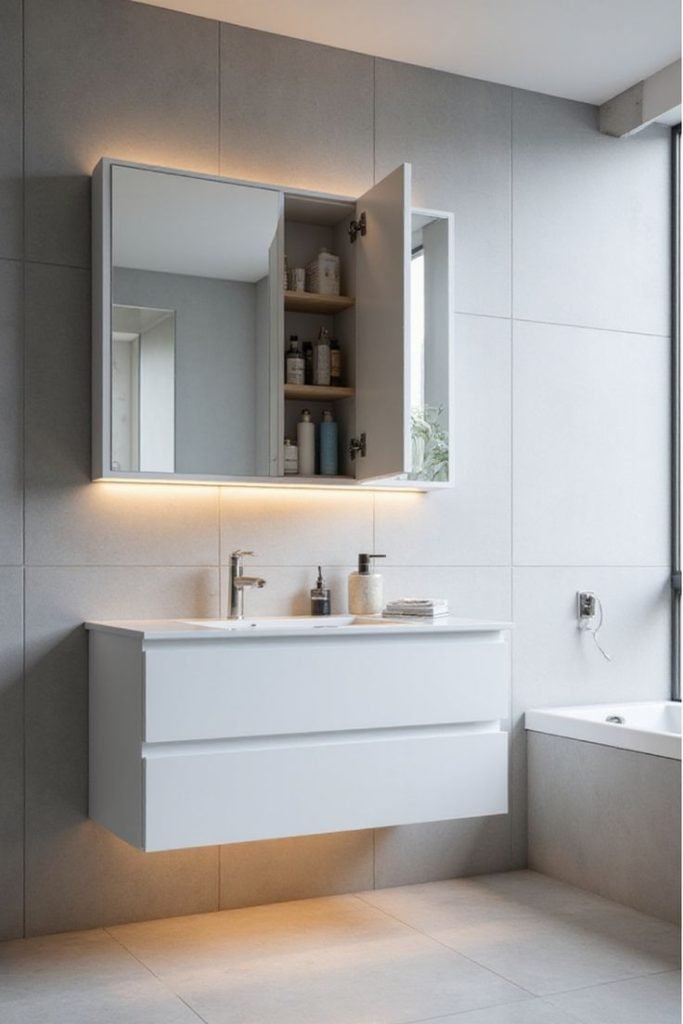
The one good spot is above the sink. That’s where you wash your face, brush your teeth, and get ready — a mirror is a necessity there. A thoughtful choice is a mirrored cabinet with storage, 12 to 15 centimeters deep: toothbrushes, skincare products, and razors all go inside, and the countertop instantly looks clean. Close the cabinet door and you have a flat, tidy mirror; open it and everything is within reach.
Size matters too: the mirror shouldn’t be wider than the sink, and its height should cover the upper body — the tallest person in the household standing straight should see the top of their head, and the shortest should see their chin. A round mirror suits a small bathroom and looks lighter than a square one; a mirror with a built-in light strip suits a bathroom with poor natural light, so morning makeup and shaving don’t need an extra lamp. A mirror itself brings neither good luck nor bad — placed right, it’s simply a useful tool.
4. Doors, Ventilation, and Light: Let the Moisture Out and Mold Won’t Move In
Almost every bathroom problem starts with moisture that can’t escape. Choose an exhaust fan with enough airflow: for a bathroom of 3 to 5 square meters, pick a model that exchanges the air at least 10 times per hour, and leave it running for 20 minutes after a shower before switching it off — far more effective than turning it off after 5 minutes. Many people switch the fan off right after showering out of habit, trapping all the steam inside; by the next day, black spots start appearing on the walls.
A bathroom with poor natural light can be brightened with light-colored tiles and a ceiling light of around 4000K neutral white; glossy wall tiles reflect more light than matte ones. For the door, choose one with louvers or a 2-centimeter gap at the bottom, so air can flow in even when the door is closed — otherwise the exhaust fan has nothing to pull. A fully sealed door plus an exhaust fan is like trying to empty a room with no inlet: the effect is cut in half.
The floor drain is another easy-to-miss spot. Once a month, pour hot water mixed with baking soda down the drain to reduce odor and clogging. A silicone anti-odor drain core costs only a few dozen yuan, and once installed, it often solves the problem of smells coming back up through the drain. Get these three small things right — ventilation, lighting, and the drain — and the bathroom stays dry all year round.
5. Storage and Cleaning: Clear the Countertop and the Room Breathes
Feng shui often says “keep the bathroom clean and tidy.” The practical version is: the fewer things on the countertop, the easier it is to clean and the fewer places dirt can hide. Keep only two or three daily essentials on the sink; everything else goes into the mirrored cabinet. Don’t pile things on top of the toilet tank, and close the lid before flushing to reduce splashing. Keep mops and brooms out of the bathroom corner — give them a spot on the balcony or in a closet instead.
Fix a cleaning routine: wipe the toilet and sink two to three times a week; every three months, take the showerhead off and soak it overnight in white vinegar — once the limescale is gone, the water flows much more smoothly; and once a month, mop the dead corners behind the toilet and under the vanity. A fixed routine beats “cleaning when I remember,” and the bathroom never suddenly becomes unusable.
Color-wise, light tones suit a bathroom: white, light gray, and beige as the base, with just one or two dark accents. Dark tiles show dirt and make the room look smaller; light colors look brighter and bigger, and after cleaning you can tell at a glance whether it’s really clean. Traditional teaching also warns against loud reds and purples in the bathroom, and modern taste agrees — a room you use every day should feel comfortable and easy on the eyes, not loud.
Start With These Three: The Change Is Visible Right Away
There’s no mystery to bathroom feng shui. It comes down to one idea: manage the water and the air, and the home feels comfortable. Location, separation, mirrors, ventilation, and storage are all ways of managing water, airflow, and sightlines. Traditional wisdom points the direction; modern living gives the concrete methods. Used together, they make the most practical layout for this small room.
This weekend, do three things: first, check whether your exhaust fan has enough airflow, and let it run 15 extra minutes after each shower; second, move any mirror that faces the door or the toilet, or hang a curtain to block the view; third, put away anything on the sink you haven’t used in a week and keep only the three things you use every day. Once you’ve done these three, the bathroom will feel noticeably drier and brighter. Bigger changes — a glass partition, an anti-odor drain, soundproofing the shared wall — can wait for the next renovation and be done one at a time, as budget allows. There’s no need to do everything at once.
Quick Answers
Where should a bathroom be located? Avoid the exact center of the home and avoid a door that faces the front door or the bedroom. If you can’t move it, keep the door closed, add a curtain or sliding door as a buffer, and soundproof the shared bedroom wall.
Is wet-dry separation worth doing in a small bathroom? Yes. A 120-centimeter glass partition in a 5-square-meter bathroom is enough, and even a “half separation” — anti-slip tiles, a water-retaining strip, and a fast-absorbing mat — keeps the dry zone safe, which matters most for elderly people getting up at night.
Where should the bathroom mirror go? Above the sink, no wider than the sink itself. Avoid mirrors facing the door, the toilet, or the bed. A mirrored cabinet 12 to 15 centimeters deep doubles as storage.
What is the simplest way to keep a bathroom dry? Ventilation: an exhaust fan exchanging the air 10 or more times per hour, left running for 20 minutes after a shower, plus a door with a 2-centimeter gap or louvers so air can flow in. Add a monthly hot-water-and-baking-soda flush of the floor drain.