It is a Friday night, and the hotpot is still steaming. Someone at the table holds out an open palm and laughs: “Go on, tell me — am I going to be rich?” Everyone leans in. Three lines cross the palm, deep in some places, faint in others, and within seconds the whole table has an opinion. Does any of it mean anything? That is the question this guide sets out to answer — not by telling your fortune, but by walking you through how Chinese palmistry, or shouxiang (literally “hand physiognomy,” the traditional art of reading character from the hand), has described those three lines for centuries.
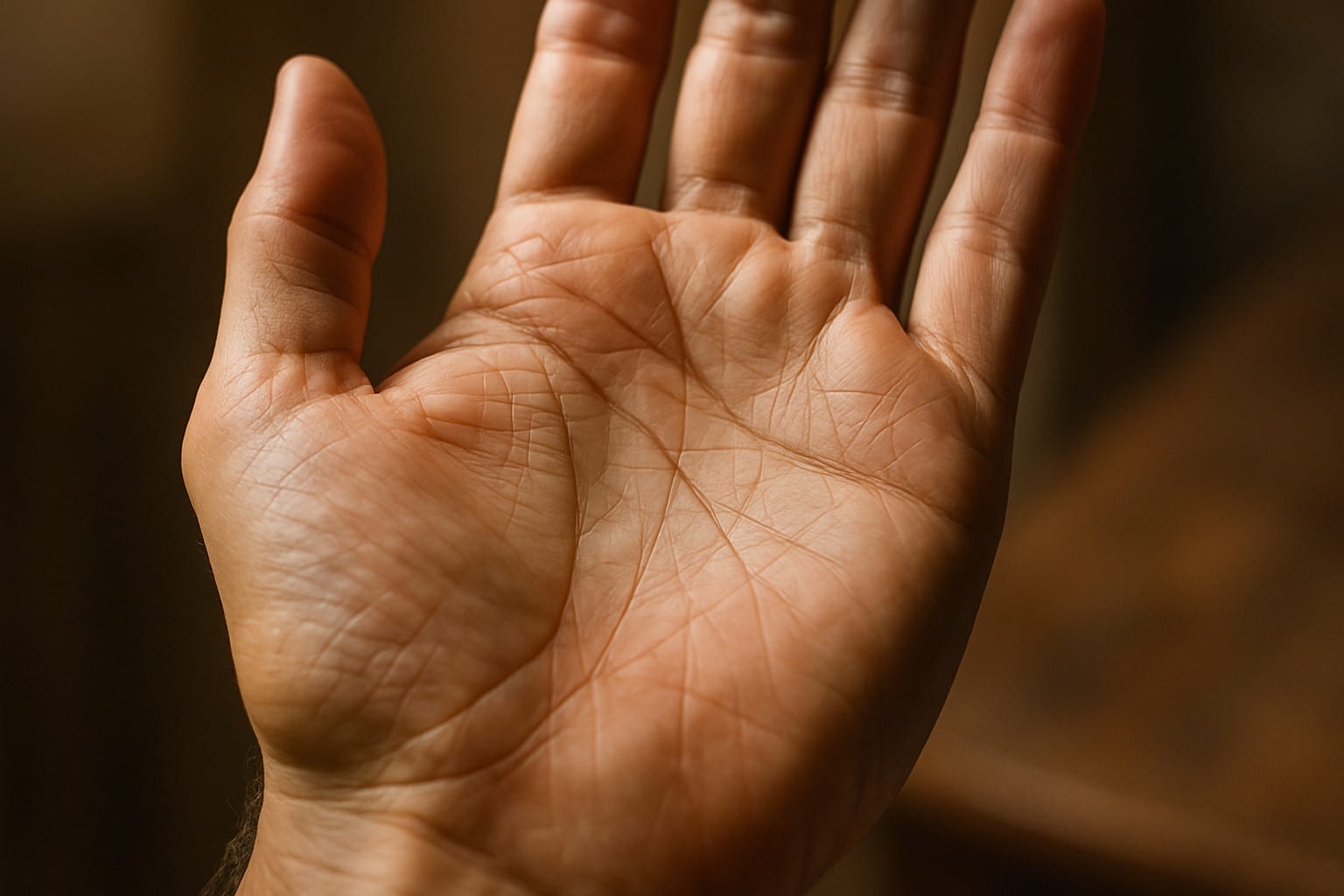
Palm reading is one of the oldest branches of Chinese folk culture. It appears in classical texts, in novels, in street-corner storytelling, and in the way grandparents tease grandchildren at family dinners. It was never a science, and it was never meant to be one. Treat what follows as a cultural tour: a way to understand what people mean when they talk about the life line, the head line, and the heart line — and why none of it should be used to judge a person’s health, character, or future. Everything here is for cultural reference and entertainment only.
Which Hand Do You Read? Left, Right, and the Dominant Hand
The first thing beginners ask is which hand to look at. The old saying is “men left, women right” — but that is a shortened version of a subtler idea. In the more common traditional explanation, the left hand represents what you were born with (xiantian, the inborn), and the right hand represents what life has added since (houtian, the acquired). The lines on the left hand are largely set early in life; the lines on the right change slowly with age, work, and habit.
That is why experienced readers in the folk tradition usually look at both hands and compare them. A right-handed person’s right hand is read as the main hand, and the left as a reference; for a left-handed person, the roles reverse. The bigger the difference between the two hands, the more the traditional reading would say that a person’s inborn tendencies and later life have diverged — a poetic idea, not a diagnosis.
Before you start, get the setup right. Find good, even light and rest your hand flat on a table, palm up, fingers slightly apart. Do not stretch the hand rigid — stretching flattens the fine lines — and do not curl it into a fist, which squeezes the lines together. The most reliable view comes from a relaxed, naturally open hand. A lunch break at your desk, palm resting face-up in daylight, is genuinely one of the best moments to look. For reference only, of course: you are learning a folk vocabulary, not taking a measurement.
The Three Major Lines: What Each One Is Said to Mean
Three lines dominate the palm, and traditional palmistry assigns each one a different job. Learning where they sit matters more than memorizing their names — so start with the map, not the meanings.
The Life Line: The Arc That Curves Around the Thumb
The life line is the curved arc closest to the thumb. It begins between the thumb and the index finger, sweeps around the fleshy mound at the base of the thumb (called the Venus mount in the traditional system), and runs down toward the wrist. In the traditional reading, it is associated with vitality, stamina, and general physical energy — a deep, long, unbroken curve is described as a sign of abundant energy, while a faint, broken line is said to suggest someone who tires easily.
Here is the most important correction in all of palmistry: the length of the life line has never, in the traditional system, been a measure of lifespan. A man in his seventies can have a life line that stops halfway across the palm and still be remarkably sturdy; a twenty-year-old can have a long, deep one and still exhaust herself staying up until 3 a.m. every night. Read it, if you read it at all, as a traditional symbol of energy and stamina — never as a verdict on health or longevity. If you feel unwell, see a doctor, not a palm. For reference and entertainment only.
The Head Line: The Line That Crosses the Palm
The head line — also called the wisdom line or mind line — usually starts near the life line, sometimes sharing its first centimeter before branching away, and runs diagonally across the palm toward the little finger. In traditional readings it is linked to thinking style. A straight head line reaching toward the little finger is described as rational and logical; a line that curves downward toward the lower palm is described as imaginative and feeling-led.
Take two people from everyday life. A friend who works in accounting has a head line that runs straight and long, all the way toward the little finger — and sure enough, she checks every figure to two decimal places, three times over. A friend who draws illustrations has a head line that dips and curves down the palm — and his sketches go through five wild revisions before he is satisfied. In the traditional reading, the two lines produce two different character sketches. It is a neat story, and a good dinner-table game — but thinking style is shaped by education, work, habit, and a hundred other things, and no single crease on a hand can settle it. Treat the match as a coincidence worth smiling at, not evidence.
The Heart Line: The Line Nearest the Fingers
The heart line sits just below the base of the four fingers, running from the little-finger side toward the index finger. In the traditional system it is associated with emotional expression and close relationships. A deep line stretching all the way to beneath the index finger is described as a sign of someone who feels deeply; a short line ending below the middle finger is said to suggest someone reserved, less comfortable putting feelings into words; a line that forks into two or three small branches at the end is called a “phoenix tail” in the folk vocabulary and is read as a sign of a sensitive, detail-oriented nature.
Real life makes the limits of this obvious. One person, after an argument, cannot say a single harsh word out loud — then writes an 800-word message at midnight to say everything they actually felt. Another lays it all out in ten minutes and moves on. The difference comes from family, experience, temperament, and practice, not from a crease. The heart line offers a traditional cultural lens for talking about those differences; it is not a test result. For reference and entertainment only.

Reading the Lines Themselves: Five Features Beginners Notice First
Once you know where the three lines sit, the next step in the traditional system is to look at the quality of the lines themselves. Five features come up again and again.
- Depth: A clear, deeply etched line is traditionally read as a sign that the quality it represents is pronounced; a faint, blurry line is said to suggest a gentler, less showy version of the same quality. A particularly deep head line, for example, is traditionally associated with strong focus.
- Length: The further a line extends, the longer the associated quality is said to last in the traditional reading. A heart line reaching the index finger and one stopping at the middle finger produce two different folk portraits.
- Breaks: A line that stops for a short stretch and then resumes is traditionally read as a turning point or a period of change — a break in the middle of the life line, for instance, is sometimes linked by folk readers to a career change in a person’s twenties or thirties.
- Forks: A line splitting into two or three fine branches at its end is traditionally said to mean more choices, or attention pulled in several directions. A forked head line is often described as a sign of wide-ranging interests — someone who wants to do several things at once.
- Islands and crosses: A small loop on a line (an “island”) or a tiny cross is traditionally read as a period of ups and downs that deserves attention — an island on the heart line, for example, is sometimes interpreted as a relationship that went through a rough patch.
All of this needs repeating, because it is the point that gets lost most often: these are cultural statements from traditional palmistry. They are not medical conclusions, and they are not verdicts on anyone’s fate. Palm lines change with age, with manual work, with dry skin and scarring. Learn the vocabulary, enjoy the tradition, and never use it to label another person.
Beyond the three major lines, the traditional system also reads the raised areas of the palm, called “mounts” (qiu): the mount at the base of the thumb is traditionally linked to vitality, the one under the index finger to ambition, and the one under the little finger to expression. The fingers have their own folk readings too — an index finger longer than the ring finger is traditionally described as a sign of an active, take-charge nature, and the reverse as a sign of strong practical drive. A beginner’s rule of thumb: pick three to five features at most in one sitting. Trying to read everything at once is how people end up inventing meanings that were never there.
Three Mistakes Beginners Make Most Often
Mistake 1: Treating palm lines as a medical report. Palmistry is folk culture, not medicine. If something about your body worries you, go to a hospital. Never use a palm line to frighten yourself — or anyone else — about health.
Mistake 2: Judging a person from a single line. The traditional system insists on reading the whole hand together: the three lines, the mounts, and the fingers, all in combination. Saying someone is “destined to be alone” because their heart line is short, or that a break in the life line means disaster in a certain year, is exactly the kind of one-line verdict the tradition itself warns against. It is also how a pleasant cultural game turns into something hurtful.
Mistake 3: Paying someone to “change your luck.” Some street stalls will read your palm and then try to sell you charms, rituals, or “luck-changing” objects. Traditional palmistry, as a cultural practice, is only an activity of observation and interpretation — it comes with no luck-changing service attached. If anyone uses a palm reading as a pitch for a paid product, walk away. For reference and entertainment only — and never for sale.
After the Reading: Use It as a Mirror, Not a Verdict
Learning palmistry means learning a piece of traditional culture, not receiving an instruction manual for your life. The three lines give you an old way of looking at people: the life line as a symbol of energy, the head line as a symbol of thinking style, the heart line as a symbol of emotional expression — and depth, length, breaks, and forks as footnotes in that old vocabulary. Knowing them gives you a better conversation at dinner, and an extra layer of understanding when you meet the art of “reading people” in classical Chinese stories.
Try it tonight. After washing your hands, dry your palms and hold your dominant hand open under a lamp. Spend five minutes following the order in this guide: find each line’s starting point, trace it to its end, and notice its depth and any forks. Compare it with your other hand. Write down the three most noticeable features in a note on your phone, and look again in three months to see what, if anything, has changed. Remember: the palm is a mirror of how the ancients understood people, not a verdict on your life. Enjoy the tradition for what it is — cultural reference and entertainment only — and then get on with living well. That is the real point.
Quick Answers
Which hand should I read first? Your dominant hand is the main one — right hand for right-handed people, left for left-handed people — with the other hand as a reference. In the traditional saying, the left hand reflects the inborn and the right hand reflects what life has added. For reference only.
Does a short life line mean a short life? No. In traditional palmistry the life line has never been a measure of lifespan; it is described as a symbol of energy and stamina. A short line says nothing about how long you will live. Health questions belong to a doctor, not a palm.
What do the three lines stand for? In the folk system, the life line is linked to vitality, the head line to thinking style, and the heart line to emotional expression. These are traditional cultural associations — interesting as heritage, not to be taken as facts about a person.
Can palm lines change over time? Yes. Lines deepen, fade, and shift with age, manual work, and skin condition. That alone is reason enough not to treat any single reading as permanent — or as a verdict.
Is palmistry real? It is real as culture: a centuries-old folk tradition with its own vocabulary, stories, and ways of talking about character. It is not a science, it makes no testable claims about fate or health, and it should be enjoyed as cultural reference and entertainment only.