You wake up with a weight on your chest, as if a stone were sitting there. One long sigh, and the pressure finally eases. Later, in a meeting, a sentence sticks in your throat and never comes out. By dinner, a full bowl of food holds no appeal at all. If this sounds familiar, the problem may not be a bad mood. In traditional Chinese medicine (TCM), there is a name for it: qi stagnation constitution, a pattern in which the body’s vital energy, qi, stops flowing freely.

What Qi Stagnation Looks Like: The Body Sends Signals First
In TCM, qi stagnation means the flow of qi has become sluggish, like a stream blocked by a fallen rock. People with this constitution often look perfectly fine on the outside. Their checkup results usually come back normal. Yet every day brings a collection of small discomforts that are hard to explain to anyone else.
The most typical signs show up in mood and in the chest and abdomen. You sigh a lot, sometimes a dozen times a day without noticing. Your chest feels tight, as though something were pressing against it, and only a few deep breaths bring relief. The sides of your ribcage ache or feel swollen, especially after you get angry or anxious. Your throat feels as if a plum pit were stuck in it: you cannot swallow it down and cannot cough it up, and drinking water does not wash it away.
Digestion is often affected too. Your appetite comes and goes. You feel hungry, then full after only a few bites. After meals you feel bloated and keep burping. Some people get diarrhea whenever they feel nervous; others go days without a bowel movement. Sleep is usually light and broken. It takes more than half an hour of tossing and turning to fall asleep, dreams are vivid and frequent, and you often wake between 3 and 5 in the morning and cannot get back to sleep.
There are also signs that are easy to miss. Your breasts feel swollen and tender in the week before your period, and your mood swings more sharply. On the first day of menstruation, your lower abdomen feels distended and achy. Breakouts cluster along the chin and cheeks. The edges of your tongue look darker than usual, with a thin white coating. If four or more of these descriptions fit you, it is worth spending a few weeks working on it seriously.
Why Qi Gets Stuck: Three Common Causes
The first cause is swallowed feelings. You take unfair treatment at work but never speak up. There is tension at home, but you hold your tongue to avoid a fight. Month after month, emotions with no outlet pile up, and the qi in your chest has nowhere to go. Many people with this constitution are the reliable, easygoing ones, the people who always look after everyone else’s feelings first and put their own discomfort last.
The second cause is sitting still for too long. Eight to ten hours a day in a chair, getting up only for water or the bathroom, with almost no large movements in between. Qi needs movement to keep flowing; the longer you sit, the slower it moves. Add a stiff neck and shoulders from hours at a computer, and the flow through the shoulder area slows even further.
The third cause is a disrupted rhythm of eating and sleeping. Meals come at random times, or you eat only when you are starving. You snack after 11 at night and scroll on your phone until 1 in the morning. In TCM, the spleen and stomach are the source of qi and blood: irregular meals and late nights weaken their ability to generate and move qi. Getting chilled in winter by wearing too little, or sitting for hours in summer with cold air blowing straight at your neck, can make the stagnation worse.
Eat Well, and Half the Problem Eases
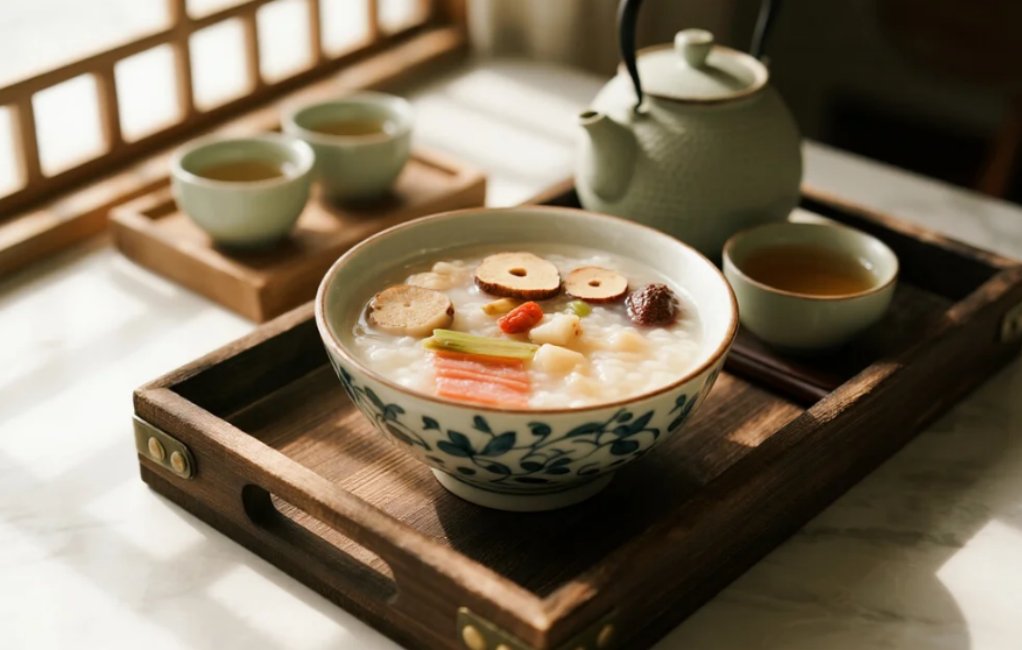
When it comes to food, the goal for qi stagnation is simple: move the qi, support the spleen and stomach, and avoid food that is too greasy or too cold. Several everyday ingredients help. Dried tangerine peel, 3 grams steeped in hot water, is a good choice when you feel bloated after a meal. Rose buds, 5 flowers with 2 red dates in a tea, suit the days before your period when your breasts feel tender and your mood is on edge. Yam, poria, and millet cooked into a porridge make a gentle breakfast for people with a weak stomach who bloat easily.
Among vegetables, celery, white radish, chayote, and enoki mushrooms are all good picks. Shredded white radish in a cold salad, or a few slices in soup, can help ease bloating. Celery stir-fried with lily bulbs is light and refreshing. Eat these kinds of vegetables three or four times a week, and your stomach will feel far more comfortable than it does on a diet of rich, heavy meals. For fruit, citrus is the best choice: one orange or pomelo a day is enough. They are tart, sweet, and appetizing, but do not eat too much on an empty stomach.
There is also a short list of things to cut back on. Fried food, fatty meat, and cream cakes are hard to digest, so keep them to no more than twice a week. Iced drinks and fruit straight from the fridge should sit out for about ten minutes to warm up before you eat them. Strong tea and coffee should stay under two cups a day, and none after 3 in the afternoon, or your sleep will suffer. One number is worth remembering at the table: chew each bite about 20 times and take about 20 minutes for a meal. That habit alone is worth more than any supplement.
Move Daily: A 30-Minute Routine That Unblocks Qi
Exercise is the most direct way to move stagnant qi, and it does not need to be punishing. What matters is doing it every day. Here are three easy routines to choose from. Pick one and stick with it for four weeks, and you will likely feel the difference.
Brisk Walking
Go out 40 minutes after dinner and walk briskly for 30 minutes. The right pace is one that leaves you lightly sweating: you can talk, but you cannot sing. Walk five days a week and rest on the other two. Swing your arms as you walk and breathe deeply. Around the 15-minute mark, that tight feeling in your chest often begins to loosen.
Two Baduanjin Movements
Baduanjin is a gentle qigong routine from China, a set of eight slow movements practiced for centuries to keep the body supple. Two of its movements are especially useful here: “Drawing the Bow to Shoot the Eagle” and “Single Lift to Regulate the Spleen and Stomach.” Practice for 15 minutes in the morning after waking, moving slowly and breathing with each motion, focusing on stretching the ribcage and the shoulders. Many people say their shoulders feel looser and they sigh less after the very first session. Standard follow-along videos are easy to find online; three repetitions are enough, so do not overdo it.
Stretching and Deep Breathing Before Bed
Spend ten minutes before sleep on three things. First, raise both arms overhead and stretch for 30 seconds, three sets. Second, rub your belly clockwise 50 times, gently. Third, take five slow belly breaths: inhale for 4 seconds, exhale for 6 seconds. A longer exhale than inhale helps the body relax, and you will fall asleep faster.
There is one bottom line for exercise: do not push yourself to a heavy sweat and wake up sore all over the next day. People with qi stagnation already tire easily, and overexertion drains qi rather than moving it. Light sweat and a clear head afterward mean you have done just the right amount.
When Emotions Get Stuck: Four Practical Ways Out
Untangling stuck emotions takes more than being told to “relax.” It takes concrete actions. The first is to write it down. Every evening, spend ten minutes writing the most frustrating thing that happened that day on paper: just the facts and how it felt, without judging right or wrong. Fold the paper and set it aside. Many people find their chest feels half as heavy once the words are out of their head.
The second is to say it out loud. At least once a week, have a conversation with a friend or family member that is not about work, whether on a walk or over a meal. The other person does not need to offer advice. Simply speaking the words aloud gets the qi moving again. If there is no one to talk to, recording yourself talking for five minutes on your phone can have a similar effect.
The third is to give your feelings a physical outlet. When you feel irritated, go for a 20-minute brisk walk, or clean a room, moving your attention from your head to your hands. And never make an important decision at the peak of an emotion. Wait 24 hours before replying to a message or having a difficult conversation; by then, the heat has usually dropped by half.
The fourth is to press two acupoints. Taichong (Liver 3) sits on the top of the foot, about two finger-widths above the gap between the big toe and the second toe. Press and rub it for three minutes a day; a clear soreness means you have found the right spot. Neiguan (Pericardium 6) sits on the inner wrist, about three finger-widths above the wrist crease, between the two tendons. Rub it for two minutes before bed to ease a racing heart and restless sleep. Use moderate pressure and never press hard enough to break the skin.
While you work on this, avoid a few traps: do not bottle everything up alone for weeks on end, do not use alcohol to take the edge off, and do not replay old grievances late at night. Alcohol may feel relaxing in the moment, but mood is often lower the next day. Late-night rehashing only makes the knot tighter. Go to sleep first and think it over in the morning instead.

Start With One Small Thing
Qi stagnation does not form in a single day, and it does not need to be fixed in a single day either. The signals your body is sending are clear: frequent sighing, chest tightness, poor sleep, and a weak appetite are all reminders to slow down, move more, and speak up.
Try just three things starting this week: walk briskly for 30 minutes every day, 40 minutes after dinner; rub your belly 50 times and take five slow belly breaths before bed; and have one real conversation each week with someone, about anything but work. Keep it up for four weeks, then count the signs from the start of this article again and see how many have faded. If chest tightness, insomnia, or rib pain lasts more than two weeks without improvement, or gets worse, visit the TCM department of a proper hospital so a doctor can assess you in person. Do not take herbal medicine on your own for a long time.
Quick Answers
How do I know if I have qi stagnation constitution? Look for the cluster, not a single sign: frequent sighing, chest tightness, rib-side distension, a plum-pit feeling in the throat, bloating after meals, light sleep with 3 to 5 a.m. waking, and mood swings before menstruation. Four or more matching signs is a good reason to work on it.
What is the fastest daily habit that helps? A 30-minute brisk walk after dinner. It is simple, costs nothing, and many people feel their chest loosen within the first two weeks.
Which foods should I eat more of? White radish, celery, chayote, enoki mushrooms, and citrus fruit, plus tangerine peel tea and rose bud tea on the days they suit you. Keep fried food, iced drinks, and late coffee to a minimum.
Can acupressure really help? Pressing Taichong on the foot and Neiguan on the wrist is a common self-care practice in TCM, often used to ease tension and restlessness. It supports relaxation but does not replace medical care.
When should I see a doctor? If chest tightness, insomnia, or rib pain persists beyond two weeks, gets worse, or comes with any new and worrying symptom, seek medical advice promptly rather than trying to manage it alone.
Disclaimer: This article is for general daily health information only. It is not a substitute for medical diagnosis or treatment, and it promises no therapeutic effect. For any medication, acupuncture, or long-term health plan, please consult a qualified doctor at a proper medical institution.