It is 11 p.m. Your calves feel heavy, your ankles are cold, and you keep turning over in bed. Without thinking, you reach down and rub the inside of your lower leg. That spot that feels sore the moment you touch it is very likely Sanyinjiao, also known as SP6.
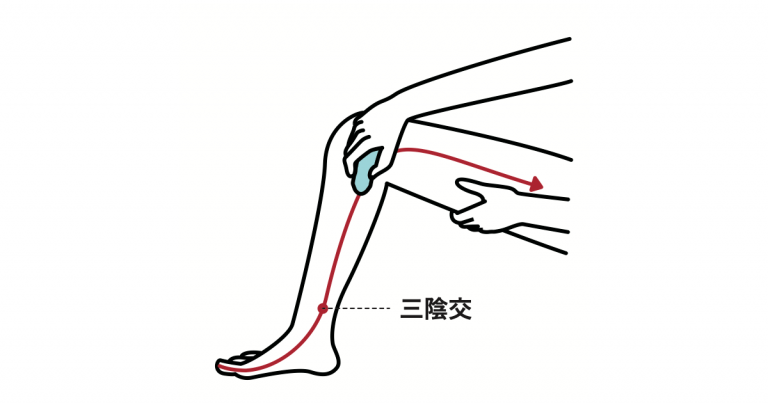
In traditional Chinese medicine, Sanyinjiao is one of the most widely used acupoints in everyday self-care. Its name tells you what it is: “San” means three, “Yin” refers to the three yin meridians of the leg, and “Jiao” means meeting point. Three yin channels – the spleen, liver, and kidney meridians – are said to cross here, which is why this single point has such a long reputation in home health routines. You do not need to believe in meridian theory to use it. You only need to find it, press it correctly, and know when to leave it alone.
Where Is Sanyinjiao? Find It in Three Steps
Sanyinjiao sits on the inner side of the lower leg, about four finger-widths – roughly 7 to 8 centimeters – above the tip of the inner ankle bone, in the hollow just behind the inner edge of the shinbone. Sit down first, plant your foot flat on the floor, and let the calf relax. The most prominent point of the inner ankle bone is your starting landmark.
Measure with your own hand: press your index, middle, ring, and little fingers together and lay them horizontally above the tip of the inner ankle. The combined width of those four fingers is “four finger-widths.” This measurement varies from person to person. People with thick fingers will measure around 8 centimeters; people with slender fingers, around 7. Both are normal. There is no need to chase the number with a ruler.
Once you have the height, slide your finger toward the back of the shinbone. The shinbone is the ridge you can feel running down the front of your lower leg. Move about one finger-width behind its inner edge and you will find a shallow groove running lengthwise. Press there and you should feel a dull ache and a sense of fullness, sometimes with a faint tingling in the toes. That is Sanyinjiao. There is one on each leg. Try both sides – the side where the ache feels stronger is often the one that needs attention more.
Beginners usually make two mistakes. The first is measuring from the wrong starting point, using the outer ankle bone instead of the inner one. The second is pressing on the front of the shinbone, where the bone is hard and the only sensation is pain, not ache. Remember two words – inner side, back edge of the shinbone – and you will not drift far from the right spot.
How to Press It: Technique, Pressure, and Timing
The most common method is thumb kneading. Place the pad of your thumb on the point and press down slowly. Hold for 3 seconds, then make small circles around the point, 10 to 15 rotations. The pressure should produce a feeling you can describe as “sore and full, bearable, never sharp.” When the skin turns slightly pink and the area feels warm, you have pressed enough.
Work one foot for 3 to 5 minutes; both feet together take 6 to 10 minutes, which is plenty. Once or twice a day is a sensible rhythm. Pressing 30 minutes before bed works well for many people – once the calves relax, falling asleep tends to come easier. If your calves feel heavy in the morning, a 3-minute session before you head out is enough.
Pressure should match the person. Younger people with firm muscles can press a little deeper, into the layer where the ache sits. Older adults, people with thin skin, or anyone whose veins lie close to the surface should use about half the pressure and shorten each side to 2 to 3 minutes. Keep your nails short, press with the fleshy pad of the thumb, and never poke the point with a fingertip – that only hurts the skin and misses the point.
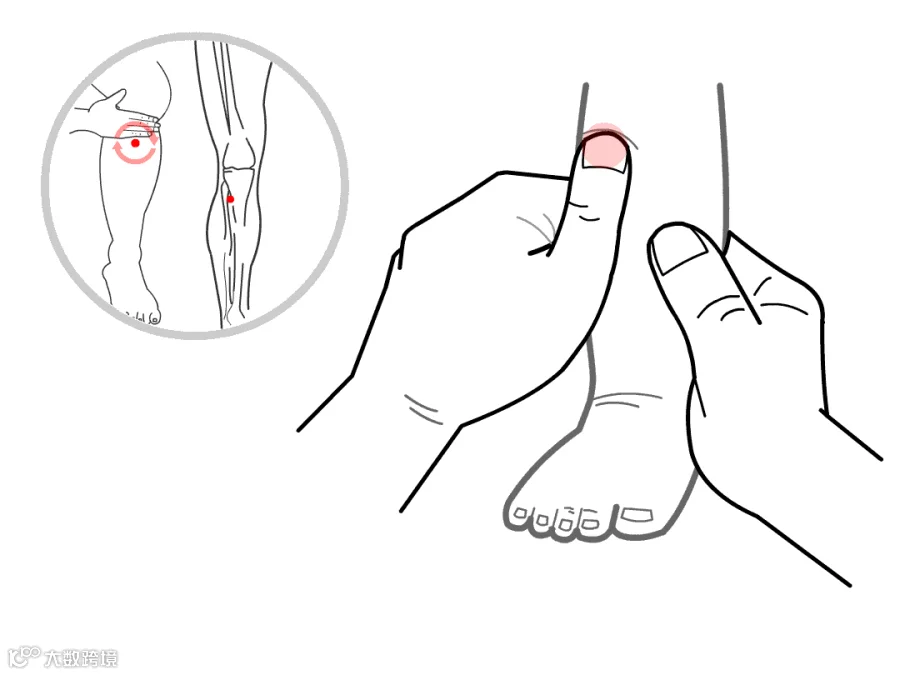
If thumb kneading tires your hand, try palm-heel stroking instead. Sit down, rest one calf across the opposite knee, and use the heel of your palm to stroke slowly upward from the inner ankle along the back edge of the shinbone, about 20 strokes. Move slowly and steadily. Afterward, you should feel a band of warmth traveling up the inner calf. This method suits anyone whose thumbs ache after a few minutes of pressing.
Breathing helps. Exhale slowly as you press down, inhale as you release. Scrolling on your phone or chatting while you press will scatter your attention, and the pressure will turn uneven – too light, then too heavy. Treat these few minutes as time set aside for yourself. A focused five minutes beats a careless ten.
Who Benefits: Three Everyday Situations
Office workers who sit all day are a natural fit. After eight hours at a desk, the calves barely move, and by three or four in the afternoon the ankles start to swell and the shoes feel tight. Press Sanyinjiao for 3 minutes, then stand up, walk a couple of laps, and rise onto your toes 10 times. The heavy, swollen feeling in the calves usually eases noticeably.
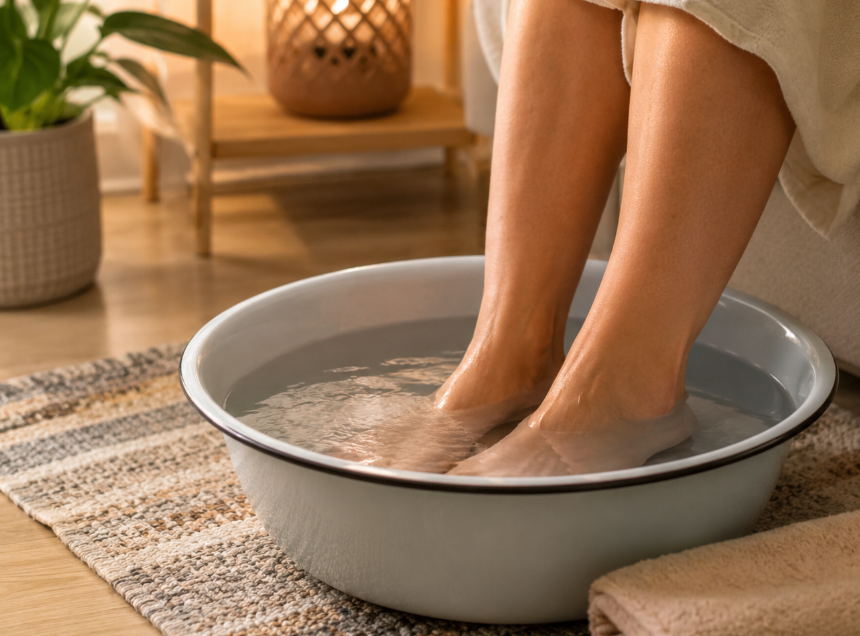
People whose hands and feet run cold can try it too. In winter, two pairs of socks may still not be enough, and the feet stay cold even under the covers at night. After pressing, local blood flow picks up and the calves and feet gradually warm. A foot soak makes the effect last longer: soak in water at around 40 degrees Celsius for 15 minutes, dry off, then press. The warmth will linger much longer.
Women who feel a dragging heaviness in the lower abdomen and an aching lower back around their period often keep Sanyinjiao in their daily self-care routine. Use a lighter touch, 2 to 3 minutes per side, and keep the ache gentle rather than intense. If it feels good, continue the next day. If it feels worse afterward, stop. There is no need to push through discomfort.
It can also help after exercise. After a 5-kilometer run or a long hike, when the calves feel hard as stone, kneading Sanyinjiao plus a gentle rub of the calf muscles for 5 minutes can make walking the next day feel easier. It does not replace stretching – stretching still has to happen. Pressing is simply one more way to relax.
Who Should Not Press It: Contraindications to Remember
Pregnant women should not press Sanyinjiao. In traditional practice, this point is considered to stimulate the uterus, so pressing it during pregnancy carries risk. It does not matter how many months along you are or how lightly you press – do not press it yourself. If pregnancy brings swollen legs or cramps, ask your doctor what is safe to do before deciding anything.
Never press on broken skin. If the inner calf has a wound, an active eczema flare, or a varicose vein that is red, hot, or visibly bulging, stay away from the area around the point. Pressing broken skin risks infection, and pressing on a varicose vein can make the discomfort worse.
Several other groups should check with a doctor first: people with a fever, people who have just had surgery, people with a bleeding disorder, and people taking blood thinners. People with diabetic foot or reduced sensation in the lower legs should also be cautious – if you cannot feel how hard you are pressing, it is easy to press too hard. Either skip it or ask a family member to control the pressure for you.
Stop immediately if any of these happen: bruising at the pressed spot, sharp pain that lasts more than 30 minutes after pressing, dizziness or a racing heart, or swelling in the ankle that gets worse. Stop, watch it for a day or two, and see a doctor if it does not improve. Do not keep pressing.
Four Common Mistakes: Pressing Wrong Is Pressing for Nothing
Mistake 1: the more it hurts, the better it works. Some people grit their teeth and press until it hurts, then find a bruise at the point the next day. A dull ache is a useful signal; sharp pain is a warning. Learn to tell them apart. After pressing, your calves should feel lighter – not injured.
Mistake 2: pressing only one side. The left leg aches, so only the left leg gets pressed, and the right leg is ignored. Press both sides, splitting the time evenly, so the relaxation stays balanced. If you are truly short on time, give each side at least 2 minutes.
Mistake 3: expecting results after one session. Sanyinjiao is a daily self-care point. Feeling your calves relax for half a day after one session is normal. Expecting one session to fix chronically cold hands and feet or long-standing sleeplessness is not realistic. Treat it as a five-minute daily habit, keep it up for two or three weeks, and then look back at what has changed. That is far more reliable than judging it after a single try.
Mistake 4: cold water or cold wind right after pressing. Pressing increases local blood flow. Rinsing your calves with cold water immediately afterward, or standing bare-legged in front of the air conditioner, scatters the warmth at once. Put your socks back on, pull the covers up, and let the warmth stay a while longer.
Quick Answers
How do I know I found the right spot? Four finger-widths above the inner ankle tip, behind the inner edge of the shinbone, in a shallow groove. Pressing there gives a dull ache and a sense of fullness, sometimes with a faint tingling in the toes. If all you feel is hard bone and sharp pain, you are on the front of the shinbone – move back.
How long should each session last? Three to 5 minutes per foot, 6 to 10 minutes total, once or twice a day. Thirty minutes before bed is the most popular time.
Can I press it during my period? Many women do, using a light touch for 2 to 3 minutes per side. If it feels comfortable, continue; if it feels worse, stop.
What if I feel nothing at all? First check the location – most “nothing” cases are a misplaced finger. If the location is right and there is still no sensation, do not press harder. Try the palm-heel stroking method instead, or simply switch to a foot soak and stretching.
Is it safe for older adults? Yes, with lighter pressure and shorter sessions – about half the force and 2 to 3 minutes per side. Anyone with varicose veins, diabetes-related foot problems, or blood-thinning medication should check with a doctor first.
Your 5-Minute Daily Routine
Sanyinjiao is not hard to find: four finger-widths above the inner ankle tip, in the hollow behind the inner edge of the shinbone. Press until you feel a dull ache and you have it. The method is just as simple: thumb kneading, 3 to 5 minutes per side, once or twice a day, at a pressure that is sore but never sharp. Pressing before bed tends to work best.
Try it tonight. Sit down, find the point, start light and press a little deeper over 3 minutes, then notice how your calves feel afterward – lighter, or no different. Keep it up for a week. If heavy calves and cold feet improve, make it a fixed part of your bedtime routine. If nothing changes, do not force it. Try a foot soak, stretching, or an earlier bedtime instead. Your body’s feedback is the best guide: if it feels good, continue; if it feels wrong, stop.
Disclaimer: This article is for general everyday health reference only. It is not a substitute for medical diagnosis or treatment, and it promises no therapeutic effect. Pregnant women must not press Sanyinjiao. People with broken skin, abnormal blood clotting, diabetic foot, or anyone currently taking medication or under medical treatment should consult a doctor before pressing. If pressing causes persistent pain, worsening swelling, or any other discomfort, seek medical care promptly.