Picture this: you are two hours into a winding mountain bus ride, the road keeps turning, and your stomach is starting to turn with it. There is no pharmacy at the next stop, no ginger tea in your bag, and the motion-sickness pills are sitting on your kitchen counter at home. Without thinking, your thumb finds the inside of your wrist and presses down. If you pressed the right spot, you just found Neiguan.
Neiguan (PC6) is one of the best-known points in acupressure, the practice of pressing specific points on the body to ease discomfort. In traditional Chinese medicine (TCM), acupressure works along channels called meridians, pathways through which the body’s energy, or qi, is believed to flow. Neiguan sits on the Pericardium meridian, a channel in TCM theory associated with protecting the heart and calming the chest. Its name means “inner gate,” and for centuries people in China have used it as a first-aid point for nausea, a racing heart, and restless sleep. The best part is that it costs nothing, needs no equipment, and you can use it almost anywhere: on a bus, at your desk, or in bed.
This guide shows you exactly where Neiguan is, how to press it properly, and when to leave it alone.
What Is Neiguan (PC6)?
Neiguan is a single point on the inner wrist, on the Pericardium meridian. In TCM theory, the Pericardium is the protective layer around the heart, and the meridian that bears its name runs from the chest down the inner arm to the middle finger. Neiguan is the point on that line most often used to settle the stomach and calm the chest, which is why it shows up in so many home remedies for motion sickness and nausea.
You do not need to believe in meridians for the technique to be worth trying. Modern studies on motion sickness and post-surgery nausea have repeatedly tested wrist pressure at this exact spot, and many people report real relief. The mechanism is still debated, but the practice is simple and low-risk, and that combination is exactly why it has survived for so long. Think of it as a tool in your pocket, not a cure: useful for everyday discomfort, never a replacement for medical care.
There is one Neiguan point on each wrist, and both work. Most people start with the left wrist and then switch to the right. If one wrist is injured or the skin is broken there, use the other side only.
How to Find It: The Three-Finger Method
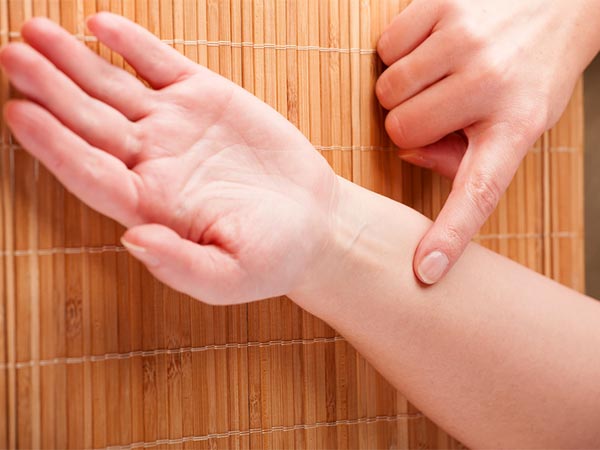
Hold out your left hand with the palm facing up. Find the crease across your wrist, right where the hand meets the forearm. From that crease, measure three finger-widths toward your elbow, roughly 5 to 6 centimeters. The point sits between two tendons in the middle of the inner forearm, in a small dip you can feel with your fingertip. The two tendons are the palmaris longus and the flexor carpi radialis; if you curl your fingers slightly and bend your wrist, they stand out as two cords under the skin.
Beginners make two common mistakes. The first is measuring too close to the wrist, landing almost on the crease itself. The second is pressing on the bone in the center of the wrist. Both miss the point by a couple of centimeters, and that is enough to weaken the effect.
Here is a more reliable way to find it. Lay your index, middle, and ring fingers flat across the wrist crease, side by side. The edge of your ring finger marks roughly the right distance up the arm. Now take the thumb of your other hand and slowly explore the area between the two tendons. You are looking for a spot that feels slightly sore or tender when you press it, a dull ache rather than a sharp pain. That ache is your confirmation: you have found Neiguan.
Take your time the first few times. Once you have found it on one wrist, finding it on the other takes seconds. Many people mark the spot mentally by remembering how it feels rather than measuring it every time.
How to Press It: Pressure, Rhythm, and Duration
The most common technique is thumb kneading. Press the pad of your opposite thumb onto Neiguan, and rest your other four fingers on the back of the wrist to hold it steady. Then make small, slow circles with your thumb, about 60 to 80 circles per minute. Press firmly enough to feel a dull ache, but never so hard that it stings. Press for 3 to 5 minutes per wrist. You may notice the achy feeling spreading slowly up the forearm; in TCM language, that is qi being stirred, and in plain terms it is simply a sign that the pressure is reaching the tissues around the point.
Three Levels of Pressure
Light pressure is for first-timers. Let the thumb rest on the skin and press just enough to feel gentle warmth. Use this level when you are learning the technique or when you only need mild relief.
Medium pressure is for everyday use. The ache is clear but comfortable, and you can keep it up for several minutes without strain. This is the level most people should aim for.
Firm pressure is for emergencies only, such as a sudden wave of nausea on a bus or boat. Hold it for 1 to 2 minutes until the queasiness eases, then drop back to light or medium pressure right away. The guiding rule is simple: lighter is safer. Acupressure works through steady stimulation, not through pain, so pressing harder does not make it work better.
Two More Techniques Worth Trying
Pinching: grip the point between your thumb and index finger and gently lift and squeeze 10 times. This suits people whose wrists feel cold or whose circulation is poor.
Point pressing: press straight down with your thumb for 5 seconds, release for 2 seconds, and repeat 10 to 15 times. This is handy for a quick reset between tasks at work.
You can rotate between the three methods, but keep the total under 15 minutes a day on the same wrist. More is not better; overstimulation can leave the wrist sore and defeats the purpose.
When It Helps Most: 5 Everyday Situations
1. Motion Sickness on Cars, Boats, and Planes
This is the classic use. Press Neiguan for 3 minutes about 10 minutes before you set off, then top it up for 1 minute every half hour during the trip. Many people find their nausea drops by half or more. It works even better if you also open a window for fresh air and fix your eyes on the distant horizon instead of your phone.
2. An Upset Stomach or Morning Sickness
After eating something that disagrees with you, or during early-pregnancy morning sickness, Neiguan can take the edge off the queasiness. One important condition: if you are pregnant, ask your doctor first, keep the pressure light, and limit each session to 2 minutes.
3. A Racing Heart After a Long Day
After a late night at work, your heart pounds and your chest feels tight. Sit down, press Neiguan for 5 minutes, and slow your breathing at the same time: breathe in for 4 seconds, breathe out for 6 seconds. Most people notice their heartbeat settling within 3 minutes. It is a pause button, not a treatment, but on a stressful evening a pause is often exactly what you need.
4. Before Sleep
Press each wrist for 3 minutes in bed, half an hour before you want to sleep. Turn off the lights, put the phone away, and let the slow, repetitive pressing help your body shift from alert to relaxed. If you struggle with sleep often, make it a fixed part of your bedtime routine and judge the results after two weeks, not two nights.
5. Hiccups That Will Not Stop
Eating too fast or drinking cold water can leave you hiccuping for what feels like forever. Press Neiguan for 2 minutes while sipping warm water in small mouthfuls. Plenty of people find the hiccups stop on the spot.

When Not to Press: Safety Rules
Never press on broken, swollen, burned, or infected skin. Pressing over a wound can make an infection worse. If you have sprained your wrist or are still recovering from a fracture, skip Neiguan until you are fully healed.
Do not press firmly within half an hour after a meal; strong pressure on a full stomach can cause discomfort. If you feel queasy right after eating, use very light pressure, or wait 30 minutes before a normal session.
Three groups should talk to a doctor before trying it: pregnant women, people with heart conditions, and anyone taking blood-thinning medication. Neiguan is often recommended for morning sickness, but the right pressure and duration during pregnancy should be decided by a doctor, not by guesswork. Never increase the pressure on your own to chase a stronger effect.
Stop immediately if the skin turns purple, if you feel sharp or persistent pain, or if your arm goes numb for more than 5 minutes. A normal response is a brief ache and warmth. Pain and numbness are warning signs, not proof that it is working.
Finally, know the limits. Neiguan is a helpful home remedy for minor discomfort, but it cannot fix persistent vomiting, chest pain, or breathing difficulty. If any of those symptoms appear, seek medical help promptly instead of pressing the point and hoping for the best.
Quick Answers
How long should I press each time? Three to 5 minutes per wrist is the standard session. For acute nausea, 1 to 2 minutes of firm pressure can help, then ease off to light pressure.
Left wrist or right wrist? Both work. Start with the left, then switch to the right. If one side is injured, use the other side only.
Can I use it every day? Yes, as part of a daily self-care routine, but keep the total under 15 minutes a day per wrist. If your wrist feels sore the next morning, take a day off.
Does it work for everyone? No. Some people feel clear relief within minutes; others feel little or nothing. Try it consistently for a week and judge by your own experience rather than by what worked for someone else.
Can I press it while driving? No. Only use Neiguan when you can sit still and focus on it. If you are driving and feel carsick, pull over safely first.
Is a wristband the same thing? Motion-sickness wristbands press this same point with a small stud, and they work on the same idea. They are convenient for long trips, but your thumb gives you better control over pressure and timing.
Make It a Habit
The real value of Neiguan is that it is always with you. No tools, no cost, no special place needed. On the bus, at your desk, or in bed, your thumb and your wrist are all you need. Learn the three-finger method, find the tender spot between the two tendons, and give yourself 5 minutes a day.
Try it today: press the left wrist for 3 minutes, then the right for 3 minutes, and notice how you feel afterward. Keep it up for a week, and you will know whether this small point earns a place in your daily routine. Good self-care is not dramatic. It is small, steady, and easy enough to repeat, like drinking a glass of water. Neiguan fits that description better than almost any other point on the body.
Disclaimer: Acupressure is a daily self-care practice, not a substitute for medical care. It cannot diagnose or treat any disease, and this article promises no health outcomes. If you are pregnant, have a heart condition, take blood-thinning medication, or feel seriously ill, consult a doctor before trying it. Seek medical help promptly for persistent vomiting, chest pain, or breathing difficulty.