Picture a quiet morning in the park. A practitioner steps forward, and a broad blade sweeps down in a clean arc, landing exactly where it was meant to. Nothing about the movement looks forced. Then you try it yourself, and the blade wobbles, your wrist aches, and the cut lands nowhere near your target. What went wrong? Usually, it is not a lack of strength. It is the grip, and the feet not moving with the blade.
The dao, the Chinese broadsword, is one of the oldest weapons in Chinese martial arts. Its blade is broad, slightly curved, and single-edged, and it is built for sweeping, powerful cuts rather than delicate thrusts. Learning it is less about memorizing dozens of techniques and more about getting three things right in order: how you hold it, how you move it, and how your feet carry it. This guide walks you through all three, with a 15-minute daily routine you can start today.
First, the Grip: Hold It Like a Handshake
In traditional dao practice, the grip is described as “holding the blade like a handshake.” Grip too tightly and the sword becomes a rigid extension of your arm, so every cut is muscled through with the shoulder. Grip too loosely and the blade flies out of your hand on the first hard swing. The right grip sits between the two, and it has a simple image to remember: hold the sword as if you were holding a small bird. Squeeze too hard and you hurt it; hold too loosely and it flies away.
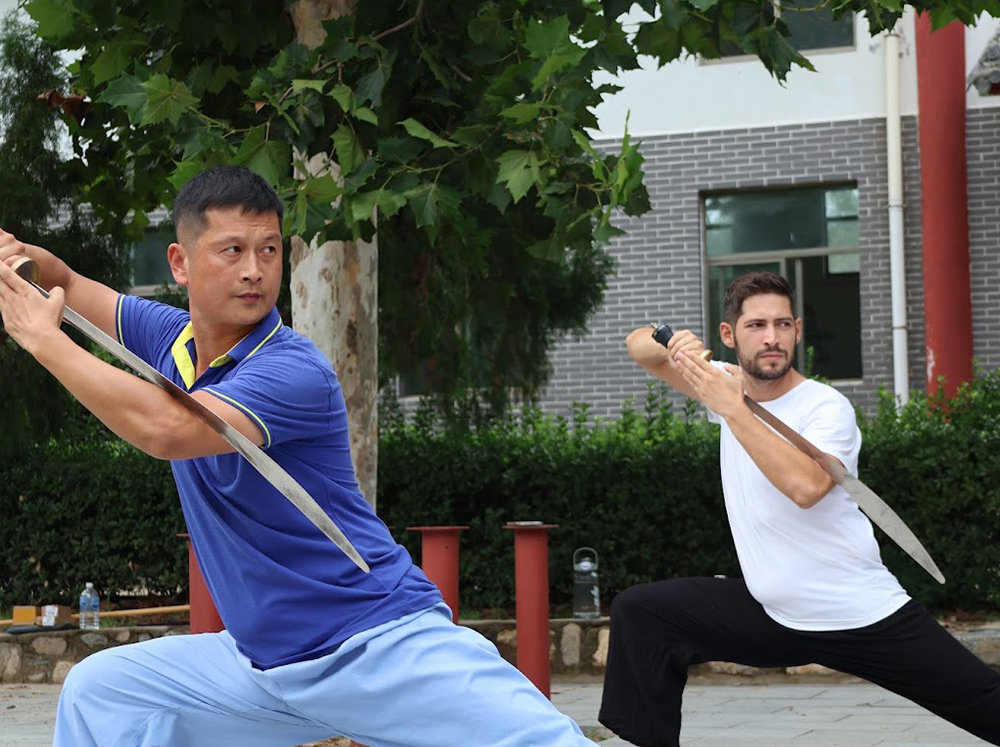
Here is how it works in practice. The web of skin between your thumb and index finger presses against the guard, the part that protects your hand. Your index and middle fingers wrap around the handle and do most of the work. Your ring finger and little finger close gently, and your palm keeps a small gap, so the handle is never crushed in a fist. When you stand at rest, the tip points toward the ground at roughly 45 degrees, the edge facing outward, never toward your own legs.
Before every practice session, spend three minutes on empty-hand grip work. Hold the handle with your right hand, steady the back of the blade with your left, and feel where the balance point sits. On a typical practice blade, the center of gravity falls about one-third of the way along the blade from the handle. Once you know where that point is, your wrist stops fighting the blade on every cut, because you are working with its weight instead of against it.
There is an easy self-check. Make ten slow, empty cuts, then look at your hand. If the skin is reddened across the web between thumb and index finger, your grip is roughly right. If the redness has moved down to the base of your little finger, you are clenching with that finger and need to relax it, letting the index and middle fingers take over.
The Eight Core Cuts: Master Four First
Traditional dao forms list eight core techniques: pi (chop down), kan (diagonal cut), liao (rising sweep), gua (block), zhan (slash), mo (wipe), jie (intercept), and ci (thrust). Beginners do not need all eight at once. Master the first four, and most of the blade’s logic falls into place.
Pi: The Downward Chop
Pi is a straight cut from directly above your head down to a target at shoulder height in front of you. The power sequence matters more than the arm: the waist turns first, the shoulder follows, and the hand sends the blade last. As the blade reaches its target, the wrist gives a small snap so the edge “stands up” at the end of the cut. Most beginners chop like they are splitting firewood, swinging the arm in a big circle and watching the blade drift off line halfway down. Remember that the force of a chop comes from the waist turning, not from the arm swinging.
Kan: The Diagonal Cut
Kan is a diagonal cut, from upper right to lower left or from upper left to lower right, at about 45 degrees. For practice, set a bamboo pole about 1.5 meters in front of you as a reference point. The edge should pass about 10 centimeters above the top of the pole every time. The exercise trains both accuracy and distance control, two things that matter far more than raw speed.
Liao: The Rising Sweep
Liao sweeps upward from below, the tip traveling in an arc, as if scooping something off the ground. The key is in the wrist: when the blade reaches waist height, the wrist turns and the tip lifts smoothly upward. The most common mistake is moving the arm straight up and down, so the tip draws a straight line and loses the coiling quality that makes this technique work. The arc is the technique.
Gua: The Block
Gua is a defensive movement, the blade held across the body to deflect an incoming cut. The back of the blade faces outward, the edge angles about 30 degrees up toward your own body, and the elbow drops to protect the ribs. Gua trains reaction speed: have a partner swing a wooden blade slowly toward you, and bring your blade up to block when it is still about 30 centimeters above your head. Block ten in a row and you have passed the test.
Footwork: Where the Blade Goes, the Feet Go
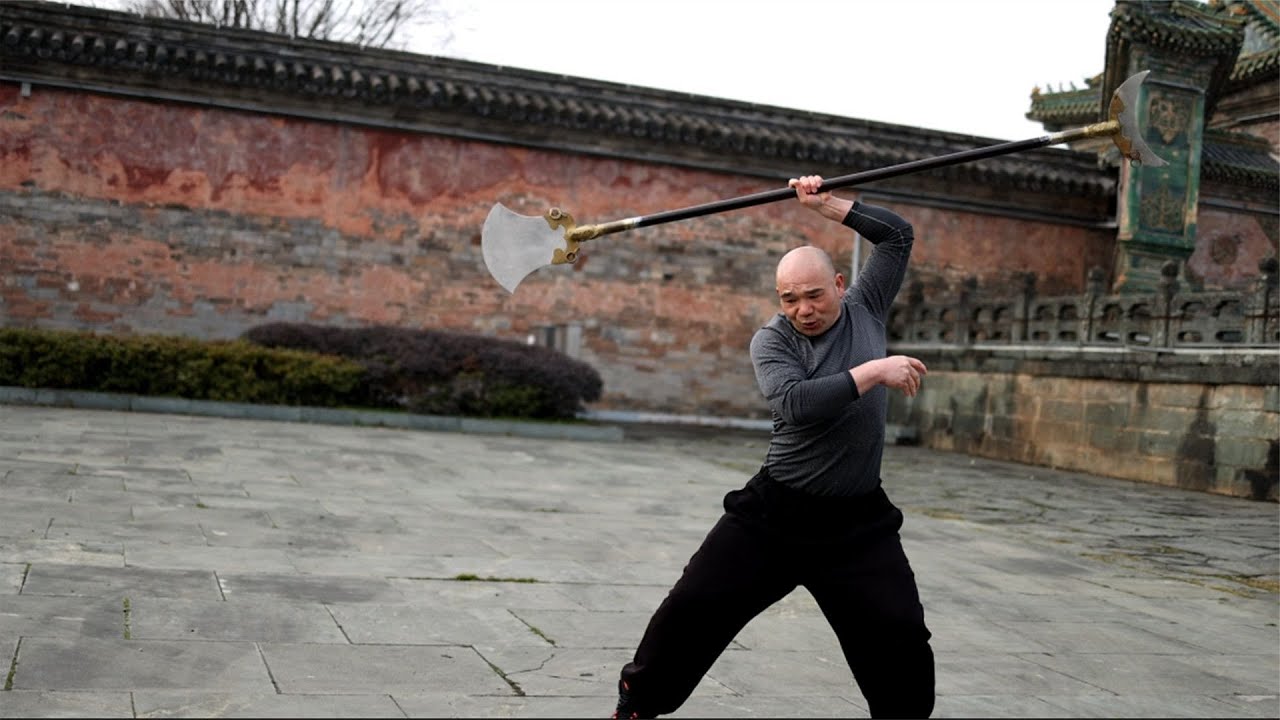
Once your cuts start to feel comfortable, the bottleneck will almost always be your footwork. If the blade goes out but the feet stay planted, your reach is only the length of your arm plus the blade, about 1.2 meters. Step forward half a pace and your reach extends to about 1.8 meters. That extra distance is what footwork is worth.
The most basic combination is the bow stance chop. Step forward with your right foot, heel landing first, and as the sole plants firmly on the ground, the blade comes down from above your head. The foot landing and the blade arriving must happen at the same moment; half a beat off is not good enough. When you are learning, count it out: on “one,” foot and blade move together; on “two,” draw the blade back to a ready position. Practice 20 sets of 10 reps a day.
Next, try the crouching stance rising sweep. Step your left foot out to the left and forward, sink your weight into a low crouching stance, and sweep the blade from lower right to upper left. This movement tests the stability of your lower body: the lower you sink into the stance, the more complete the arc of the sweep becomes. Keep the knee behind the toes, the back leg straight, the front leg bent, and about 70 percent of your weight on the front leg.
A third drill is the turning block. On a call, turn 180 degrees and bring the blade across your body to block, all in one motion. Turn on your heel, not on your toes, and settle immediately after the turn. If you wobble, your stance has no root. Practice ten turns a day; if you can stand rock-steady the moment the turn ends, you have passed.
A 15-Minute Beginner Routine
Put it all together and 15 minutes a day is enough. There is no need to train for an hour and wear yourself out.
- Minutes 1 to 3: Empty-hand grip work. Feel the balance point, make ten slow empty cuts to warm up, and loosen the wrists and shoulders.
- Minutes 4 to 8: Practice pi, kan, liao, and gua in place, ten reps each. Do not rush; aim for a clear, readable path of the blade on every rep.
- Minutes 9 to 12: Twenty bow stance chops and ten crouching stance rising sweeps. A rep only counts if foot and blade land together.
- Minutes 13 to 15: A slow, continuous combination: chop, block, rising sweep, diagonal cut. Return the blade to a ready position and settle your breathing.
After 30 days of this routine, look back at your first day and you will see a steadier blade path. After 90 days, waist, shoulder, and hand will mostly move as one unit when you chop. That is when to move on to combination forms like “wrapping the head and neck” and “fighting in eight directions.” You will learn them faster, and with far less distortion, because the foundation is already in place.
Four Mistakes Beginners Make Most
First, gripping too tightly. If your wrist is sore after ten minutes, your grip is wrong. Relax the little finger and let the index and middle fingers do the work.
Second, using only the arm and not the waist. If your chop looks like splitting firewood, stand in place and practice turning only the waist, without moving the blade. Feel how the waist turns the shoulder, and the shoulder moves the hand.
Third, feet that lag behind the blade. If the blade is out but the feet are still where they started, count the beat and force the synchronization. Foot lands, blade arrives. Twenty forced reps usually fix it.
Fourth, training too fast. Speed comes naturally after the movement is set in the body. Before that point, slow is fast. Rushing to go fast before the form is settled only builds bad habits that take longer to undo.
Getting started with the dao is not a test of strength. It is a test of sequence: grip first, then the four core cuts, then the footwork, then a fixed 15-minute routine, repeated every day. Fifteen minutes a day, visible change in 30 days, real structure in 90. Today, find a wooden practice blade and an open patch of ground, and finish your twenty bow stance chops. That is the first step.
Quick Answers
Do I need a real blade to start? No. Start with a wooden practice blade or an unsharpened training blade. A real, sharpened blade is for much later, after your control is reliable.
How long should I practice each day? Fifteen minutes is enough for a beginner. Consistency beats long sessions, and long sessions before your form is set are how wrists and backs get hurt.
Which cut should I learn first? Pi, the downward chop. It teaches the waist-to-hand power sequence that every other cut depends on.
Why does my wrist hurt? Usually a grip that is too tight, or a wrist that is fighting the blade instead of following its balance point. Loosen the little finger, find the balance point, and slow down.
When can I move on to combination forms? When the waist, shoulder, and hand move together on a chop and your foot lands at the same moment as the blade, usually after about 90 days of steady practice.
Safety note: Start with a wooden or unsharpened practice blade, and train in an open space away from people, vehicles, and anything breakable. Keep the tip pointed away from others, warm up your wrists, shoulders, and lower back before each session, and progress gradually. Stop immediately if your wrist or lower back hurts. This article is an introduction to traditional Chinese martial arts culture and makes no promises about fitness results or health outcomes; consult a qualified professional if you have any physical concerns.