It’s 3 p.m. Your head feels like it’s caught in a tightening band, your tooth has been throbbing since last night, and your nose is so blocked you can only breathe through your mouth. Most people reach for the medicine cabinet first. But there is a tool you carry with you everywhere, right in the web of your hand: Hegu, the acupressure point between your thumb and index finger. Find the right spot, press it the right way, and a few minutes can help your whole upper body let go.
Where Is Hegu? Find It in Three Steps
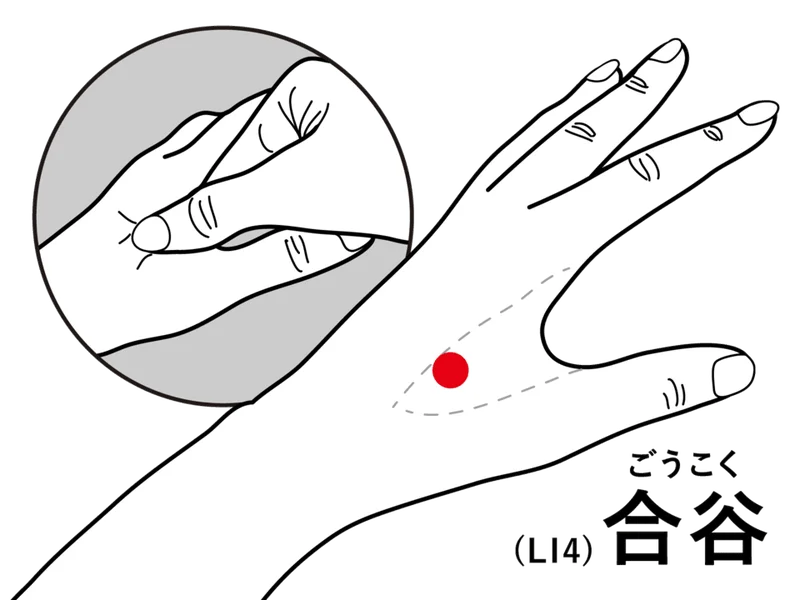
Hegu (LI4) — the name literally means “joining valley” — sits on the Large Intestine Meridian, one of the twelve main meridian pathways in traditional Chinese medicine. A meridian is a channel along which qi, or vital energy, is understood to flow through the body. Hegu lies on the back of the hand, in the fleshy mound between the first and second metacarpal bones, at the base of the thumb and index finger. Here is how to find it in three steps.
Step one: spread your palm flat, back of the hand facing up, thumb and index finger naturally apart. The raised mound of muscle in the web of your hand is the area you want. Step two: press the pad of your opposite thumb into that mound, then gently bring your thumb and index finger together. The muscle will bulge, and the point where the soreness and fullness feel strongest is the center of Hegu. Step three: cross your hands so that the thumb of one hand rests in the web of the other. Where the tip of that thumb naturally lands is almost exactly on Hegu.
Beginners usually make two mistakes. The first is pressing too close to the finger joints, where the sore, heavy feeling is very weak. The second is pressing directly on bone, which feels hard and flat, with no muscle underneath. The right spot feels soft with a dull ache when you press it, on the thickest part of the muscle. You have one on each hand — work them one at a time, alternating sides.
What Can It Help With? Four Everyday Situations
Traditional Chinese medicine has an old saying: “For the face and mouth, Hegu collects.” In other words, many problems of the head and face can be addressed through this one point on the hand. It is not a cure-all, but in the four situations below it is genuinely useful.
Headaches and migraines. You have been staring at a screen all day, and by mid-afternoon your temples are pulsing. Press Hegu for three to five minutes and the tight feeling across your head often eases with it. It works best for dull, pressing, or heavy headaches, and for the head pain that comes with the first day of a cold.
Toothache and swollen gums. A toothache at 2 a.m., with no dentist available until morning, is one of the most miserable experiences there is. Hegu is especially known for easing pain in the upper teeth — as you press, the sore, heavy sensation often seems to travel up along the arm. It can only buy you time, though. A cavity or pulp infection still needs a dentist, and soon.
Blocked nose and the start of a cold. When the seasons change and a cold sets in, a stuffed nose can force you to breathe through your mouth all day. Massaging Hegu while breathing deeply helps some people feel their nasal passages gradually open up. At the very start of a cold — when you feel chilled and a little feverish — Hegu is often used together with Yingxiang, the point beside the nose.
Dry eyes and a stiff neck and shoulders. Two hours of screen time without looking away leaves your eyes dry and your neck rigid — a daily reality for office workers. Hegu can help the tension in your upper body unwind. Roll your neck gently and look out the window at something far away for twenty seconds, and you will feel noticeably more relaxed.
Hegu is good at easing symptoms and supporting the body’s own recovery. Expecting a few presses to cure a chronic condition is unrealistic. If a symptom keeps coming back, you still need to find out what is causing it.
How to Press It: Pressure, Timing, and Rhythm
Finding the point is only the first step. Whether it helps depends on how you press it. The method below is the one most commonly taught, and it is easy to learn.
Basic Press-and-Hold
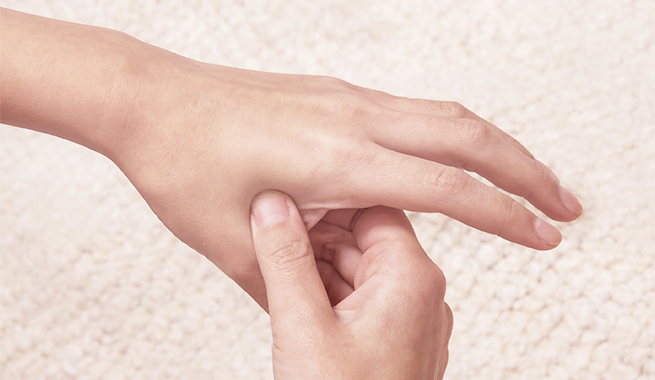
Press the pad of your opposite thumb straight down onto Hegu. The right pressure produces a feeling of soreness, numbness, or fullness — what traditional practitioners call de qi, the arrival of qi at the point. If you are gritting your teeth, you are pressing too hard; if you feel almost nothing, you are pressing too lightly. Hold for three seconds, release for one second, and repeat twenty to thirty times, which takes about two to three minutes. Then switch hands and do the same on the other side.
Circular Rubbing
Press your thumb onto the point, then rub in small circles around it — thirty circles clockwise, then thirty counterclockwise — keeping the pressure even throughout. This is gentler than pressing, so it suits people with sensitive skin or a low tolerance for pain, and it works well as a way to unwind before bed.
Pressing with Your Breath
Breathe in slowly as you press down, and breathe out slowly as you release, matching one press to one full breath. This method is especially kind to tension headaches. Many people notice after about five minutes that their breathing has deepened and their shoulders have dropped. Once or twice a day, three to five minutes per hand, is enough — more is not better.
Timing matters too. A round first thing in the morning helps you wake up. A round in the afternoon, when you feel drowsy and foggy, often works better than a third cup of coffee. A round before bed, especially with a warm foot soak, helps you wind down. Wait at least half an hour after a meal, and let yourself cool down after heavy exercise before you start.
Pairing Points: The Right Partner Doubles the Effect
Acupoints rarely work alone. Paired with the right partner, Hegu can cover more situations. Memorize these four combinations.
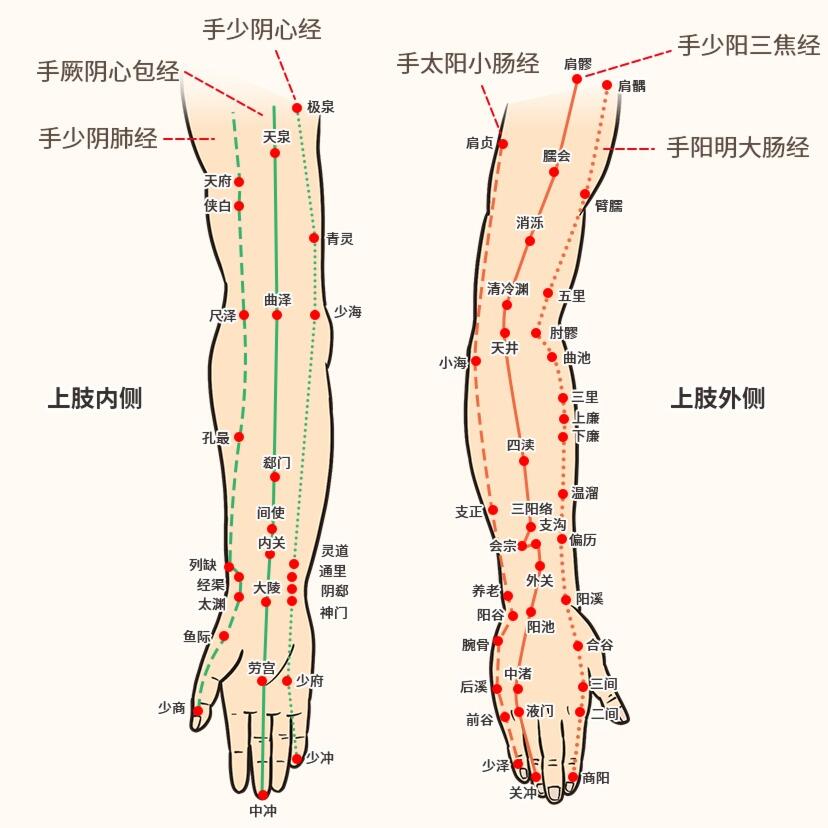
- Hegu + Lieque: for the start of a cold. Lieque (LU7) sits on the inside of the wrist, just above the bony bump on the thumb side. Cross the webs of your hands and rest your index finger on the opposite wrist — the point is where your fingertip lands. When a cold is just starting, with a blocked nose, clear runny mucus, and a chilled feeling, press each point for three minutes, then drink something warm like ginger tea and get to bed early.
- Hegu + Yingxiang: to open a blocked nose. Yingxiang (LI20) sits at the midpoint of the outer edge of each nostril, in the crease where the nose meets the cheek. When your nose is badly blocked, press Yingxiang for one minute first, then Hegu for three minutes, and repeat the cycle once more. Many people find their nose clears during the second round.
- Hegu + Taichong: for headaches with irritability. Taichong (LR3) sits on the top of the foot, between the first and second metatarsal bones, where you can push upward into the hollow at the end of the gap. When a headache comes with frustration and stress, press the hand point and the foot point together, three minutes each.
- Hegu + Zusanli: an everyday wellness pair. Zusanli (ST36) sits below the knee, about four finger-widths down on the outer side of the shin. It is one of the most commonly used points for general health maintenance. Press each point once in the morning, three to four times a week — a good routine if you tire easily or feel run down.
More pairings are not better. Pick one combination per session and press it properly; that beats rushing through seven or eight points. Learn Hegu well first, then add partners gradually.
Who Should Skip It: Contraindications and Safety Notes
Hegu is one of the most commonly used points, but it is not for everyone, and harder is not better. Read through the list below and check it against your own situation.
- Pregnant people must not press Hegu. This is the most important rule in this guide. Hegu is understood to strongly move qi and blood, and stimulating it during pregnancy may trigger uterine contractions and increase the risk of miscarriage. Do not press it yourself at any stage of pregnancy, and do not let a family member press it for you either.
- Do not press broken, red, swollen, or burned skin. If the web of your hand has a cut, eczema, redness, or a hot, swollen patch, pressing will only add irritation. Wait until the skin has fully healed.
- Go very gently if you are weak or recovering from serious illness. If you have just had surgery, are running a high fever, or are extremely run down, use the lightest touch — or skip it entirely until you are stable again.
- Aim for soreness and fullness, never severe pain. Bruising, purple marks, or a hand that stays swollen afterward are signs you pressed far too hard. That dull ache and heavy feeling is de qi — it is the signal you are looking for. Pain is not the standard.
- Do not press one side for too long. Alternate hands, three to five minutes per hand, and no more than fifteen minutes total in a day. Overstimulating the point can leave the muscles of your hand sore instead of relaxed.
- Keep warm afterward. In winter, the hand feels warm and active after pressing, and touching cold water or stepping into a cold wind right away can easily chill it. Rub your hands together and cup them for a while before you do anything else.
Massage is a wellness practice, not a treatment. If a toothache does not ease within two days, if a headache comes with vomiting or blurred vision, if a blocked nose lasts more than ten days, or if a fever rises above 38.5°C, do not try to tough it out with acupressure alone — see a doctor promptly.
Quick Answers
How hard should I press? Hard enough to feel a dull ache, numbness, or fullness — never hard enough to make you wince. If the skin turns purple or stays swollen, you overdid it.
How long does one session take? About three to five minutes per hand, once or twice a day. Fifteen minutes total per day is the ceiling.
Can I press it every day? Yes, if you are healthy and not pregnant, daily use is fine. For general wellness, three to four times a week is plenty.
Why do I feel almost nothing on one hand? The two sides are rarely identical. If one side feels weak, check that you are on the thickest part of the muscle, not on bone or too close to the finger joints. The other hand often gives a clearer reference for the right feeling.
Does it work for lower-tooth pain too? It is best known for upper-tooth pain. For lower teeth it may help less, and either way it is only a stopgap until you can see a dentist.
Can children press Hegu? Children can use a very light touch for a stuffy nose or a mild headache, with an adult guiding the pressure and the timing. Pregnant people, as above, should not use it at all.
Make Hegu Your Pocket Relaxation Tool
The best thing about Hegu is how convenient it is. No tools, no undressing, no appointment — you can press it between meetings, while waiting for a bus, or on the subway. Remember three things: the spot is the thickest part of the muscle in the web of your hand, the place that feels sore and heavy when you press it; the pressure should aim for that soreness and fullness, three to five minutes per hand; and pregnant people should skip it entirely, broken skin is off limits, and symptoms that persist or worsen need a doctor.
Start today with a small goal: at 3 p.m., when your head feels foggy, put the phone down, press Hegu for three minutes, and take five slow, deep breaths. Keep it up for a week, and you may find that this small point hidden in the web of your hand is more useful than you expected. Regular sleep, moderate exercise, and timely medical care matter just as much — Hegu works best as one small habit among them.
Disclaimer: This article is for informational purposes only and does not replace medical advice, diagnosis, or treatment. If symptoms persist, recur, or worsen, please seek medical care promptly. No therapeutic effect is promised. If you have any concerns, consult a qualified healthcare professional.