Two college classmates meet again at a reunion ten years after graduation. One has worked at the same company since day one: a steady salary, a fixed routine, a savings account that grows a little every month. The other has had three different jobs, started a side business, sold it, tried e-commerce, and now runs a small trading company out of a rented office above a noodle shop. Neither is richer than the other, exactly — but they live in two completely different relationships with money. One earns by the calendar. The other earns by the opportunity. In BaZi, the ancient Chinese system of personality analysis, that second way of making money has a name: Pian Cai, the Indirect Wealth star.

This guide explains Pian Cai the way BaZi readers have understood it for centuries — as a cultural symbol, not a verdict. You will learn where it sits among the Ten Gods, why it points some people toward opportunity and others toward overspending, what it looks like inside relationships, and what traditional wisdom suggests when the balance tips too far in either direction.
What Is Pian Cai? The “Windfall Star” of BaZi
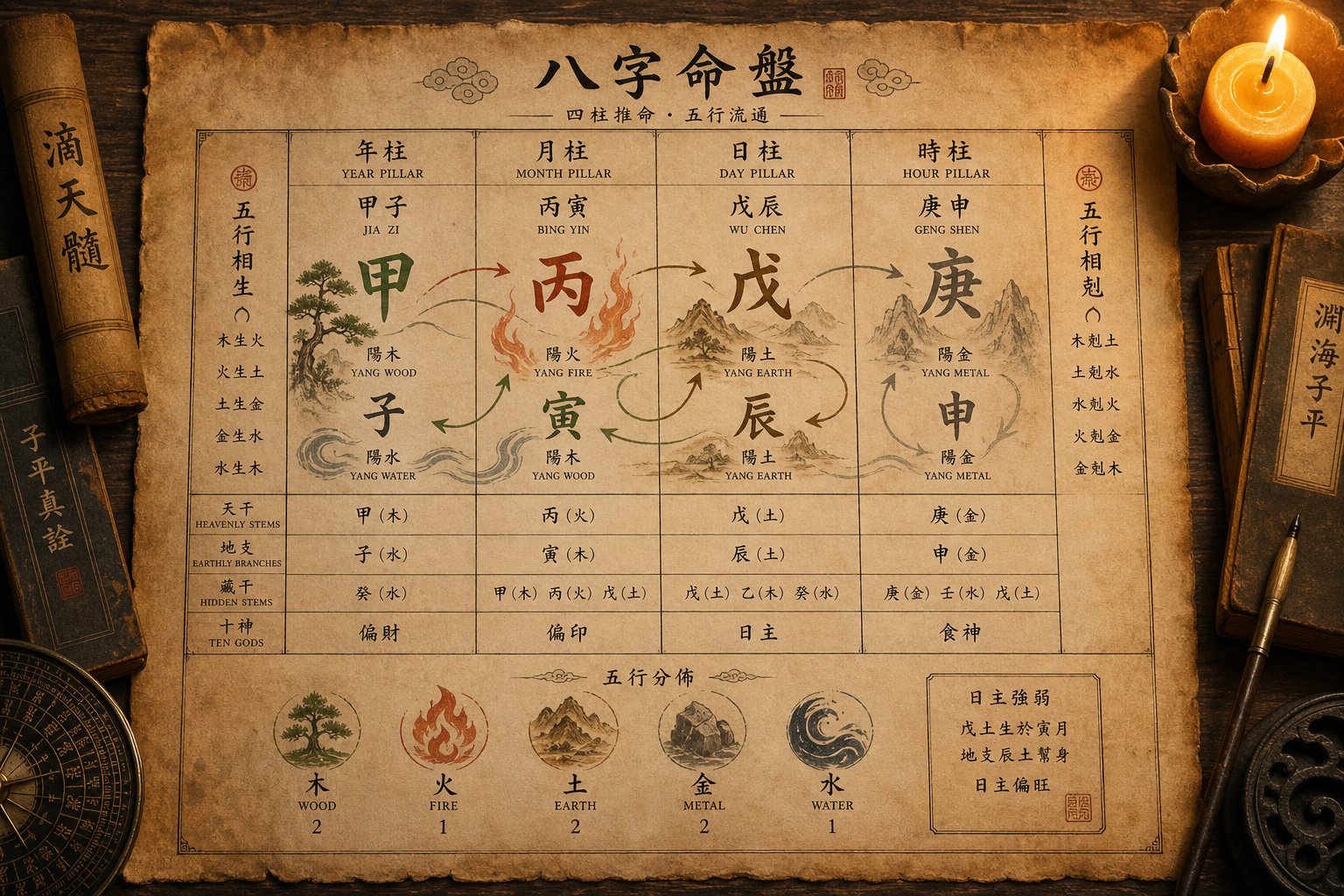
BaZi, literally “eight characters,” is a traditional Chinese system that maps a person’s birth date and time onto four pairs of characters — year, month, day, and hour. Each pair contains a Heavenly Stem and an Earthly Branch, and together they form a chart that readers use as a framework for talking about personality and life patterns. It is a cultural tradition, not a science, and this article treats it as such.
Inside that chart, the Ten Gods are ten roles assigned according to how each element in the chart interacts with the Day Master — the element of the day you were born, which represents you. Pian Cai, Indirect Wealth, is the element that the Day Master controls, with the same yin-yang polarity. Take a Day Master of Jia Wood, for example: Wood controls Earth, and Yang Earth (Wu) becomes Jia Wood’s Pian Cai. For a Day Master of Bing Fire, Fire controls Metal, and Yang Metal (Geng) becomes Bing Fire’s Pian Cai.
The classic texts draw a vivid contrast between Pian Cai and its sibling, Zheng Cai, Direct Wealth. Direct Wealth is like a monthly salary: it arrives on schedule, in an amount you can predict. Indirect Wealth is like the takings of a market stall: some days are busy, some days are quiet, and everything depends on the season, the foot traffic, and your eye for a good deal. A salary, rental income, or a fixed dividend is closer to Direct Wealth. Running a business, landing a project, earning investment returns, or collecting a sales bonus is closer to Indirect Wealth.
The Ten Gods are a framework from traditional culture for reflecting on yourself — not a judgment of fate. Everything that follows describes tendencies, things a person is “likely to do,” not things they “must do.”
Three Personality Traits of a Strong Pian Cai
When Pian Cai is prominent in a chart, three traits tend to show up again and again. The first is a sharp nose for opportunity. A friend mentions that live-stream shopping is taking off, and this person asks two questions before anyone else: “How many orders a day?” and “What is the margin?” A new breakfast stall opens at the end of the street, and they are already doing the mental arithmetic: how many buns a day would it take to cover the rent? This is not greed. It is closer to a professional habit — the eyes are always scanning for where value is moving. The upside is speed: when an opening appears, they act. The downside is diffusion: four projects started at once, none of them finished properly.
The second trait is generosity. The old texts say Pian Cai “loves to give and loves company,” which in modern language means spending freely and picking up the check without a second thought. They are the one who grabs the bill at the class reunion, the one who wires money to a friend whose startup is short on cash for a month, the one who books the best restaurant for a parent’s birthday without checking the price first. Generosity itself is a strength — it buys goodwill and a good reputation. But it needs a boundary. Before lending money or covering someone else’s costs, it is worth asking one question first: “If this money does not come back for three months, will my life be affected?” Answer that honestly, and then decide.
The third trait is an appetite for the road less traveled. Pian Cai does not like doing things step by step. While everyone else queues patiently for a promotion, this person is quietly planning a side business. While everyone else puts their savings in a fixed deposit, this person is studying index funds and second-hand resale. In entrepreneurship, sales, freelancing, or running a media channel, that restlessness is an advantage. In a job that demands stability and repetition, it feels like being stuck in a room with no windows.
Pian Cai and Money: It Is About How You Earn, Not How Much
Many people hear that their chart carries Pian Cai and immediately ask, “Will I get rich?” The question itself is pointing in the wrong direction. Pian Cai describes how a person deals with money — not how much is in the bank.
Traditional readings describe three features of Pian Cai money. The first is that it rises and falls. Pian Cai money comes fast and leaves fast, like a tide: one good project can bring in more in a month than half a year of salary, and then the market turns and two months pass with nothing at all. The most important lesson for a Pian Cai type is therefore “store grain in a good year.” When a windfall arrives, set aside thirty percent first — into savings or against debts — before spending a cent or reinvesting.
The second feature is that it comes through people, information, and judgment. Pian Cai money rarely arrives while you are sitting alone in an office waiting. It comes from a tip heard over dinner, a new client introduced by an old one, or a decision to move half a step earlier than everyone else.
The third feature is that spending is just as active as earning. People with strong Pian Cai usually have strong spending urges too: they see something they like and buy it first, reasoning that money is meant to be spent and can always be earned back. That attitude is harmless while income is rising. The moment income wobbles, it becomes pressure. A practical fix is to draw two lines for yourself. One is the “fixed expenses line”: rent, utilities, food, and insurance — the non-negotiable costs that must always be covered by your most stable income. The other is the “flexible spending line”: travel, a new phone, treating friends to dinner — costs that should only ever be paid from extra, Pian Cai-style income.
Pian Cai and Relationships: Generosity Needs Boundaries
In social life, people with strong Pian Cai are usually popular, because they are willing to give — time, money, connections, all of it. A friend of mine runs a small restaurant, and his Pian Cai is strong. His shop has become the information exchange for the whole street: who needs a renovation, which storefront is about to change hands — every piece of news passes through his counter.
But there are two things to watch in the Pian Cai style of relating. The first is that “loyalty over profit” taken too far becomes “unable to say no.” A relative asks for a loan. A friend invites you into a project you do not really believe in. A business partner asks you to cut your price and promises to make it up later. In these moments, the Pian Cai type tends to nod first and regret it later. It helps to keep one standard delaying sentence ready: “Let me run the numbers and get back to you tomorrow.” Twenty-four hours of space stops a surprising number of impulsive decisions.
The second is the habit of measuring relationships in money. Because Pian Cai values tangible returns, conversations can drift toward “how much will this project earn?” or “what is this contact good for?” That is a strength in business. In family and friendship, it can feel calculating. The dividing line is simple: in a business partnership, by all means do the math. In family and friendship, lead with the feeling.

Three Daily Practices: Turning Pian Cai Into a Mirror
If you recognize traces of Pian Cai in your own character or habits, try treating it as a mirror rather than a label. Three small practices are enough.
Practice one: keep an “indirect income ledger.” For thirty days, record every piece of income and spending that is not your fixed salary in a separate account: side-business income, freelance fees, investment returns, bonuses, gifts, and money spent on social obligations. After thirty days you will see clearly how large your “extra income” really is, how much it fluctuates, and how much of it actually stays with you.
Practice two: set a “trial budget” for new opportunities. Pian Cai types are not afraid to try new things — the danger is betting everything on each new thing. Make yourself a rule: the first investment in any new venture must not exceed ten percent of your monthly income. If it works, add more. Ten percent is small enough to lose. But it buys you the freedom to test five or six new directions a year, and the number of trials is itself the probability of finding the right one.
Practice three: do a monthly “favor inventory.” List the people you helped this month and the people who helped you, and write down three concrete things for each side. You will find that the relationships that last are never one-way giving — they are a cycle of give and take.
None of these practices requires knowing anything about BaZi. They simply translate an old concept into methods you can use today: see how you earn, manage the ups and downs, and guard your boundaries.
Quick Answers
What does Pian Cai mean in BaZi? Pian Cai, Indirect Wealth, is one of the Ten Gods in BaZi — a traditional Chinese system that reads personality from a birth chart. It represents the element your Day Master (the element of your birth day, which stands for you) controls with the same yin-yang polarity. It is traditionally linked to irregular income: business, projects, investments, and bonuses.
Does having Pian Cai mean I will get rich? No. Pian Cai describes how you deal with money, not how much you will have. Traditional readings link it to income that rises and falls, that comes through people and information, and that tends to be spent as quickly as it is earned. The practical lesson is saving in good times and capping the risk of each new venture.
What is the difference between Pian Cai and Zheng Cai? The classical image is that Zheng Cai, Direct Wealth, is like a monthly salary — fixed and predictable. Pian Cai, Indirect Wealth, is like the takings of a market stall — variable and dependent on timing, information, and judgment. Most people’s real income mixes both.
Which careers suit a strong Pian Cai? Traditionally, fields where income follows opportunity and initiative: entrepreneurship, sales, freelancing, trading, media, and project-based work. Highly routine and repetitive roles tend to feel restrictive for a Pian Cai type.
Why are Pian Cai types said to be generous? The old texts describe Pian Cai as loving to give and to socialize. In modern terms, these people spend freely, pick up the check, and lend a hand without hesitating — which wins them friends and a good reputation, but also calls for a boundary, such as a standard twenty-four-hour pause before saying yes to a loan or a favor.
Can BaZi predict my future? No. BaZi is a cultural system for reflecting on personality and life patterns. This article presents it as cultural knowledge for interest and self-reflection only. It is not a prediction of fate, and it is not a basis for life decisions.
In the end, Pian Cai is not a guarantee of wealth, and it is not an excuse for spending carelessly. It is traditional culture’s name for a way of living: sensitive to opportunity, willing to try, generous with others, and earning through judgment and action. Knowing it is valuable not because it predicts the future, but because it helps you see yourself more clearly. This month, do two things. First, keep a separate record of your non-fixed income for thirty days and see what your real money path looks like. Second, cap any new venture at ten percent of your monthly income. Pian Cai is about flow, and flowing things need a container. Your ledger, your budget, and your sense of boundaries are that container.
This article is a cultural introduction to traditional Chinese BaZi for general interest only. It is not a prediction of fate or financial advice. Decisions involving investment, borrowing, or starting a business should be based on your own circumstances and, where needed, professional advice.