“Tai Chi is an internal martial art; Shaolin is an external one” — you’ve probably heard this a hundred times. But what exactly is “internal” about one and “external” about the other? Today we’ll settle it once and for all — and help you decide which side to start with if you want to learn.
The One-Sentence Answer: It’s About How Power Is Generated
External styles generate power from the muscles. You build muscle, you build speed, and a punch lands with the force of contracting muscle plus body momentum. Shaolin, Long Fist (Changquan), and Sanda (Chinese kickboxing) all work this way.
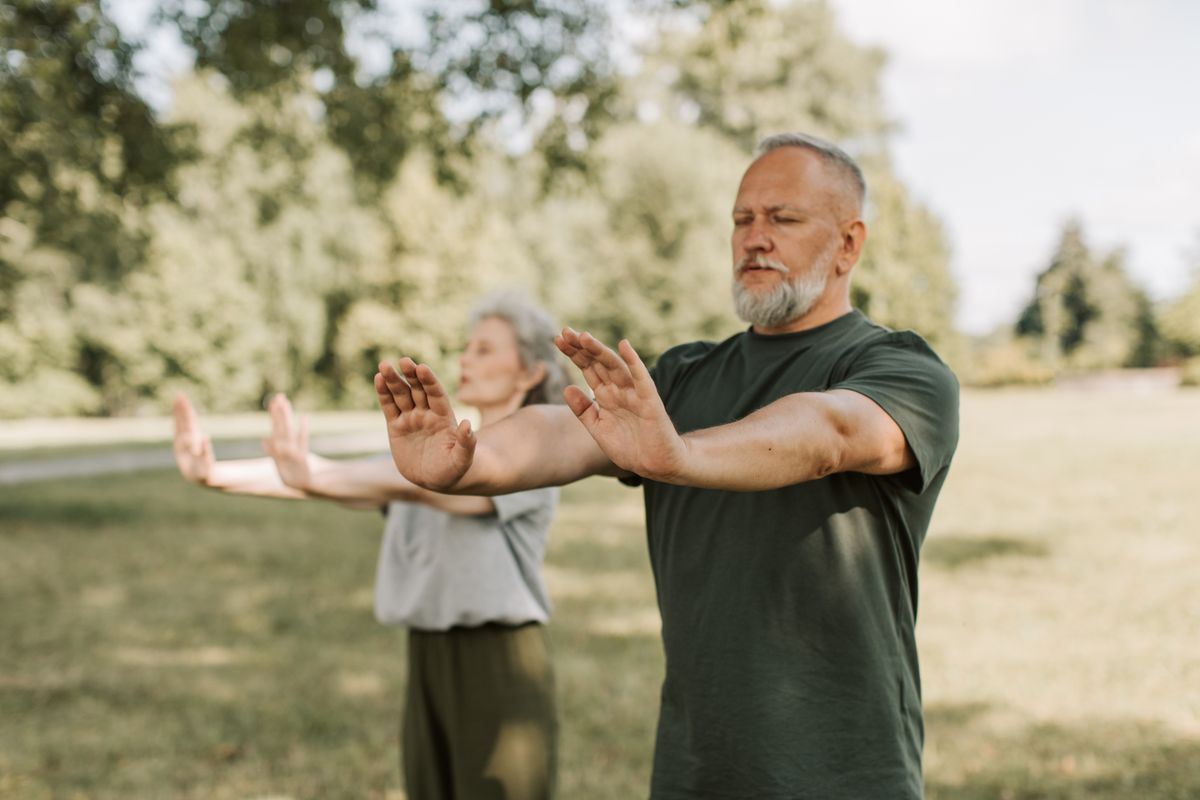
Internal styles generate power from whole-body structure plus intent. You train relaxation and unified whole-body force first; power equals the skeletal frame conducting force, driven by the waist and hips. Tai Chi (Taijiquan), Xingyi, and Bagua follow this path.
An analogy: the external approach is like hammering a nail — it relies on the hammer’s weight and swing speed. The internal approach is like cracking a whip — it relies on a wave traveling down the entire length, with the tip moving fastest of all. Different physics, same goal: effective force.
One important clarification up front: “internal” doesn’t mean “magical energy” and “external” doesn’t mean “brute force.” Both are physical, trainable methods. The difference is in the training sequence and the body’s organization — which muscles fire, in what order, under what kind of mental command.
The Three Internal Schools: What Each One Trains
- Tai Chi (Taijiquan): the emblem of “softness overcoming hardness.” Train slow, apply fast; push-hands (the two-person sensitivity drill) is the proving ground. The best entry point for complete beginners and older practitioners.
- Xingyi (Xingyiquan): the “hardest” of the internal schools. Its Five Element Fists — chopping, crashing, drilling, pounding, crossing — are direct and linear; students can produce unified whole-body power within about six months. Suits younger people who want to feel real striking power quickly.
- Bagua (Baguazhang): circle-walking with palm changes; the most complex footwork of the three. Demands the highest coordination — better approached after some foundation in something else.
What unites them: all three begin with relaxation and structural training (including Zhan Zhuang standing practice), all three treat the waist/hip area as the engine of movement, and all three consider tension the enemy of power.
The External Representatives: Shaolin, Long Fist, Sanda
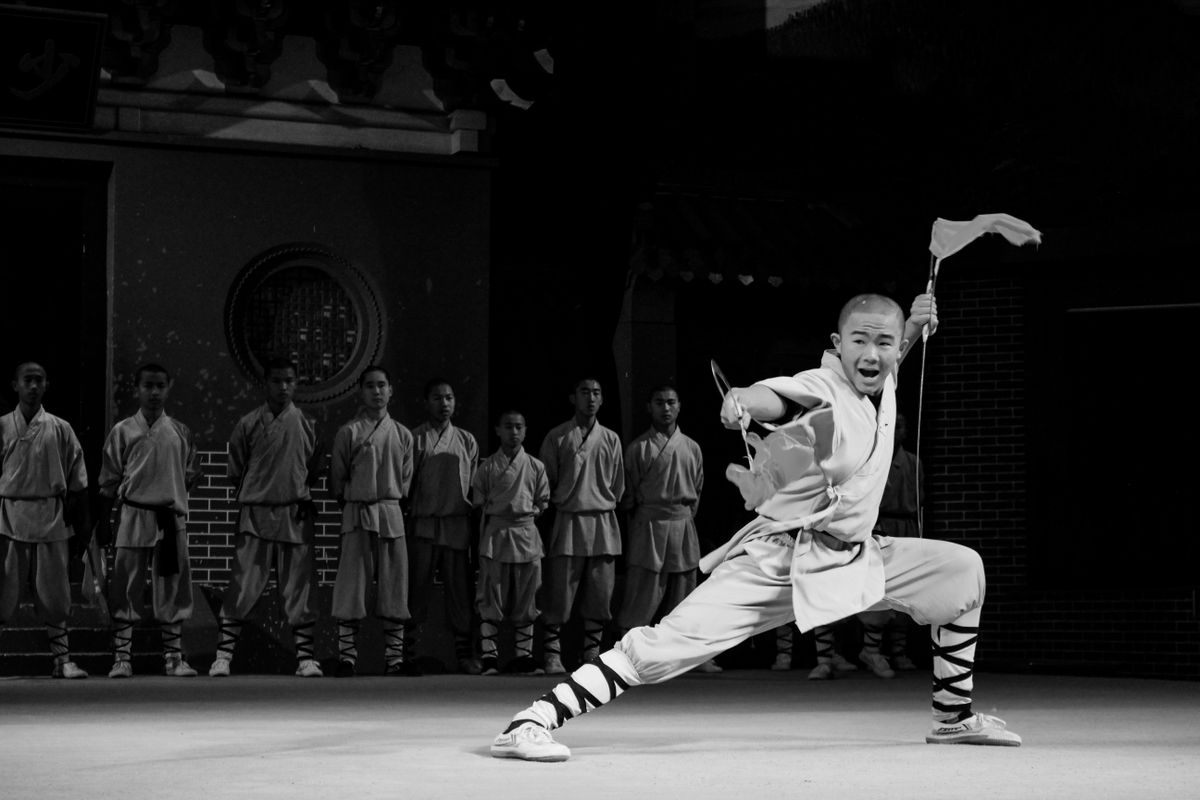
- Shaolin: fierce, expansive, wide-open movements. The basic training — leg stretches, horse stances, jumping kicks — is extremely demanding. Ideal for teenagers and young athletes.
- Long Fist (Changquan): the mainstream of competitive wushu. Big, extended, beautiful movements with strong visual appeal — the style you see in wushu performance competitions.
- Sanda (Chinese kickboxing): purely combat-oriented. The fastest route to usable fighting skill, but sparring intensity is high and the injury risk is relatively greater.
What unites them: conditioning comes first. Strength, speed, flexibility, and toughness are built deliberately, and technique is layered on top of a capable body.
How to Choose: Ask Yourself 4 Questions
- How old are you, and what’s your baseline? Over 40 with no athletic background: start internal (Tai Chi). In your 20s–30s and in good shape: either path works.
- What do you want from it? Health, relaxation, stress relief: Tai Chi or Baduanjin. Self-defense or real fighting ability: Sanda or Xingyi.
- How much time do you have? Fifteen minutes a day: Tai Chi or standing practice fits. An hour or more daily: you can take on the demanding basics of an external style.
- What’s taught near you? A good teacher matters ten times more than the style. Find the teacher first, then pick the art.
That last point deserves emphasis. A mediocre Tai Chi class teaches you to wave your arms slowly; a great Sanda coach teaches you body awareness that rivals any internal master. The teacher’s quality determines 80% of your outcome regardless of style.
Where Did “Internal” Come From? A Short History
The term neijia (“internal school”) first appears in the late Ming to early Qing dynasty. The scholar Huang Zongxi, writing the epitaph of the martial artist Wang Zhengnan, described the internal school as “using stillness to overcome motion — whoever attacks is thrown the moment contact is made,” contrasting it with Shaolin’s “strength built from the outside in.” From that point on, the martial world had its internal-external divide.
Here’s the twist: at the time, “internal” referred specifically to the Wudang lineage. The legendary Zhang Sanfeng was later credited as the founder of Tai Chi, and only afterward were Tai Chi, Xingyi, and Bagua grouped under the “internal” banner. So the “three internal schools” as a set is actually a modern formulation — a useful map, but don’t let sectarian loyalty stop you from training. The map is not the territory.
Training Compared: Where a Day’s Hours Go
- An external day: 30 minutes of basics (stretches, stances, jumps) + 40 minutes of forms + 20 minutes of sparring or weapons. You will sweat buckets.
- An internal day: 20 minutes of standing practice + 30 minutes of slow form + 20 minutes of push-hands or single-move drills. Less sweat — but your legs will ache and your brain will feel tired.
- Recovery: after external training, two days of muscle soreness is normal. After internal training, you feel a deep tiredness that makes you want to sleep — and one good night’s rest clears it.
- The results curve: external training transforms your fitness visibly within 3 months. Internal training may feel like “nothing is happening” for the first 3 months — then something clicks around month six. Impatient types do better starting external; patient types do better starting internal.
Spot the Style in 3 Seconds: Three Details to Watch
Watching people practice in the park? Here’s how to tell internal from external training at a glance:
- Watch the shoulders: shoulders hunched high with a stiff neck — usually an external beginner muscling through it. Shoulders settled and neck loose — likely someone with internal training under their belt.
- Watch the feet: big open stances and jumping movements: external. Feet gliding close to the ground, stepping like a cat: internal (Bagua’s circle-walking is the classic example).
- Watch the breathing: panting and red-faced after a few moves: external power pushed too hard. Finishing a whole routine with even breathing: the internal “stillness overcoming motion” approach.
One caveat: you can’t judge masters this way. Advanced external fighters are deeply relaxed, and internal masters explode with shocking speed when they release power. These three tells only reveal the training method — never the skill level.
The Biggest Myth: Internal Isn’t “Slow” and External Isn’t “Brutal”
Tai Chi trains slowly in order to build whole-body unity — but in real application, its explosive release happens in a single instant, and can be faster than external striking. Xingyi looks aggressive and hard, yet inside it’s all relaxation; stiffen up and you physically cannot throw a proper crashing fist.
The reverse is equally true: at high levels, external styles must learn relaxation too — a boxer’s loose, fluid upper body is no less “song” (relaxed-alert) than a Tai Chi player’s. The internal-external distinction describes the entry path, not the destination. At the top, everyone converges: Shaolin’s famous Yijin Jing (Muscle-Tendon Change Classic) trains precisely “internal strengthening,” while renowned Tai Chi masters all know how to issue real force.
FAQ
Can I train both at the same time? As a beginner, pick one as your main practice for at least a year. The training cues can conflict — “relax everything” versus “explode through the target” — and beginners end up doing neither well. After a solid foundation, cross-training is excellent.
Which is better for self-defense? Honestly: whichever one you train with resisting partners. Sanda gets you there fastest because sparring is built in from day one. Internal arts get there too, but only if your school does real push-hands and application work — many don’t.
Is Qigong the same as internal martial arts? Related but different. Qigong (like Baduanjin) is health cultivation; internal martial arts add martial application on top of similar body methods. Many people do both, and they reinforce each other nicely.
Stop agonizing over which school to join and just start moving. Internal and external are only maps — you still have to walk the road yourself. Try one free Tai Chi class and one free Sanda class; your body will tell you the answer. Remember: the best style is the one you’ll still be practicing three years from now. Don’t let “which school” delay “getting started.”
Practice within your limits; consult a qualified professional if you feel unwell.
中文版:内家拳与外家拳的区别